
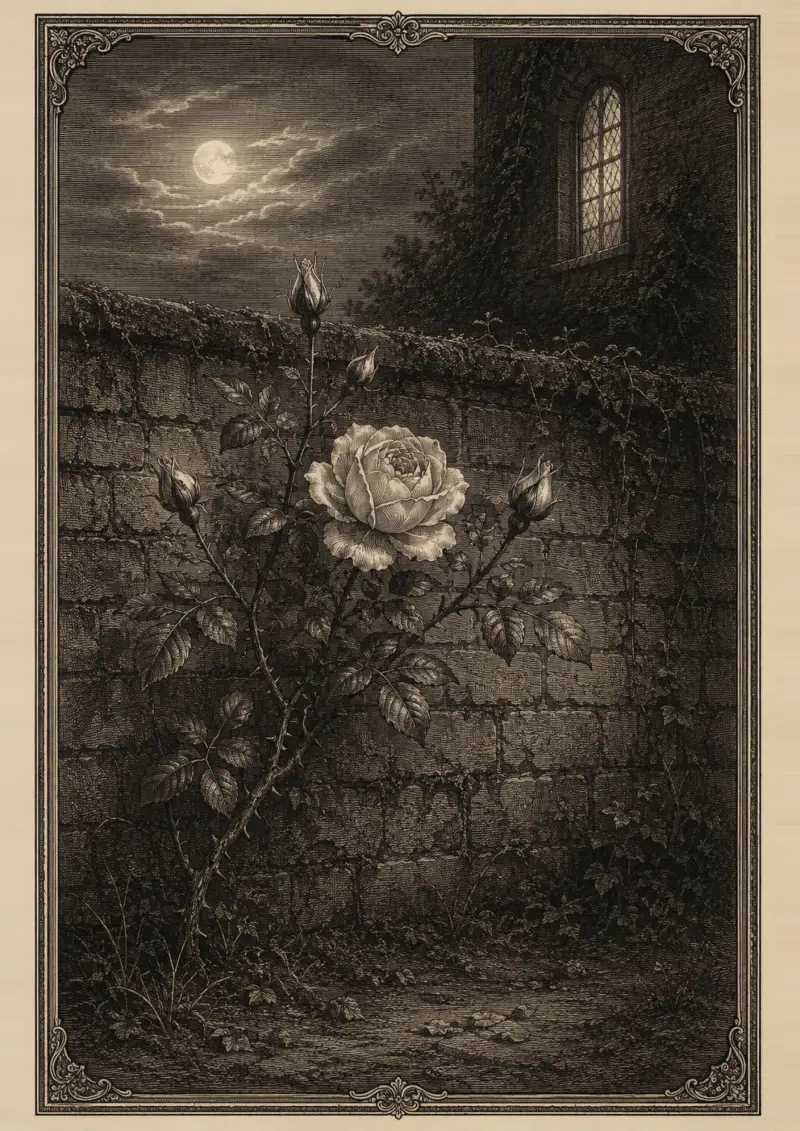
The passage
’Tis but thy name that is my enemy.
Juliet · Romeo and Juliet · Act 2, Scene 2
Thou art thyself, though not a Montague.
What’s Montague? It is nor hand, nor foot,
Nor arm, nor face. O, be some other name
Belonging to a man.
What’s in a name? That which we call a rose
By any other word would smell as sweet.
So Romeo would, were he not Romeo called,
Retain that dear perfection which he owes
Without that title. Romeo, doff thy name,
And, for thy name, which is no part of thee,
Take all myself.
In plain English
Only your name is my enemy. You would still be yourself if you were not a Montague. What is “Montague”? It is not a hand or a foot or an arm or a face. Be some other name, any name that belongs to a man. What does a name contain? The flower we call a rose would smell just as sweet if we called it something else. In the same way Romeo, if he were not called Romeo, would keep the precious perfection he possesses without that title. Romeo, take off your name, and in exchange for that name, which is no part of you, take all of me.
Where it comes in the play
Earlier that night, at her father’s feast, Juliet met a young man, kissed him, and then learned who he was. Her reaction was a couplet of pure paradox: My only love sprung from my only hate! / Too early seen unknown, and known too late!
The Montagues and Capulets have been enemies for longer than anyone can explain, and the Prologue has already told the audience that these two lovers will die. The Romeo and Juliet study guide sets out the feud and its consequences.
Now Juliet stands at her window above the orchard and thinks aloud. She believes she is alone. In fact Romeo is below in the dark, having just spoken his own lines of wonder, discussed in “But soft, what light through yonder window breaks?”
So Juliet is not flirting or persuading. We hear her reason with herself, which is why the speech sounds like an argument, and Romeo knows her whole mind before she knows he is there.
Close reading
An argument in plain words
Romeo’s language in this scene is full of suns, stars and angels. Juliet’s is strikingly different. She uses short, ordinary words and tests an idea step by step. The speech opens with a clear proposition: ’Tis but thy name that is my enemy
. The little word but
(meaning “only”) shrinks the feud to a single word.
Her next move is to separate the person from the label: Thou art thyself, though not a Montague
. Then she asks what the label is, and answers by listing what it is not: It is nor hand, nor foot, / Nor arm, nor face
. The repeated nor
ticks through the parts of a body, each a stressed monosyllable. It is a list of things that can be touched. Juliet’s standard for what is real is physical: a name cannot be held, so it does not count.
The rose
What’s in a name?
is a rhetorical question, one asked for effect, and she expects the answer “nothing”. The proof is an analogy: That which we call a rose / By any other word would smell as sweet
. Notice the careful phrasing That which we call
. She is pointing out that the name comes from us, not from the flower. A rose’s scent is a fact of nature; its name is a human habit.
The choice of a rose is not accidental. It was the conventional emblem of love and beauty in the poetry of the period. Juliet takes the most poetic object available and uses it to make a thoroughly unpoetic point: that words are arbitrary.
She then applies the analogy with a logician’s So
: So Romeo would, were he not Romeo called, / Retain that dear perfection which he owes
. Here owes
means “owns”.
The bargain
The speech ends with an imperative and an offer: Romeo, doff thy name
. To doff
is to take off, as one doffs a hat. A name is treated as clothing, something worn on the outside. In exchange she proposes a trade whose terms are wildly unequal: for a name, which is no part of thee
, he may Take all myself
. The final phrase is a half-line of four plain syllables, and it gives away everything. Without knowing it, Juliet has proposed.
Romeo completes her broken line and accepts at once: Call me but love, and I’ll be new baptized
. He treats renaming as a second christening, a new birth, as if love could remake him from the beginning.
What it tells us about the play
Juliet’s reasoning is sound, and that is what makes the play painful. A name truly is not a hand or a foot. The feud has no stated cause; it is an ancient grudge
kept alive by nothing more than two surnames. In exposing the emptiness of the name, Juliet exposes the emptiness of the hatred.
But the play also shows that she is wrong about what names can do. In Verona a name is not a private label. It is family, loyalty, property and obligation, and other people will act on it whatever the lovers decide. Tybalt challenges Romeo because he is a Montague. Mercutio dies cursing both your houses
. Romeo kills Tybalt, a Capulet, and is banished.
The bitter answer to Juliet’s speech comes in Act 3, Scene 3. Romeo, hearing how Juliet weeps, speaks of his name as a weapon, Shot from the deadly level of a gun
, and then asks the Friar: In what vile part of this anatomy / Doth my name lodge? Tell me, that I may sack / The hateful mansion
. He draws a dagger to cut it out. Juliet said the name was no part of thee
. Romeo now feels it lodged in his body like a disease.
The speech also establishes Juliet’s character. She is the more clear-sighted of the two, the one who asks practical questions. For Shakespeare’s most confident statement of what words can do for love, set this speech against Sonnet 18, where a poem promises to keep the beloved alive.
What people get wrong
- “A rose by any other name.” That is the popular version. The Folger text reads
By any other word would smell as sweet
; the early printed editions differ, and “name” comes from another of them. Use the wording of the edition you are studying. - “Wherefore” means “where”. A few lines earlier Juliet asks
wherefore art thou Romeo?
She is asking why he is Romeo, that is, why he has to be a Montague. She is not looking for him, and has no idea he is there. - “The balcony.” Shakespeare’s text never mentions a balcony. Juliet appears above, at a window. “The balcony scene” is a later, convenient label.
Using it in an essay
This speech is most valuable as one half of a contrast: Juliet’s hope here against what the name does later. Comment on her plain diction and logical connectives as well as on the rose. You will find a method for this in the close reading toolkit, and the surrounding lines on the Romeo and Juliet quotation sheet.
Fragments worth memorising:
’Tis but thy name that is my enemy
- the feud reduced to a single word.nor hand, nor foot
- what is real, for Juliet, is the physical body.That which we call a rose
- names are given by people, not by nature.doff thy name
- identity imagined as clothing that can be removed.Take all myself
- an unequal bargain; a proposal she does not know she is making.
For a classroom sequence on this scene, see the Romeo and Juliet lesson plans, and use the essay planner to shape an answer on love and conflict. For a comic treatment of obstacles to love, see “The course of true love never did run smooth”.
Speeches you half know from quotation are worth meeting again in their own words. That is the idea behind the Daily Bard app: a single page each day, free to download, with no ads and no tracking. If you want to keep the pages and write on them, the Full Edition of Daily Bard adds a Commonplace Book and margin notes for a one-time US$11.99.