
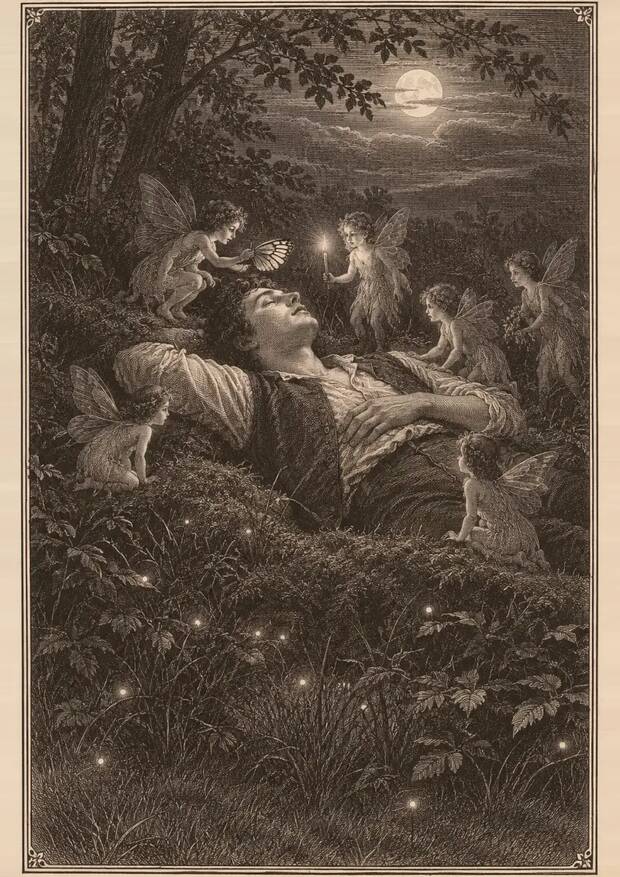
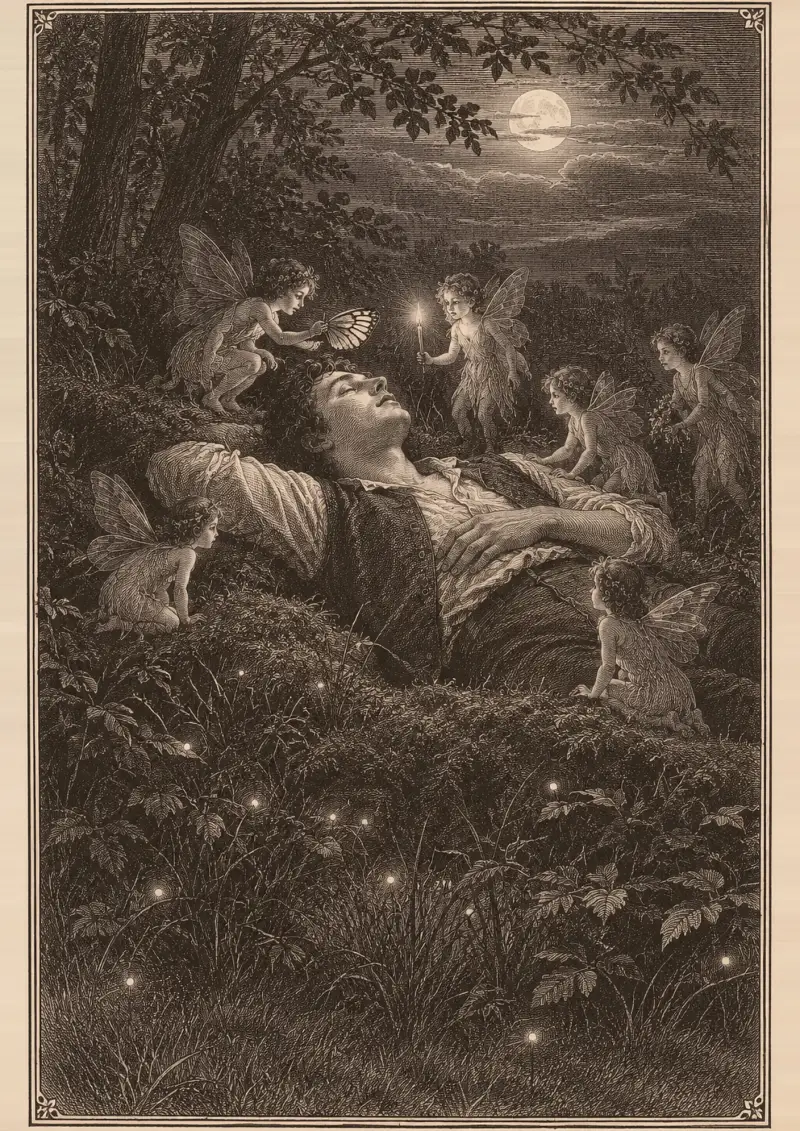
- Written
- c. 1595-96
- Genre
- Comedy
- Setting
- Athens and a wood outside it
- Form
- Verse drama: blank verse, rhymed couplets, fairy song and prose
- Structure
- Five acts; four interwoven plots and a play within the play
- Studied for
- GCSE, A-level, AP Literature, IB, undergraduate surveys
A Midsummer Night’s Dream: study guide (PDF)
PDF, 12 pages, 1.1 MB. Free, no sign-up, made to be printed.
Also for A Midsummer Night’s Dream: quotation sheet (PDF), three lesson plans.
Context
Shakespeare wrote A Midsummer Night’s Dream around 1595 or 1596, close in time to Romeo and Juliet, and the two plays look at the same material from opposite sides: young lovers, an obstructive father, a flight by night. It has often been suggested that the comedy was written for an aristocratic wedding. There is no firm evidence, but the play is certainly about marriage and ends by blessing three of them.
Sources
Unusually, there is no single source for the plot. Shakespeare combined materials: Theseus and Hippolyta from Chaucer’s “Knight’s Tale” and from Plutarch; Pyramus and Thisbe, and the name Titania, from Ovid’s Metamorphoses; Robin Goodfellow from English folklore. The transformation of a man into an ass recalls Apuleius. The mixture matters. Classical myth, native fairy belief and Elizabethan working men share one stage, and the comedy comes from their collisions.
Marriage and the father’s will
Egeus claims the right to dispose of his daughter, and the law of Athens backs him with death or a convent. Elizabethan fathers had no such legal power of life and death, but the expectation that a daughter’s marriage needed her father’s consent was real. The play takes Hermia’s side while leaving the structure of authority standing: she gets Lysander only because a duke overrules a father.
Festivity, fairies and the stage
Midsummer Eve and May Day were holidays associated with courtship, night-time licence and a touch of madness; Theseus assumes the lovers rose early for The rite of May
. Elizabethan fairies were not pretty. They were household spirits blamed for spoilt milk and lost travellers, which is how Robin is introduced. Finally, the play was written for a bare daylight stage, where moonlight and forest exist only in language. The mechanicals’ anxieties about how to bring in a wall and a moon are Shakespeare joking about his own medium.
Plot summary
Act 1
Theseus, Duke of Athens, is four days from marrying Hippolyta, the Amazon queen he defeated in war. Egeus demands that his daughter Hermia marry Demetrius, although she loves Lysander. Theseus gives her until his wedding day to obey, die or become a nun. The lovers plan to flee through the wood, and tell Helena, who loves Demetrius and betrays the plan to him. Elsewhere, a group of working men cast a play for the wedding. The turning point is the decision to leave Athens.
Act 2
In the wood, Oberon and Titania, king and queen of the fairies, are quarrelling over a changeling boy, and their quarrel has disordered the seasons. Oberon sends Robin Goodfellow (Puck) for a flower whose juice makes a sleeper love the first creature seen on waking. He anoints Titania, and, pitying Helena, orders Robin to anoint Demetrius. Robin mistakes Lysander for him. The turning point comes when Lysander wakes, sees Helena and abandons Hermia.
Act 3
The workmen rehearse near Titania’s bower. Robin gives Bottom an ass’s head; Titania wakes and adores him. Oberon tries to mend the lovers by anointing Demetrius, so both men now pursue Helena, who believes all three are mocking her. The women quarrel, the men go off to fight, and Robin leads them in circles until all four sleep. This is the point of maximum confusion, and Robin applies the remedy to Lysander’s eyes.
Act 4
Oberon, having obtained the boy, releases Titania from the spell and the fairy rulers are reconciled. Theseus, out hunting at dawn, finds the lovers asleep. Demetrius declares he now loves Helena, and Theseus overrules Egeus: the couples will marry alongside him. Bottom wakes, restored, and tries to describe his dream. The turning point is Theseus’s judgement, which undoes the threat of Act 1.
Act 5
After the weddings Theseus dismisses the lovers’ story as fantasy, and Hippolyta disagrees. The workmen perform “Pyramus and Thisbe”, a tragedy of forbidden love played so badly it becomes farce, while the nobles heckle. At midnight the mortals go to bed, the fairies enter to bless the house, and Robin asks the audience to think of the whole play as a dream.
Characters
Bottom
Nick Bottom the weaver wants to play every part and is unembarrassed by anything, including a fairy queen’s love. He is the only mortal who meets the fairies, and he takes it calmly. His vanity is comic, but his good nature and his wonder on waking make him the play’s unlikely visionary: I have had a most rare vision
.
Robin Goodfellow (Puck)
Oberon’s servant and the engine of the plot. He calls himself that merry wanderer of the night
and treats human distress as entertainment. His mistake with the flower shows that the wood’s magic is powerful and careless. He does not change; he is given the epilogue because he stands between the play and its audience.
Oberon and Titania
The fairy rulers quarrel like a married couple with the power to flood fields. Titania’s loyalty to her dead friend’s child is the play’s most serious moment of female attachment; Oberon answers it with a humiliating trick and wins. Their greeting sets the tone: Ill met by moonlight, proud Titania
.
Theseus and Hippolyta
They frame the play as figures of daylight authority. Theseus speaks for law and reason, yet he is the one who finally bends the law. Hippolyta says little, and what she says often quietly contradicts him, as when she finds in the lovers’ story something of great constancy
.
Hermia and Helena
Hermia is short, dark and defiant; Helena tall, fair and self-pitying. Hermia begins loved by two men and Helena by none, and the wood reverses this. Their quarrel, which ends a childhood friendship, is funnier and more painful than anything the men say: though she be but little, she is fierce
.
Lysander and Demetrius
The young men are deliberately hard to tell apart, which is the joke. Each justifies his changed affection as rational, Lysander insisting that The will of man is by his reason swayed
while under a spell. Demetrius is never released from the flower, a point worth using.
Themes
Love is arbitrary
The play argues that desire has little to do with the merits of the person desired. Before any magic, Demetrius has already switched from Helena to Hermia, and Helena observes that love sees with the mind, not the eyes. The flower only speeds up what people do anyway. The theme develops from complaint in Act 1 to chaos in Act 3 and to an uneasy settlement in Act 4, where one happy marriage rests on an enchantment that is never lifted.
Order and disorder
Athens stands for law, hierarchy and daylight; the wood for night, change and appetite. The comedy sends its characters out of order and brings them back, and the question is what the return is worth. Disorder is not confined to mortals: the fairies’ quarrel has wrecked the harvest. Harmony at the end is real but conditional, depending on Titania’s defeat and Theseus’s change of mind.
Power between men and women
Every couple begins in a contest. Theseus won his bride in battle, Egeus treats his daughter as property, Oberon punishes his wife for refusing him, and Helena abases herself before a man who threatens her. Comedy resolves these conflicts in marriage without pretending they never happened. A strong essay notices who has yielded by the final scene, and who has stopped speaking: Hermia and Helena say nothing in Act 5.
Imagination, dreams and theatre
The play keeps asking how much of what we see we make ourselves. Lovers, dreamers and audiences all supply what is not there. Theseus mocks this faculty; the play depends on it. “Pyramus and Thisbe” fails because the actors do not trust imagination, explaining that the lion is not a lion. By the epilogue the audience is invited to class the whole performance as a dream, a move Shakespeare returns to in Prospero’s “such stuff as dreams”.
Key quotations
Ten short quotations, each chosen to open a theme. If you would rather build familiarity a little at a time, the Daily Bard app shows one Shakespeare passage a day, checked against the Folger text, with a plain-English reading on the back of the leaf.
Hippolyta, I wooed thee with my sword
Theseus · Act 1, Scene 1
And won thy love doing thee injuries,
Plain English: I courted you by conquering you, and won your love by harming you.
Within the first twenty lines the play joins love to violence. The alliterative pairing of wooed
and won
makes courtship and conquest sound alike. Theseus promises a change of key
, a musical metaphor for the comic movement from discord to harmony.
As she is mine, I may dispose of her,
Egeus · Act 1, Scene 1
Plain English: She belongs to me, so I can do what I like with her.
The possessive mine
and the commercial verb dispose
reduce Hermia to property. The line is flat, regular and legalistic: Egeus is citing a right, not expressing a feeling. It states the patriarchal problem the comedy must solve.
The course of true love never did run smooth.
Lysander · Act 1, Scene 1
Plain English: True love has always met with obstacles.
The metaphor is of a river, and the line has the ring of a proverb, which is the irony: Lysander is quoting what he has read in tale or history
, unaware that he will soon prove inconstant himself. Our essay on “The course of true love” reads the whole exchange.
Love looks not with the eyes but with the mind;
Helena · Act 1, Scene 1
And therefore is winged Cupid painted blind.
Plain English: Love sees what the mind imagines, not what is there, which is why Cupid is shown blind.
A rhyming couplet gives the idea the neatness of a maxim. Mind
here means fancy, not judgement. The flower will later work through the eyes, so the line begins the play’s pattern of sight imagery and prepares the theme of love as projection.
And this same progeny of evils comes
Titania · Act 2, Scene 1
From our debate, from our dissension;
We are their parents and original.
Plain English: All these disasters are the offspring of our quarrel; we are their cause.
The metaphor of parenthood makes floods and rotten crops the children of a marital quarrel, pointed in a play about a disputed child. Titania accepts joint responsibility in the plural our
and We
. Disorder among rulers spreads to nature, a common Elizabethan idea.
I am your spaniel, and, Demetrius,
Helena · Act 2, Scene 1
The more you beat me I will fawn on you.
Plain English: I am your dog; the worse you treat me, the more I will adore you.
The animal metaphor is self-chosen and degrading, and it reverses the convention in which the man pursues. Helena’s line is comic in its excess and disturbing in its content, a useful example of how the play keeps cruelty just inside laughter.
And yet, to say the truth, reason and love keep little company together nowadays.
Bottom · Act 3, Scene 1
Plain English: To be honest, reason and love do not have much to do with each other these days.
The play’s central truth is spoken in prose by a weaver wearing an ass’s head to a queen under a spell. The personification of reason and love as estranged neighbours is homely and exact. Bottom is wiser here than the lovers, who keep insisting that their passions are rational.
Lord, what fools these mortals be!
Robin · Act 3, Scene 2
Plain English: How foolish human beings are.
The line is one of the fairies’ short, chanting lines, lighter than the lovers’ pentameter. Robin speaks as a spectator about to enjoy a fond pageant
, which places the audience beside him, laughing from above. The irony is that his own error caused the foolishness.
The lunatic, the lover, and the poet
Theseus · Act 5, Scene 1
Are of imagination all compact.
Plain English: Madmen, lovers and poets are all made entirely of imagination.
A list of three, bound by alliteration, puts the poet in doubtful company. Theseus means it as dismissal, yet he is himself a poet’s invention, speaking some of the play’s finest verse about the faculty he distrusts. Shakespeare lets the sceptic make the case for art.
If we shadows have offended,
Robin · Act 5, Scene 1
Think but this and all is mended:
That you have but slumbered here
While these visions did appear.
Plain English: If our play has displeased you, pretend you were asleep and dreamed it.
Rhymed couplets in a short four-beat line give the epilogue the sound of a charm. Shadows
means both spirits and actors. The apology is mock-modest: by calling the play a dream, Robin extends the title to the audience and claims for theatre the strange authority dreams have.
Language, form and structure
Four kinds of speech. Shakespeare sorts his groups by sound. The court speaks blank verse (unrhymed iambic pentameter, five pairs of unstressed and stressed syllables). The lovers speak mostly in rhymed couplets, whose predictability makes their passion sound formulaic. The fairies use blank verse for argument and shorter, song-like rhyming lines for spells. The workmen speak prose, the form of everyday talk, until they perform, when they produce verse so bad it is funny: Whereat, with blade, with bloody blameful blade
parodies overdone alliteration.
Imagery. Follow three patterns. The moon, named in the opening lines, presides over change and inconstancy. Eyes and sight run through every plot, since love enters by the eye and the flower is applied there. Images of nature turn from lush, as in I know a bank where the wild thyme blows
, to diseased when the fairies quarrel.
Structure. The play has a three-part shape: court, wood, court. Four plots (the rulers, the lovers, the fairies, the workmen) are kept distinct and then crossed, with Bottom as the point of contact. The audience always knows more than the characters, so the confusion in Act 3 is enjoyed through dramatic irony. The play within the play then turns the lovers into an audience, laughing at a story that could have been theirs. For vocabulary and verse forms, see the guide to Shakespeare’s language; for a method, the close reading toolkit.
Critical perspectives
Festive comedy
C. L. Barber read the play alongside holiday customs such as May games: a temporary release from everyday rules that ends in clarified order. Northrop Frye described a similar movement into a “green world” and back. Use this to explain the structure, then ask whether everyone is equally released and equally restored.
The dark Dream
Jan Kott argued that the night in the wood is erotic and frightening, not charming, and that the lovers are interchangeable objects of animal desire. His view counters sentimental readings. A student can challenge it by pointing to tone: the verse insists on delight as well as menace.
Feminist and historicist readings
Feminist critics note that harmony is bought by subduing women: an Amazon conquered, a daughter threatened, a queen drugged. New historicists, notably Louis Montrose, connect this to a culture ruled by a queen, in which fantasies of mastering powerful women had political meaning. Test both against Hippolyta’s dissent and Titania’s eloquence.
Performance
Peter Brook’s 1970 production set the play in a bright white box with trapezes and doubled the actors of Theseus and Hippolyta with Oberon and Titania, suggesting the wood is the court’s dream of itself. Doubling is an interpretation you can cite as evidence that the two worlds mirror each other.
Essay questions
GCSE style
- Starting with Helena’s speech in Act 1, Scene 1, explore how Shakespeare presents love as irrational.
- How does Shakespeare present the relationship between Oberon and Titania?
- Explore how Shakespeare creates comedy through the character of Bottom.
A-level and IB style
- “The harmony of the ending depends on the defeat of the play’s women.” How far do you agree?
- Examine the dramatic function of the wood.
- To what extent does “Pyramus and Thisbe” change our view of the lovers’ story?
AP Literature style
- Analyse how the contrast between two settings contributes to the meaning of the work as a whole.
- Choose a comic character and analyse how the humour surrounding him or her serves a serious purpose.
- Discuss how the play’s ending both resolves and leaves open its central conflicts.
Undergraduate
- Consider the play as a defence of theatre.
- How does Shakespeare’s handling of his sources in this play produce comedy?
- “Demetrius is never disenchanted.” Discuss the implications for the play’s idea of marriage.
Planning a top-band answer
Comedy essays go wrong when they describe what is funny without saying what the laughter does. Choose an argument about function, select three moments from different plots, and analyse the form of each. The essay planner gives a one-page frame, and the assessment map shows what each course tends to reward.
Revision checklist
- I can name the four plots and explain how they connect.
- I can summarise each act and identify its turning point.
- I can explain who is under the flower’s influence at each stage.
- I can contrast Athens and the wood with a quotation for each.
- I can analyse how verse, rhyme and prose distinguish the groups of characters.
- I can explain the significance of the changeling boy.
- I can discuss what “Pyramus and Thisbe” adds to the play’s themes.
- I can set Theseus’s view of imagination against Hippolyta’s.
- I can use one critical view and one production to support an argument.
Because the plots are easy to confuse, revise with a grid: one row for each group, one column for each act. Then attach a short quotation to every square you can. The printable quotation sheet groups lines by theme for self-testing, and the lesson plans include a worksheet on Theseus’s imagination speech. Speak the lines aloud: rhyme makes this play unusually easy to memorise. A daily habit helps too, and Daily Bard is built for that, though a page a day accompanies the play and does not replace reading it whole.
A page of Shakespeare, every day.
This resource comes from Daily Bard, an app for iPhone and iPad. Each morning it shows one engraved plate and one passage, exactly as Shakespeare wrote it, with a plain-English reading on the back of the leaf.
Free to download. The Full Edition is a one-time US$11.99: no subscription, no account, no ads, no tracking.
Get it on the App Store: apps.apple.com/app/id6792967225
More free study guides, lesson plans and close readings: dailybard.app