
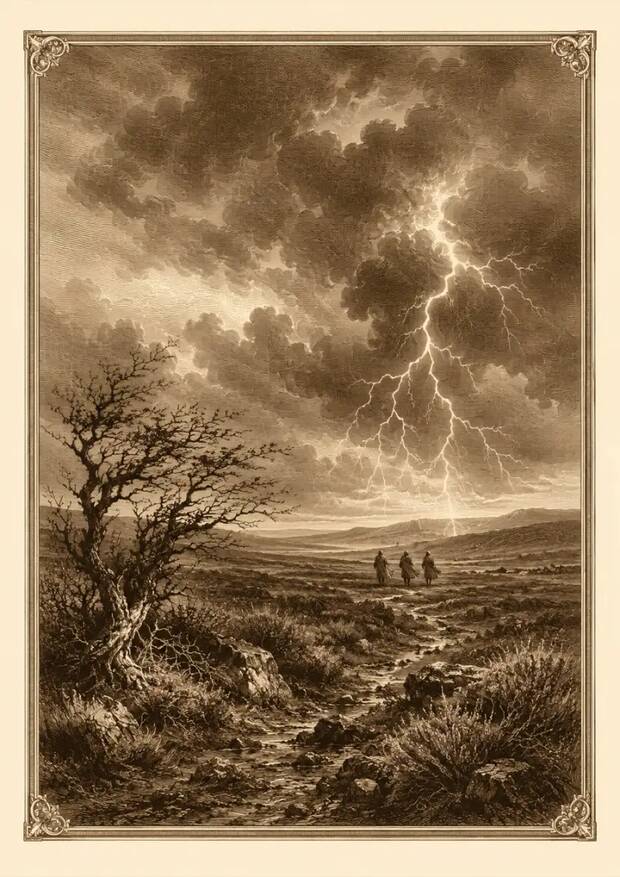
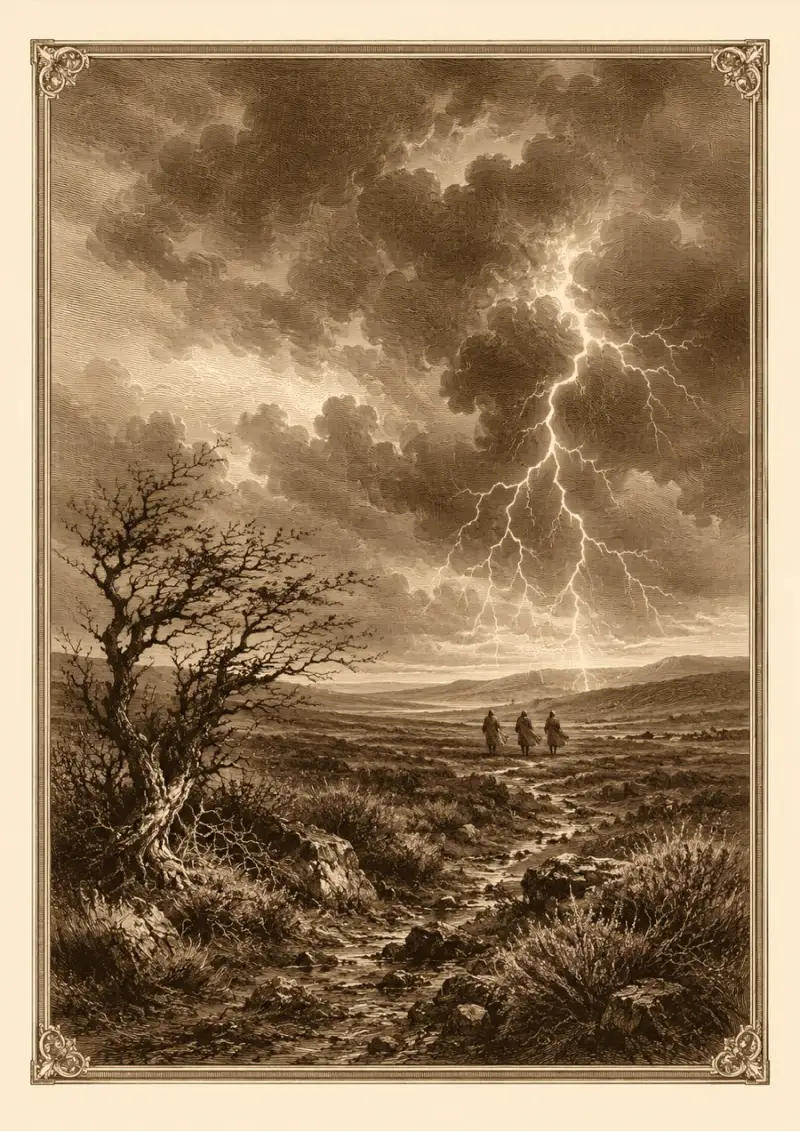
- Written
- c. 1606
- Genre
- Tragedy
- Setting
- Medieval Scotland, with one scene at the English court
- Form
- Blank verse; rhymed chant for the Witches; prose for the Porter and the sleepwalking scene
- Structure
- Five acts; Shakespeare’s shortest tragedy
- Studied for
- GCSE, A-level, AP Literature, IB, undergraduate surveys
Macbeth: study guide (PDF)
PDF, 13 pages, 1.1 MB. Free, no sign-up, made to be printed.
Also for Macbeth: quotation sheet (PDF), three lesson plans.
Context
Macbeth was written around 1606, three years after James VI of Scotland became James I of England and patron of Shakespeare’s company, the King’s Men.
Kingship and treason. James believed that kings ruled by divine right, as God’s deputies. Killing a king was therefore sacrilege as well as murder, and Macduff describes Duncan’s body in exactly those terms: The Lord’s anointed temple
has been broken open. The Gunpowder Plot of November 1605 had just shown such an attack was possible. The Porter’s joke about an equivocator
who could not equivocate to heaven
is widely read as a reference to the trials that followed, in which equivocation (misleading under oath without technically lying) was a notorious issue.
Witchcraft. James had written a book on the subject, Daemonologie, and took part in the examination of accused witches in Scotland. For the first audiences the Witches represented a real and feared evil. Notice, though, how little they do. They predict and tempt; they never tell Macbeth to kill.
Sources. The story comes from Holinshed’s Chronicles. Holinshed’s Duncan is a weak ruler and his Banquo is Macbeth’s accomplice. Shakespeare makes Duncan saintly, so that the murder has no excuse, and makes Banquo innocent, since James traced his descent from him.
Order. Many Jacobeans pictured creation as a hierarchy, often called the Great Chain of Being, in which a crime against the king disturbs nature itself. Hence the darkness at noon and the horses that eat each other after Duncan’s death: ’Tis unnatural, / Even like the deed that’s done.
Plot summary
Act 1
Three Witches plan to meet Macbeth. He and Banquo, returning from victory over rebels and invaders, are hailed with prophecies: Macbeth will be Thane of Cawdor and then king; Banquo will father kings. The first comes true at once. King Duncan names his son Malcolm heir and visits Macbeth’s castle. Lady Macbeth calls on spirits to harden her for murder. The turning point is Scene 7: Macbeth decides against the deed, and his wife talks him back into it.
Act 2
Macbeth follows a visionary dagger to Duncan’s chamber and kills him offstage. He returns unnerved, still holding the daggers; Lady Macbeth takes them back and smears the sleeping grooms with blood. A drunken Porter plays keeper of hell’s gate, and Macduff finds the body. Macbeth kills the grooms before they can speak. Duncan’s sons flee, which makes them look guilty, and Macbeth is named king. The murder itself is the turning point.
Act 3
Banquo suspects the truth. Macbeth, crowned but afraid of the prophecy about Banquo’s heirs, hires murderers; Banquo dies but his son Fleance escapes. At the state banquet Banquo’s ghost sits in Macbeth’s chair, visible only to him, and his terror wrecks the feast. The turning point is his decision afterwards to go on killing because retreat is as hard as advance. He now plans without his wife.
Act 4
The Witches show Macbeth three apparitions: beware Macduff; no man born of woman can harm him; he is safe until Birnam Wood comes to Dunsinane. He takes comfort, then has Macduff’s wife and children slaughtered. This is the turning point of our sympathy: a crime with no political purpose. In England Malcolm tests Macduff’s loyalty, Ross brings the news, and Macduff’s grief hardens into resolve.
Act 5
Lady Macbeth walks in her sleep, trying to wash invisible blood from her hands. Malcolm’s army advances, each soldier carrying a bough cut from Birnam Wood. Told that his wife is dead, Macbeth speaks of life as meaningless. The prophecies collapse: the wood moves, and Macduff reveals that he was cut from his mother’s womb. Macbeth dies fighting, and Malcolm is hailed king.
Characters
Macbeth
A tragic hero: a man of high standing destroyed by his own choice. We hear of him first as Valor’s minion
, a ferocious and loyal soldier. What makes him tragic and not merely criminal is imagination. He sees the full horror of the murder beforehand and commits it anyway. Each killing costs him less feeling, until he can say, I have supped full with horrors.
Lady Macbeth
She supplies the will her husband lacks, attacking his manhood until he consents. She believes guilt can be managed: A little water clears us of this deed.
Her arc reverses his. As he hardens, she is shut out of his plans and breaks, and her last scene answers her earlier confidence: What’s done cannot be undone.
Banquo
Macbeth’s foil (a character whose likeness to the hero highlights a difference). He hears the same prophecies and does not act on them, warning that The instruments of darkness tell us truths
in order to betray us. He is not spotless: he suspects Macbeth played’st most foully for ’t
and stays silent.
The Witches
The play’s source of temptation and its masters of double meaning. They speak in riddles such as Lesser than Macbeth and greater.
Whether they control events or only reveal what Macbeth already desires is the central interpretative question. He starts guiltily at their first greeting, which suggests the second.
Macduff
The play’s avenger, who pays for his loyalty to Scotland with his family. Told to take the news like a man, he replies that he must also feel it as a man
, redefining a word the Macbeths have corrupted.
Duncan and Malcolm
Two kinds of king. Duncan is generous and too trusting, twice deceived by a Thane of Cawdor. Malcolm is cautious, testing Macduff before he trusts him. His closing verdict, this dead butcher and his fiend-like queen
, is a victor’s summary, far cruder than the play we have watched.
Themes
Ambition
Claim: the play presents ambition as a force that defeats itself. Macbeth names it as his only motive, and in the same breath pictures it as a rider who jumps too far and falls. The crown brings no pleasure: he calls it a fruitless crown
because he has no heir. The theme develops from desire for a prize to fear of losing it.
Guilt and conscience
Claim: punishment in Macbeth is psychological before it is political. Indelible blood, lost sleep and a ghost at the feast are all forms of conscience. Macbeth’s guilt is loud and immediate: O, full of scorpions is my mind, dear wife!
Lady Macbeth’s is suppressed and returns in sleep, as the essay on “Out, damned spot” shows.
Fate and free will
Claim: the prophecies describe a future but Macbeth chooses the means. He considers waiting: If chance will have me king, why, chance may crown me
. The later prophecies are true in a sense Macbeth fails to hear, and he ends by cursing fiends who palter with us in a double sense
.
Manhood and cruelty
Claim: the Macbeths equate being a man with being willing to kill, and the play shows that definition to be false. Lady Macbeth’s taunt is When you durst do it, then you were a man
. Macbeth’s first answer was the right one: I dare do all that may become a man. / Who dares do more is none.
Kingship and tyranny
Claim: a king’s legitimacy is shown by the health of his country. Under Duncan there is trust, perhaps too much. Under Macbeth, Scotland is a wounded body: Bleed, bleed, poor country!
By Act 4 he is rarely named; he is simply the tyrant.
Key quotations
Ten short passages for almost any question. Lines learned one at a time stay learned, which is how Daily Bard works: one passage a day, checked against the Folger text, with a plain-English reading on the back of the leaf.
Fair is foul, and foul is fair;
Witches · Act 1, Scene 1
Hover through the fog and filthy air.
Plain English: Good is bad and bad is good; let us fly off through the murk.
The line is a chiasmus (a pattern repeated in reverse order), so the sentence itself turns values upside down. The Witches chant in short rhymed lines with a falling beat, unlike the blank verse of the human characters. Macbeth’s first words, So foul and fair a day I have not seen
, echo them before he has met them.
Stars, hide your fires;
Macbeth · Act 1, Scene 4
Let not light see my black and deep desires.
Plain English: Let the stars go dark so that no light can reveal what I secretly want.
An aside in a rhyming couplet, spoken while Duncan praises him. The imperative hide
begins the play’s long appeal to darkness, and black and deep
shows that Macbeth already judges his wish as evil. He wants the result without having to look at the act.
Come, you spirits
Lady Macbeth · Act 1, Scene 5
That tend on mortal thoughts, unsex me here,
Plain English: Come, spirits that serve murderous thoughts, and strip away my womanhood.
Lady Macbeth summons evil in imperatives: Come
, unsex
. She assumes that pity is feminine and must be removed before she can act. For a Jacobean audience this invocation aligns her with the Witches. That she needs outside help implies cruelty is not her nature, which her collapse confirms.
Look like th’ innocent flower,
Lady Macbeth · Act 1, Scene 5
But be the serpent under ’t.
Plain English: Appear harmless, but be the snake hidden beneath.
The contrast of Look
and be
states the theme of appearance and reality as an instruction. The serpent recalls the temptation in Eden, casting the murder as a second Fall. The image had topical force after the discovery of a hidden plot against the King.
I have no spur
Macbeth · Act 1, Scene 7
To prick the sides of my intent, but only
Vaulting ambition, which o’erleaps itself
Plain English: Nothing drives me on except ambition, which jumps too high and comes crashing down.
An extended riding metaphor: intent is a horse, ambition a rider who vaults too far. After listing every reason against the murder, Macbeth admits he has only one for it and predicts its failure. The soliloquy breaks off unfinished as his wife enters, so the argument is interrupted, not answered.
Is this a dagger which I see before me,
Macbeth · Act 2, Scene 1
The handle toward my hand?
Plain English: Is that a dagger in front of me, its handle turned for me to grasp?
The soliloquy begins with a question, and the speech keeps questioning its own senses. The dagger may be supernatural or the product of a feverish mind; Shakespeare does not decide. The handle points to his hand, so that the vision invites him and he chooses to follow.
Will all great Neptune’s ocean wash this blood
Macbeth · Act 2, Scene 2
Clean from my hand? No, this my hand will rather
The multitudinous seas incarnadine,
Making the green one red.
Plain English: Could the whole ocean wash my hand clean? No: my hand would turn the seas red.
Hyperbole measures guilt on a cosmic scale. Two long Latinate words, multitudinous
and incarnadine
, swell the line; then plain monosyllables, Making the green one red
, state the fact flatly. The contrast with Lady Macbeth’s brisk A little water
a few lines later defines the difference between them.
I am in blood
Macbeth · Act 3, Scene 4
Stepped in so far that, should I wade no more,
Returning were as tedious as go o’er.
Plain English: I have waded so deep into blood that going back would be as wearisome as going on.
Blood is now a river to be crossed. The key word is tedious
: murder has become a matter of effort, not horror. Compare the agonised imagery of Act 2 to see how far his conscience has dulled.
Out, damned spot, out, I say! ... Yet who would have thought the old man to have had so much blood in him?
Lady Macbeth · Act 5, Scene 1
Plain English: Away, cursed stain. Who would have guessed the old man had so much blood in him?
She speaks in broken prose, the verse of her earlier scenes gone with her control. Fragments of different murders surface together. damned
is literal as well as an oath: she fears hell. The woman who needed only water now cannot clean one hand. Read the full essay on this scene.
Life’s but a walking shadow, a poor player
Macbeth · Act 5, Scene 5
That struts and frets his hour upon the stage
And then is heard no more.
Plain English: Life is only a moving shadow, a bad actor who swaggers and worries through his hour on stage and is then forgotten.
The metaphors shrink life from shadow
to poor player
. The theatrical image is self-aware, since an actor speaks it on a stage. This is Macbeth’s view, not the play’s: he has emptied his own life of meaning. The essay on “Tomorrow and tomorrow and tomorrow” analyses the whole speech.
Language, form and structure
Verse and prose. The nobles speak blank verse: unrhymed iambic pentameter, ten syllables alternating unstressed and stressed. The Witches chant in shorter rhymed lines that begin on a stress, which marks them as other. Prose appears rarely and tellingly: the Porter’s dark comedy and Lady Macbeth’s sleepwalking.
Soliloquy and aside. A soliloquy is a speech delivered alone; an aside is a remark the other characters do not hear. Macbeth has many of both, so we share the mind of a murderer and cannot simply condemn him from outside.
Imagery. Trace four patterns: blood, darkness, sleep and clothing. Macbeth’s titles are borrowed robes
that never fit. Sleep, once murdered, is denied to both Macbeths. Notice also euphemism (a mild word for a harsh thing): the killing is the deed
or this business
, because neither can bear to name it. The close reading toolkit shows how to annotate patterns like these, and the guide to Shakespeare’s language explains unfamiliar words.
Equivocation. Paradox and double meaning run from the first scene to the last prophecy. Language itself cannot be trusted in this play.
Structure. The plot is single, fast and compressed, with the murder early and the consequences long. Duncan is killed offstage, so we experience the act through Macbeth’s mind. Dramatic irony (the audience knowing more than a character) is sharpest when Duncan admires the castle where he will die. The two central figures move in opposite directions, and the ending answers the opening battle with another severed traitor’s head.
Critical perspectives
A. C. Bradley
Bradley stressed Macbeth’s poetic imagination: his conscience speaks to him in images, and that is why we pity him. He also emphasised the play’s atmosphere of darkness. Challenge it by asking whether it makes a murderer too sympathetic.
L. C. Knights
Knights attacked the habit of treating characters as real people with lives outside the text, and proposed reading the play as a dramatic poem about evil and disorder. This is a useful discipline: write about patterns of language, not about what Lady Macbeth “must have felt”.
Imagery critics
Caroline Spurgeon and Cleanth Brooks traced recurring images, notably ill-fitting clothes and the vulnerable infant, and argued that they carry the play’s moral argument. The method works on any passage, though it can neglect the play as performance.
Feminist readings
Feminist critics, Janet Adelman among them, examine the play’s fear of female power: the Witches, the mother who imagines killing her child, the promise of safety from anyone born of woman. Ask whether the play shares that fear or exposes it.
Political readings
One view is that the play flatters James by condemning regicide. Another, common in more recent criticism, notes that it begins and ends with a loyal soldier praised for butchery, so the line between lawful and unlawful violence is thin.
Essay questions
GCSE style
- How does Shakespeare present Macbeth as a hero at the start of the play and as a tyrant by its end?
- Explore how Shakespeare presents the relationship between Macbeth and Lady Macbeth.
- How does Shakespeare present the supernatural in Macbeth?
A-level and IB style
- “Macbeth is a victim of his own imagination.” How far do you agree?
- Examine the view that Lady Macbeth is punished more harshly by the play than her husband.
- To what extent does the ending of Macbeth restore order?
AP Literature style
- Analyse how a character’s conflict between private desire and public duty shapes the meaning of the work as a whole.
- Choose a recurring image (blood, sleep or darkness) and analyse how its development contributes to the play’s meaning.
- Discuss how Shakespeare keeps the audience’s sympathy for a protagonist who commits terrible acts.
Undergraduate
- How far is Macbeth a play written for James I, and how far does it resist that purpose?
- Discuss the relationship between equivocation and tragedy in Macbeth.
- “The play defines manhood only by violence.” Discuss.
Planning a top-band answer
Start from an argument, not a list of points. Choose four or five short quotations from different acts so that you can show change, and analyse individual words. Give one paragraph to an alternative reading. The essay planner provides a one-page frame, and the assessment map shows what each course rewards. For a contrasting tragic hero, who thinks before he kills, see the Hamlet study guide.
Revision checklist
- I can summarise each act in two sentences and name its turning point.
- I can explain how James I, witchcraft and the Gunpowder Plot illuminate particular lines.
- I can explain two changes Shakespeare made to his source and why.
- I can trace how Macbeth and Lady Macbeth change in opposite directions.
- I can argue both sides of the question of fate and free will.
- I can follow the imagery of blood, sleep and darkness across the play.
- I can explain two critical views of the play and respond to each.
- I can quote ten short passages accurately and say one precise thing about each.
Memorise little and often. Print the Macbeth quotation sheet and test yourself for five minutes a day, speaking the lines aloud so that the rhythm helps you remember. Teachers will find the same passages in the Macbeth lesson plans, and this guide is available as a printable PDF. A daily page from the Daily Bard app keeps Shakespeare’s language in your ear between study sessions.
A page of Shakespeare, every day.
This resource comes from Daily Bard, an app for iPhone and iPad. Each morning it shows one engraved plate and one passage, exactly as Shakespeare wrote it, with a plain-English reading on the back of the leaf.
Free to download. The Full Edition is a one-time US$11.99: no subscription, no account, no ads, no tracking.
Get it on the App Store: apps.apple.com/app/id6792967225
More free study guides, lesson plans and close readings: dailybard.app