
The passage
LADY MACBETH Yet here’s a spot. ... Out, damned spot, out, I say! One. Two. Why then, ’tis time to do ’t. Hell is murky. Fie, my lord, fie, a soldier and afeard? What need we fear who knows it, when none can call our power to account? Yet who would have thought the old man to have had so much blood in him?
Macbeth · Act 5, Scene 1
DOCTOR Do you mark that?
LADY MACBETH The Thane of Fife had a wife. Where is she now? What, will these hands ne’er be clean? No more o’ that, my lord, no more o’ that. You mar all with this starting.
DOCTOR Go to, go to. You have known what you should not.
LADY MACBETH Here’s the smell of the blood still. All the perfumes of Arabia will not sweeten this little hand. O, O, O!
In plain English
Lady Macbeth, asleep, rubs at her hand: there is still a stain. Get out, cursed spot. She counts a bell: one, two, so it is time to do it. Hell is dark. Shame on you, my lord, a soldier and frightened? Why should we fear anyone knowing, when nobody is powerful enough to hold us to account? But who would have thought the old man had so much blood in him? The Thane of Fife had a wife; where is she now? Will these hands never be clean? Stop that, my lord; you ruin everything with your flinching. I can still smell the blood. All the perfume in Arabia will not make this small hand sweet.
Where it comes in the play
This is the first scene of Act 5 and the last time we see Lady Macbeth. She has been absent from the stage since the banquet in Act 3, where she covered for her husband as he raved at Banquo’s ghost. Since then Macbeth has acted without her, ordering the slaughter of Macduff’s wife and children. The Macbeth study guide, also available as a printable PDF, traces how the two characters change places.
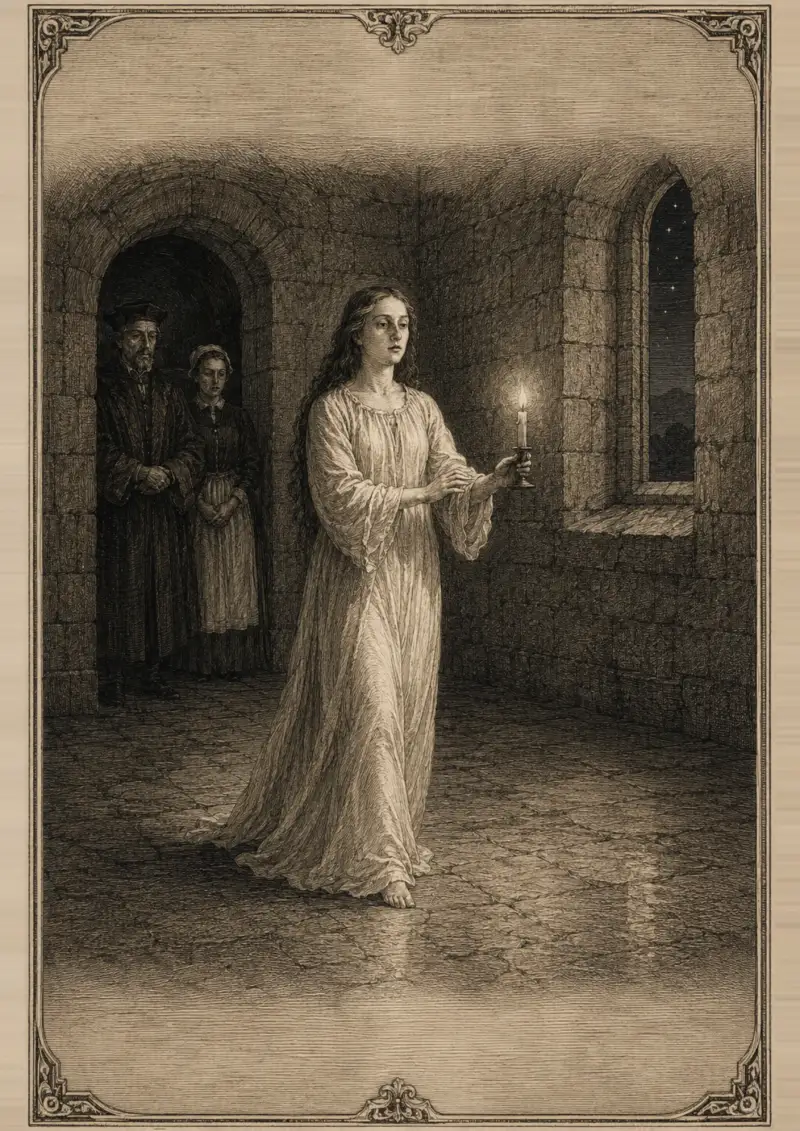
A Doctor and a waiting Gentlewoman watch by night. When Lady Macbeth enters she carries a candle: She has light by her continually. ’Tis her command
.
So the audience watches two observers watching her. She does not know she is speaking. For the only time in the play we hear what she thinks without any performance at all.
Close reading
Why prose
Until now, apart from reading her husband’s letter aloud, Lady Macbeth has spoken blank verse (unrhymed iambic pentameter), and spoken it with great command. Here she speaks prose. In Shakespeare, a shift from verse to prose in a noble character often signals madness or a loss of control, and that is its effect here. What remains is a series of very short sentences, some only one word long: One. Two.
There are no connectives, no “because” or “therefore”. Thoughts simply follow one another.
A collage of the past
Almost every phrase belongs to an earlier moment, and the moments arrive out of order. One. Two. Why then, ’tis time to do ’t
takes us back to the night of Duncan’s murder, when she rang the bell that sent Macbeth to the King’s chamber. Fie, my lord, fie, a soldier and afeard?
is the taunt she used to drive him on. What need we fear who knows it, when none can call our power to account?
repeats her old logic: power puts them beyond judgement. Even asleep, she is still managing her husband.
Then, with the single word Yet
, the argument collapses into a memory she never spoke aloud at the time: who would have thought the old man to have had so much blood in him?
Duncan is not “the King” here but the old man
. The plain phrase carries a horror she refused to feel in Act 2.
The Thane of Fife had a wife
jumps forward to Macduff’s murdered family. The line has the jingle of a nursery rhyme, with its internal rhyme of Fife
and wife
, and after its past tense, had
, comes a blunt question: Where is she now?
This was Macbeth’s crime, not hers, yet it has entered her guilt. One wife thinks of another.
The hand
The central image answers a line from Act 2. After the murder, Lady Macbeth dismissed her husband’s terror with a housewife’s practicality: A little water clears us of this deed
. He knew better, crying that his hand would The multitudinous seas incarnadine
, turn the oceans red. Now she has arrived where he was. What, will these hands ne’er be clean?
Her version of the image differs from his in scale. Macbeth thought of seas; she thinks of scent: All the perfumes of Arabia will not sweeten this little hand
. This is hyperbole (deliberate exaggeration), setting the luxury of a whole region against one small part of the body. The adjective little
is striking. The woman who called on spirits to unsex me here
now sees her hand as small and, by implication, as a woman’s hand. Guilt has moved from sight to smell, the sense that cannot be shut out, and the speech ends not in words but in sound: O, O, O!
What it tells us about the play
The scene completes one of the play’s great reversals. At the start, Lady Macbeth is the stronger partner and Macbeth is tormented by imagination. By Act 5 he has hardened until he has almost forgot the taste of fears
, while she relives what he once suffered.
It also shows how the play understands guilt. Lady Macbeth believed that a deed could be finished: What’s done is done
, she told her husband in Act 3. In this scene the phrase returns altered: What’s done cannot be undone
. The first version means “forget it”. The second means that it can never be escaped.
The Doctor draws the moral conclusion: More needs she the divine than the physician
. He treats this as a sickness of the soul. Feminist critics have asked a further question: whether the play punishes Lady Macbeth for stepping outside the role allowed to women, or shows the human cost of forcing feeling down. You can argue either way, but the evidence of this scene is that her humanity was never removed, only suppressed.
Her final words are addressed to a husband who is not there: Give me your hand
. The marriage survives only in her sleep. When Macbeth hears of her death four scenes later, his reply is the speech examined in “Tomorrow and tomorrow and tomorrow”.
What people get wrong
- “There is blood on her hands.” There is nothing there. The Doctor and Gentlewoman see only the rubbing. The spot is imagined, which is the point.
- “She confesses.” She does not choose to speak. A confession is deliberate; this is involuntary, overheard by people who are afraid to repeat it.
- “She kills herself on stage.” Her death is reported in Act 5, Scene 5, and only at the very end does Malcolm mention the rumour that she died
by self and violent hands
, qualified withas ’tis thought
.
Using it in an essay
The best answers treat the scene as the end of a pattern. Pair each fragment with its earlier source, and comment on the change of form from verse to prose. The Macbeth quotation sheet sets these pairs side by side, and the close reading toolkit explains how to write about form as well as words.
Fragments worth memorising:
Out, damned spot
- an imperative addressed to a stain that is not there.Hell is murky
- the darkness she once summoned now surrounds her.so much blood in him
- the suppressed horror of Duncan’s murder surfaces.this little hand
- vulnerability replaces the earlier denial of feeling.What’s done cannot be undone
- her own earlier maxim, rewritten as despair.
For teaching, the Macbeth lesson plans include activities on Lady Macbeth’s arc, and the essay planner will help students structure a “how does she change” answer around three moments. For another mind unravelling, see Othello in “Beware, my lord, of jealousy”.
To build up a store of short lines like these gradually, the Daily Bard app is free to download for iPhone and iPad, and the Full Edition keeps every page you have seen in your Commonplace Book. Use a daily page alongside your reading of the play, not in place of it.