
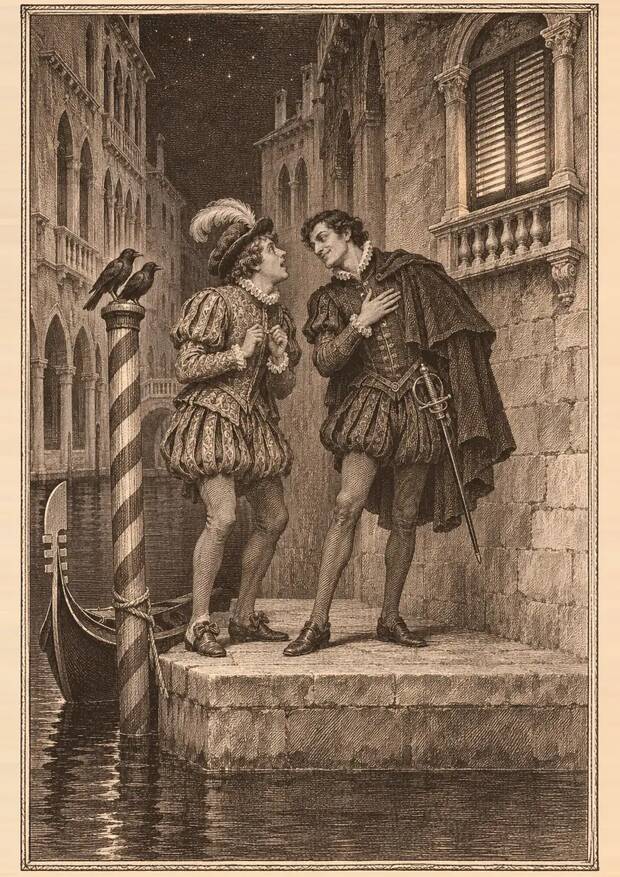
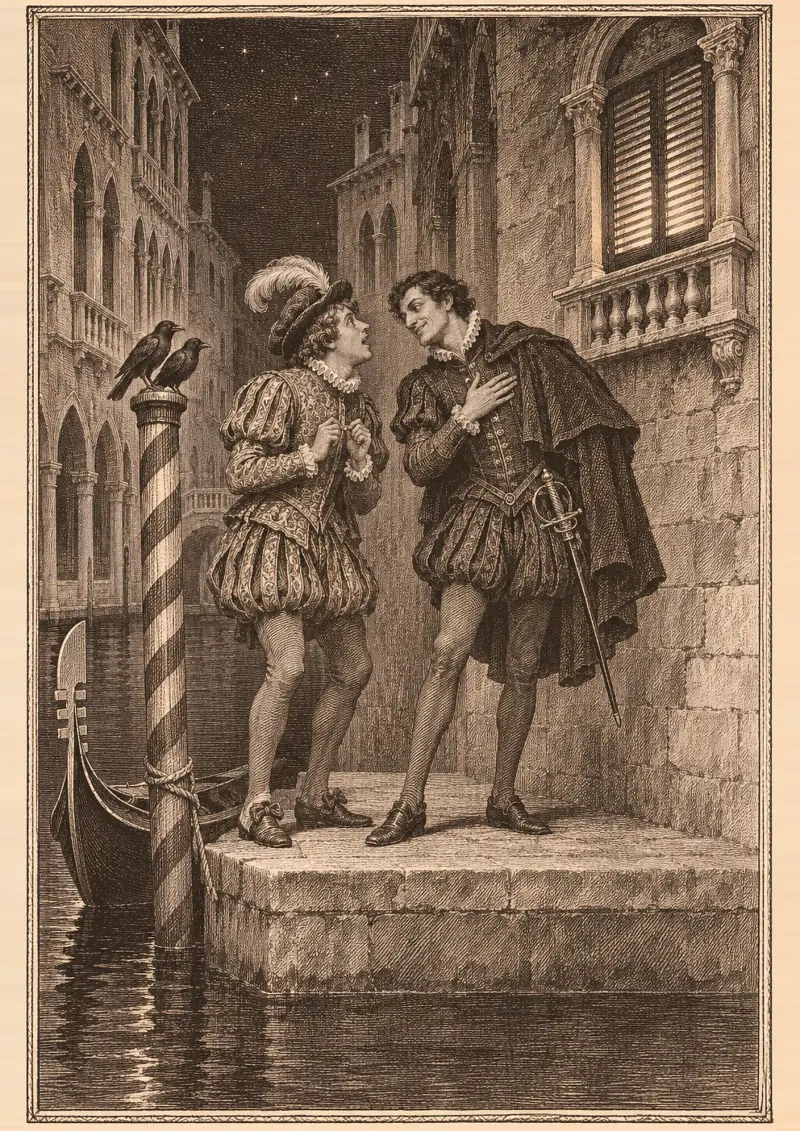
- Written
- c. 1603-04
- Genre
- Tragedy (often called a domestic tragedy)
- Setting
- Venice, then the Venetian garrison on Cyprus
- Form
- Blank verse, with significant prose for Iago and for Othello’s collapse
- Structure
- Five acts; one act in Venice, four in Cyprus; a single plot with no subplot
- Studied for
- GCSE, A-level, AP Literature, IB, undergraduate surveys
Othello: study guide (PDF)
PDF, 12 pages, 1.1 MB. Free, no sign-up, made to be printed.
Also for Othello: quotation sheet (PDF), three lesson plans.
Context
Shakespeare wrote Othello around 1603-04, between Hamlet and King Lear. There are no kings, ghosts or battles on stage: the Turkish fleet is drowned before Act 2 is under way, and what remains is a marriage, a garrison and a liar. Hence the label domestic tragedy.
The source, and what Shakespeare changed
The plot comes from a prose tale in Giraldi Cinthio’s Italian collection Hecatommithi (1565). In Cinthio the Ensign has a simple motive: he desires the Moor’s wife and is rejected. Shakespeare gives Iago several motives, none of them sufficient, and gives Othello a name, a history and the most majestic verse in the play.
Venice, Cyprus and the Turk
To a London audience Venice meant wealth, law and sophistication; Cyprus was its exposed frontier against the Ottoman Empire. The move matters: in Venice Brabantio’s accusation is tested by a court and fails; in Cyprus there is no Duke to hear evidence, only Othello, who is judge and injured party at once.
Race and the word “Moor”
Shakespeare’s contemporaries used “Moor” loosely for African peoples, and the stage associated blackness with devilry. Shakespeare inherits that prejudice and puts it in the mouths of Iago, Roderigo and Brabantio before Othello has spoken a word, then brings on a man who contradicts it. The play makes racism a mechanism of the plot: Iago succeeds partly because Othello comes to see himself through Venetian eyes.
Marriage, reputation and the Vice
A daughter was expected to marry with her father’s consent, and a wife’s fidelity was treated as her husband’s honour, so cuckoldry was a public humiliation. Iago descends from the Vice of the medieval morality plays, the tempter who confides in the audience and enjoys his own tricks. Shakespeare places that theatrical devil inside a realistic soldier.
Plot summary
Act 1
Venice, at night. Iago, passed over for promotion in favour of Cassio, and his dupe Roderigo wake the senator Brabantio with the news that his daughter Desdemona has secretly married Othello, the Moorish general. Before the Duke, Othello and Desdemona defend the marriage calmly and are believed. Othello is sent to defend Cyprus; Desdemona will follow. Turning point: alone on stage, Iago resolves to make Othello believe Cassio is too familiar with his wife.
Act 2
A storm destroys the Turkish fleet, so the war ends before it starts. Husband and wife are reunited in Cyprus. During the celebrations Iago gets Cassio drunk and has Roderigo provoke a brawl in which the governor Montano is wounded. Othello dismisses Cassio. Turning point: Iago advises Cassio to ask Desdemona to plead for him, so that her kindness will look like guilt.
Act 3
The long scene 3.3 is the hinge of the play. Iago hints, withdraws, and warns Othello against jealousy until Othello demands proof. Desdemona drops the handkerchief that was Othello’s first gift; Emilia gives it to Iago, who plants it on Cassio and invents a story of Cassio talking in his sleep. Turning point: Othello kneels, vows revenge and makes Iago his lieutenant. When Desdemona cannot produce the handkerchief, he takes it as confirmation.
Act 4
Othello falls in a fit. Iago stages a conversation with Cassio about Bianca, which Othello overhears and takes to be about Desdemona. Lodovico arrives from Venice with letters recalling Othello and giving Cassio command; Othello strikes his wife in public, then treats her chamber as a brothel. Turning point: in the quiet “willow” scene Desdemona prepares for bed while Emilia argues that husbands are to blame when wives fall.
Act 5
Iago sets Roderigo to kill Cassio; in the dark he wounds Cassio himself and murders Roderigo. Othello smothers Desdemona in her bed. Emilia raises the alarm and, defying her husband, reveals the truth about the handkerchief; Iago kills her and is captured. Turning point: Othello, understanding at last, delivers a final speech and kills himself. Iago refuses to explain and is led away to torture.
Characters
Othello
A Black general serving a white state, valued for his usefulness and never quite at home. He begins with complete self-possession: My parts, my title, and my perfect soul / Shall manifest me rightly
. His tragedy is the destruction of that composed self. The verse shows it: the measured music of Act 1 breaks into fragments by Act 4 and is consciously rebuilt for his last speech.
Iago
Ensign, confidant and stage manager. He speaks more lines than anyone else, takes the audience into his confidence and improvises brilliantly with whatever chance hands him. His stated motives (the lost promotion, a rumour about Emilia, plain hatred in I hate the Moor
) shift from speech to speech, which is why Coleridge thought him a man hunting for motives rather than driven by one.
Desdemona
Not the passive victim of weak productions. She chooses her husband, speaks before the Senate and insists on going to war with him: I do perceive here a divided duty
. Her confidence is what Iago exploits, since she pleads for Cassio openly. By Act 4 she is bewildered and isolated, yet she dies trying to shield Othello.
Emilia
Iago’s wife and Desdemona’s attendant. She hands over the handkerchief to please her husband and says nothing when it is missed, which makes her complicit. In Act 5 she becomes the play’s truth-teller at the cost of her life: I will not charm my tongue. I am bound to speak.
Cassio
The courteous Florentine lieutenant, everything Iago is not: educated, favoured, at ease with women. His weakness for drink and his horror at disgrace, O, I have lost my reputation!
, make him easy to use. He survives to govern Cyprus.
Themes
Jealousy
Shakespeare presents jealousy as self-generating rather than caused. Iago calls it a monster that feeds on itself, and Emilia agrees that the jealous need no reason. The evidence never improves across the play; only Othello’s readiness to believe does. For the central speech, see our essay on “O, beware, my lord, of jealousy”. Jealousy is also Iago’s own condition: he suspects both Othello and Cassio with Emilia.
Appearance and reality
The play’s cruellest irony is the word “honest”, attached to Iago again and again by the people he is destroying. Othello believes that men should be what they seem
; Iago knows they need not be. The handkerchief turns the theme into an object: it means love, then proof, depending on who tells its story.
Race and the outsider
Act 1 lets us hear Othello described in animal and diabolic terms before we see him, then overturns the description. But the insults do their work later. Under Iago’s pressure Othello starts to speak of his own blackness as a stain, comparing Desdemona’s supposedly ruined name to mine own face
.
Women, men and power
All three women are judged by men as either chaste or whores, and all three are called the latter. None is believed over a man until it is too late. Emilia’s speech in 4.3 gives the play’s most direct challenge to the double standard, and her defiance in 5.2 is what finally breaks Iago’s plot.
Reputation and honour
Cassio mourns his reputation as the immortal part of himself; Iago preaches its value while privately despising it. Othello ends by calling himself An honorable murderer
, a phrase whose two halves cannot be reconciled. Honour, in this play, is the language men use to justify what they do to women.
Key quotations
Short quotations, exactly remembered, beat long ones half-remembered. For the same close attention beyond your set text, Daily Bard shows one Folger-verified Shakespeare passage a day, with a plain-English reading on the back of the leaf.
But I will wear my heart upon my sleeve
Iago · Act 1, Scene 1
For daws to peck at. I am not what I am.
Plain English: If my behaviour ever showed my real feelings I would be easy prey. I am not the man I appear to be.
The final sentence is six monosyllables that cancel themselves out, a blasphemous inversion of God’s “I am that I am” in Exodus. Iago defines himself as an absence, which prepares us for a villain whose motives never settle. Dramatic irony begins here: the audience knows what no character learns until Act 5.
Even now, now, very now, an old black ram
Iago · Act 1, Scene 1
Is tupping your white ewe.
Plain English: At this very moment an old black ram is mating with your white ewe.
The repeated now
forces Brabantio to picture the act in the present tense. Animal imagery and the black/white antithesis reduce a marriage to breeding and make race the ground of disgust. It is Iago’s method in miniature: he does not argue, he plants an image.
She loved me for the dangers I had passed,
Othello · Act 1, Scene 3
And I loved her that she did pity them.
Plain English: She fell in love with me because of what I had lived through, and I loved her for feeling for me.
Balanced, end-stopped lines give Othello the calm authority that wins the Senate. Yet the couplet-like symmetry also exposes a weakness: this love is founded on storytelling. A marriage made by a persuasive tale can be unmade by another one, and Iago is the better storyteller.
The Moor is of a free and open nature
Iago · Act 1, Scene 3
That thinks men honest that but seem to be so
Plain English: Othello is frank and trusting; he assumes that anyone who looks honest is honest.
In soliloquy Iago gives an accurate, even generous, account of his victim, then decides to use that virtue as the weapon. The hinge is seem
, the play’s key verb. Closing Act 1 with the plan engendered
, it sends the audience to Cyprus as Iago’s unwilling accomplices.
O, beware, my lord, of jealousy!
Iago · Act 3, Scene 3
It is the green-eyed monster which doth mock
The meat it feeds on.
Plain English: Be careful of jealousy, my lord. It is a monster that torments the very person it consumes.
A warning that works as a suggestion: until now Othello has not used the word. Personification makes jealousy an outside creature, so Othello can feel attacked rather than responsible. The feeding image links to Emilia’s later remark that men eat us hungerly
. A full reading is in our essay on this passage.
Haply, for I am black
Othello · Act 3, Scene 3
And have not those soft parts of conversation
That chamberers have
Plain English: Perhaps it is because I am black, and lack the smooth manners of courtiers.
Left alone for a moment, Othello searches himself for the reason and reaches first for race, then manners, then age. The tentative Haply
shows a mind that minutes earlier was certain. This is the point at which Venetian prejudice becomes self-doubt, and it is essential evidence for any essay on Othello as outsider.
They are not ever jealous for the cause,
Emilia · Act 3, Scene 4
But jealous for they’re jealous. It is a monster
Begot upon itself, born on itself.
Plain English: Jealous people are not jealous for a reason. They are jealous because they are jealous; it breeds itself.
Emilia echoes her husband’s monster
without knowing it, and her circular syntax (jealous for they’re jealous
) enacts the closed loop she describes. She diagnoses the play exactly and still fails to connect it with the handkerchief she stole.
Let husbands know
Emilia · Act 4, Scene 3
Their wives have sense like them.
Plain English: Husbands should understand that their wives have feelings and appetites just as they do.
Plain diction and an imperative verb give Emilia the voice of common sense against the idealising and degrading language men use about women. Placed in the intimate willow scene, just before the murder, it offers a perspective the male characters never hear.
Put out the light, and then put out the light.
Othello · Act 5, Scene 2
Plain English: First I will put out this candle, and then I will put out her life.
Ten monosyllables in perfectly regular iambic pentameter: the control is chilling. The repeated phrase shifts from literal to metaphorical, and Othello goes on to admit that a candle can be relit but a life cannot. He speaks as a priest performing a sacrifice, which shows how completely he has dressed murder as justice.
Then must you speak
Othello · Act 5, Scene 2
Of one that loved not wisely, but too well;
Of one not easily jealous, but being wrought,
Perplexed in the extreme
Plain English: Describe me as a man who loved unwisely but too much; not jealous by nature, but, once worked upon, utterly confused.
Anaphora (Of one
) and antithesis rebuild the grand style of Act 1 as Othello dictates his own epitaph. Whether this is honest self-knowledge or a final self-deception is the central critical debate about the play. Note the passive being wrought
: even now he presents himself as acted upon.
Language, form and structure
Verse and prose. Most of the play is in blank verse (unrhymed iambic pentameter, ten syllables with five stresses). Othello’s early speeches are long, rhythmical and full of exotic place names. Iago moves easily between verse and blunt prose, matching his listener. In 4.1 Othello’s language collapses into broken prose, Handkerchief - confessions - handkerchief
, before he falls in a fit: form shows a mind coming apart.
Infection of language. Track who uses animal imagery. In Act 1 it belongs to Iago; by Act 4 Othello is crying Goats and monkeys!
, an echo of words Iago gave him. Iago calls his method poison
, and the image is exact.
Soliloquy (a character alone, speaking thoughts aloud). Iago has most of them, so the audience shares his view and his secret.
Structure. There is no subplot and almost no relief. Critics note a “double time scheme”: events move too fast for any adultery to have been possible, yet characters speak as if weeks have passed. The speed serves the tragedy, since Othello is never given time to think. Dramatic irony (the audience knowing more than the characters) is sustained from the first scene to the last.
Critical perspectives
Coleridge and Iago’s motives. Coleridge saw Iago’s soliloquies as a search for reasons to justify a malice that has none. Use this to explain the shifting motives, or challenge it: the lost promotion and sexual jealousy are stated plainly.
A. C. Bradley’s noble Othello. For Bradley, Othello is the most romantic of the tragic heroes, a man of great trust undone by an almost superhuman villain; his jealousy is not in his nature. This fits Act 1 and the hero’s own final account.
F. R. Leavis’s reply. Leavis argued the opposite: Iago succeeds so quickly because Othello is self-dramatising and proud, and the last speech is self-flattery, not insight. T. S. Eliot had similarly read that speech as Othello cheering himself up. Weigh the two views against 3.3: how much does Iago actually have to do?
Feminist readings. These shift attention to Desdemona, Emilia and Bianca, and to a society in which a woman’s word carries no weight against a man’s. Emilia’s 4.3 speech and her death become central.
Postcolonial readings. These treat Othello as a colonised subject who has adopted the values of the state he serves, so that his suicide, in which he is both Venetian avenger and turbanned Turk
, enacts a divided identity. Ask whether the play exposes racist assumptions or finally confirms them.
Essay questions
GCSE style
- How does Shakespeare present Iago as a manipulator in the play?
- Explore how Shakespeare presents the relationship between Othello and Desdemona.
- How does Shakespeare use the handkerchief to develop the theme of jealousy?
A-level and IB style
- “Othello’s tragedy is that he never understands himself.” How far do you agree?
- Examine the view that the women of the play are more clear-sighted than the men.
- To what extent is Othello’s race the cause of his downfall?
AP Literature style
- Choose a character who deceives others. Analyse how the deception contributes to the meaning of the work as a whole.
- Analyse how Othello’s position as an outsider shapes the play’s treatment of trust.
- Read Othello’s final speech in 5.2 and analyse how Shakespeare uses language to convey his complex state of mind.
Undergraduate
- “Iago does not create Othello’s jealousy; he reveals it.” Discuss.
- Consider the relation between storytelling and identity in Othello.
- How does the play’s handling of time and place shape its tragic effect?
Planning a top-band answer. Decide your argument before you write, and make every paragraph a step in it. Choose three or four moments from different acts to show development, anchor each in a short quotation, and name the method before the effect. Where the question invites debate, set Bradley against Leavis. The essay planner gives a one-page structure for doing this under timed conditions.
Revision checklist
- I can summarise each act in two sentences and name its turning point.
- I can explain three changes Shakespeare made to Cinthio’s story and why they matter.
- I can trace the handkerchief from Othello’s gift to Emilia’s revelation.
- I can list Iago’s stated motives and explain why none fully accounts for him.
- I can show how Othello’s language changes between Act 1, Act 4 and his final speech.
- I can compare Desdemona, Emilia and Bianca as responses to male power.
- I can explain how race works in the play using at least two quotations.
- I can define blank verse, soliloquy and dramatic irony, with an example of each.
- I can set out the Bradley and Leavis views of Othello and argue for one.
- I can quote ten short lines accurately, with speaker, act and scene.
Learn quotations in pairs that speak to each other, such as Iago’s and Emilia’s two “monsters”, and practise writing them from memory, not rereading them. The Othello quotation sheet sets the key lines out for printing, and the Othello lesson plans include a worksheet on the temptation scene that works well for self-testing. For comparison, read Macbeth, another play in which a soldier is talked into murder.
The other study guides follow the same plan. If a line you know turns up as the day’s page in Daily Bard, gloss it yourself before you turn the leaf.

A page of Shakespeare, every day.
This resource comes from Daily Bard, an app for iPhone and iPad. Each morning it shows one engraved plate and one passage, exactly as Shakespeare wrote it, with a plain-English reading on the back of the leaf.
Free to download. The Full Edition is a one-time US$11.99: no subscription, no account, no ads, no tracking.
Get it on the App Store: apps.apple.com/app/id6792967225
More free study guides, lesson plans and close readings: dailybard.app