
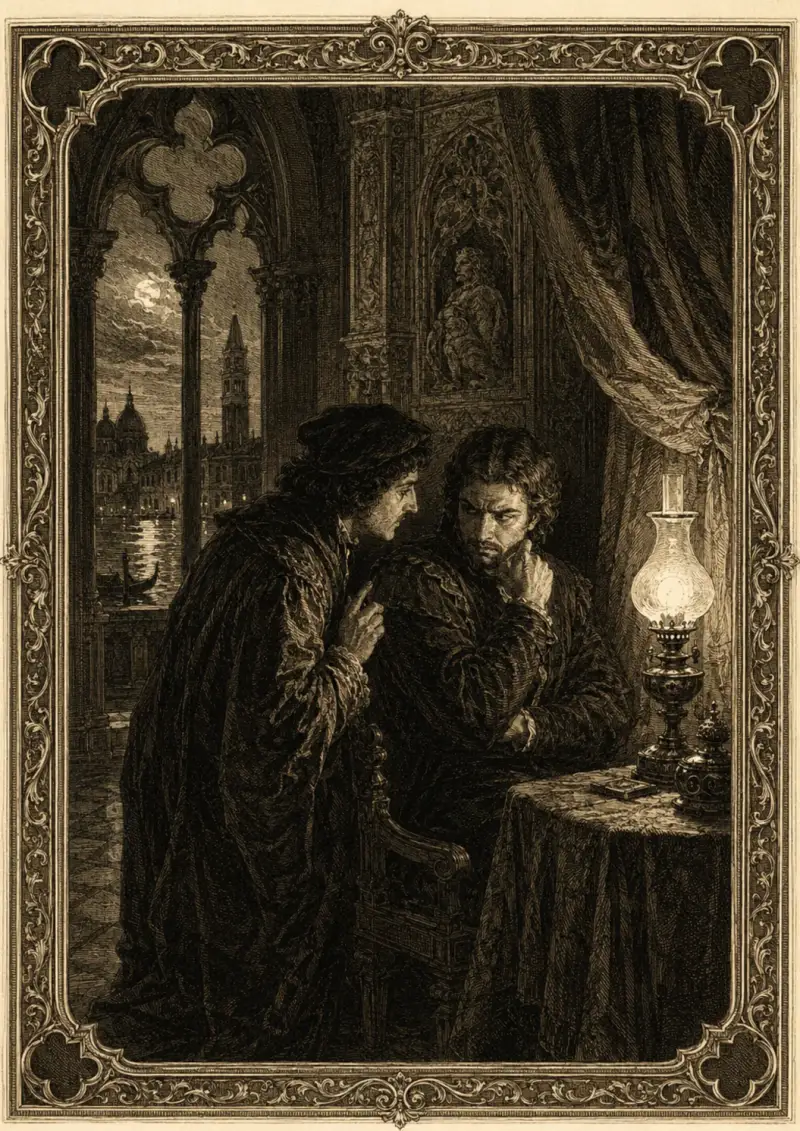
The passage
IAGO O, beware, my lord, of jealousy!
Othello · Act 3, Scene 3
It is the green-eyed monster which doth mock
The meat it feeds on. That cuckold lives in bliss
Who, certain of his fate, loves not his wronger;
But O, what damned minutes tells he o’er
Who dotes, yet doubts; suspects, yet strongly loves!
OTHELLO O misery!
IAGO Poor and content is rich, and rich enough;
But riches fineless is as poor as winter
To him that ever fears he shall be poor.
Good God, the souls of all my tribe defend
From jealousy!
In plain English
Iago: My lord, be on your guard against jealousy. It is a green-eyed monster that toys with the very thing it devours. A husband whose wife is unfaithful is happy enough if he knows it for certain and does not love her. But what hellish minutes he counts who adores his wife and yet doubts her, suspects her and yet loves her deeply. Othello: What misery. Iago: A poor man who is content is rich enough. Limitless wealth is as bare as winter to someone who is always afraid of losing it. God protect everyone of my kind from jealousy.
Where it comes in the play
Act 3, Scene 3 is the long central scene of Othello (c. 1603-04), often called the temptation scene. At its start Othello is a happily married general. By its end he has sworn to kill his wife. Almost nothing happens in between except talk.
Iago, passed over for promotion in favour of Cassio, has contrived for Othello to see Cassio leaving Desdemona. Since then he has offered no accusation at all. He has hesitated, echoed Othello’s words, praised Good name in man and woman
, and refused to share his thoughts. Othello, exasperated, has demanded to know them. This warning is Iago’s answer. Notice what has not yet been said: nobody has mentioned Desdemona’s fidelity, and Othello has not said he is jealous. Iago introduces the word.
The audience hears all this with knowledge Othello lacks. In soliloquy Iago has told us his plan, and promised to pour this pestilence into his ear
.
Close reading
A warning that plants what it warns against
O, beware, my lord, of jealousy!
has the form of loyal advice: an exclamation, a respectful title, an imperative. Its function is the opposite. To tell a man who has not yet suspected anything to beware of jealousy is to tell him there is something to be jealous of. Antony uses a related trick in public, raising a subject by seeming to steer away from it, in “Friends, Romans, countrymen”.
The monster
Jealousy is personified as the green-eyed monster which doth mock / The meat it feeds on
. Green was the colour of sickliness and of envy. Shakespeare had already written of green-eyed jealousy
in The Merchant of Venice, but here the adjective is given a body.
The image is usually explained as a cat playing with its prey. Whose flesh is the meat
? The likeliest answer is the jealous man himself: jealousy feeds on the heart that holds it, and torments it while it eats. The verb mock
adds humiliation to pain. A monster that mocks is very like Iago, who destroys Othello and enjoys the performance.
Appetite is one of the play’s persistent image patterns, and from this point Othello’s own speech fills with animals and devouring.
Certainty and doubt
Iago then contrasts two husbands. The first is certain of his fate
and does not love: he lives in bliss
. The second counts damned minutes
. tells
means counts, as a bank teller does: the jealous man measures time by the minute, and damned
makes the minutes a foretaste of hell.
The key line is built from two matched halves: Who dotes, yet doubts; suspects, yet strongly loves!
In each half a yet
sets love against suspicion, and the order reverses, love then doubt, doubt then love (a pattern called chiasmus). The alliteration of dotes
and doubts
makes the two words almost one. The line describes a mind going back and forth, and its shape makes the reader’s mind do the same.
The argument beneath it is poisonous. Iago says the misery lies in uncertainty, not in betrayal. The only cures are to stop loving or to become certain. He is teaching Othello to crave proof, and Othello duly asks for it later in the scene: Give me the ocular proof
.
Othello’s two words
Othello’s two words are among the most debated in the scene. He may be agreeing in the abstract, or the image may already be his own. An actor has to choose, and the choice decides how quickly this Othello falls. Iago’s next speech, with its proverb-like Poor and content is rich
, casts Desdemona as riches
Othello may lose, and ends with a mock prayer. Good God, the souls of all my tribe defend / From jealousy!
is piety from the play’s least pious character, and it repeats the word once more.
What Othello says next
Othello resists. He will not make a life of jealousy
, he says: I’ll see before I doubt; when I doubt, prove
. It sounds rational. But it accepts Iago’s terms, that doubt must be settled by evidence, and Iago at once gives his first real instruction: Look to your wife; observe her well with Cassio
. The warning has done its work.
What it tells us about the play
The lines show Iago’s method in miniature. He rarely lies outright in this scene. What he says about jealousy is accurate, and the play proves it. His dishonesty lies in his purpose. This is why everyone can call him honest: his statements bear inspection, and only the audience sees what they are for.
He also speaks from experience. Iago suspects, on no evidence, that Othello has slept with his own wife, Emilia: it is thought abroad that ’twixt my sheets / ’Has done my office
. Coleridge famously thought Iago’s stated motives were excuses hunted up by a malice that had no real motive. The jealousy speech supports another view: Iago wants Othello to feel what he feels.
The monster returns. Emilia later tells Desdemona that jealous people are not ever jealous for the cause, / But jealous for they’re jealous. It is a monster / Begot upon itself, born on itself.
Jealousy needs no facts. As Iago puts it, Trifles light as air / Are to the jealous confirmations strong / As proofs of holy writ.
A handkerchief will be enough.
Finally, the passage raises the play’s hardest question: how far is Othello responsible? A. C. Bradley saw a noble, trusting man overwhelmed by an almost superhuman deceiver. F. R. Leavis replied that Othello’s own self-regard makes him ready to fall, and that Iago merely supplies the occasion. Othello’s last account of himself, one not easily jealous, but being wrought, / Perplexed in the extreme
, can be read either way.
What people get wrong
Othello does not say it. The phrase is so well known that it is often attributed to the jealous man. It belongs to the man who makes him jealous.
It is not sincere advice. Quoted alone, the line sounds like a wise friend’s caution. In context it is the opening move of an attack.
Jealousy here is not envy. In everyday use the phrase means wanting what someone else has. Iago means sexual suspicion: fear of losing what you have.
Using it in an essay
Use the passage to show how Iago controls Othello through language, not evidence. The close reading toolkit gives a method for tracking a single word such as jealousy through a scene. Strong answers comment on the dramatic irony, on who introduces the idea of jealousy, and on the imagery of feeding. The Othello quotation sheet places these lines beside the others you will need, and the Othello lesson plans work through the temptation scene step by step.
Fragments worth memorising:
O, beware, my lord, of jealousy!
- a warning that introduces the very idea it warns against.the green-eyed monster which doth mock / The meat it feeds on
- jealousy consumes and humiliates its host.Who dotes, yet doubts
- alliteration binds love and suspicion together.Begot upon itself, born on itself
- Emilia’s later echo: jealousy needs no cause.
To turn this into a full argument, the essay planner shows how to move from a close reading to a thesis about the whole tragedy. For Shakespeare’s earlier stage villain who confides in the audience, read our essay on Richard III’s opening soliloquy, and for guilt that feeds on the mind in a different way, see “Out, damned spot”.
Read the whole scene in one sitting, marking every time Iago says something true. As a daily companion to that kind of study, not a replacement for it, the Daily Bard app is free to download, and you can get the Full Edition as a one-time purchase if you want to keep every page in the Commonplace Book and add your own margin notes.