

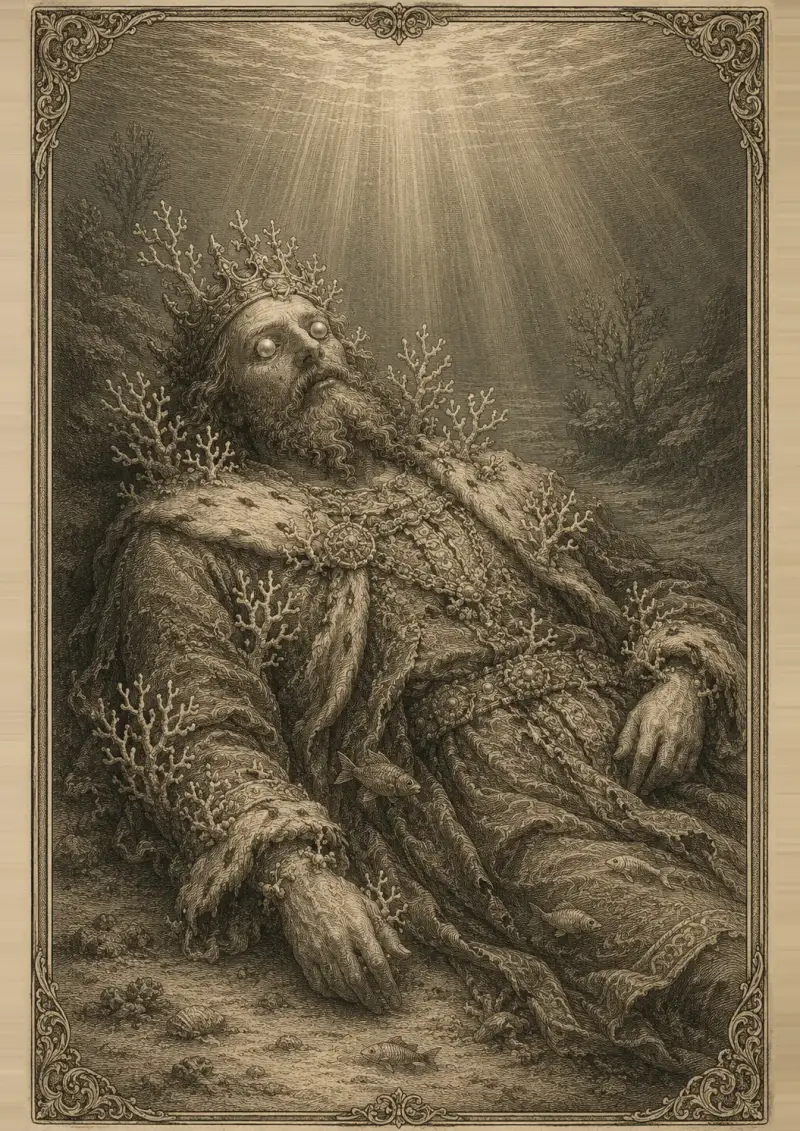
- Written
- c. 1610-11; first printed in the First Folio of 1623
- Genre
- Late romance (printed among the comedies), drawing on tragicomedy and court masque
- Setting
- A ship at sea, then an unnamed island; the action covers about four hours
- Form
- Mostly blank verse, with prose for the comic plot, songs, a masque and a rhymed epilogue
- Structure
- Five acts, nine scenes and an epilogue; three interwoven plots, all directed by Prospero
- Studied for
- GCSE, A-level, AP Literature, IB, undergraduate surveys
The Tempest: study guide (PDF)
PDF, 12 pages, 1.1 MB. Free, no sign-up, made to be printed.
Also for The Tempest: quotation sheet (PDF), three lesson plans.
Context
The Tempest was written around 1610-11 and is recorded as having been performed at court in November 1611. It is one of the last plays Shakespeare wrote alone, and it stands first in the First Folio of 1623.
Voyages and the colonial encounter
In 1609 the Sea Venture, bound for the English colony at Jamestown, was wrecked on Bermuda, and its people survived. Accounts reached London, among them a letter by William Strachey that Shakespeare appears to have known. The island lies between Tunis and Naples, but the play’s language of masters, servants and a native taught to speak by newcomers belongs to the age of Atlantic colonisation. Caliban’s claim, This island’s mine by Sycorax, my mother
, is an argument about inheritance, and the play lets him make it.
Montaigne, nature and nurture
Gonzalo’s ideal commonwealth in Act 2, Scene 1 borrows from Montaigne’s essay “Of Cannibals”, in John Florio’s translation, which suggested that so-called savages might live more honestly than Europeans. Shakespeare gives the idea to a kind old man and lets two cynics mock it, leaving the audience to judge.
Magic and authority
Renaissance thinkers separated learned magic, achieved by study, from witchcraft, achieved by a pact with devils. Prospero practises the first and Sycorax the second, though his renunciation speech is adapted from the sorceress Medea in Ovid’s Metamorphoses, which blurs the line. James I wrote against witchcraft and insisted on the authority of kings and fathers. A duke who loses his state through his books, then regains it by them, speaks to Jacobean debate about a ruler’s duty.
Romance and masque
With Pericles, Cymbeline and The Winter’s Tale, the play belongs to the late romances: stories of loss at sea, a lost daughter and a half-miraculous restoration. Shakespeare’s company now also played indoors at the Blackfriars, which suited music and effects, and the court loved the masque, a costly show of song, dance and spectacle. Act 4 imitates one, then breaks it off.
To keep Shakespeare’s language in your ear while you study, Daily Bard shows one passage a day, verified against the Folger text, with a plain-English reading on the back of the leaf. It is a companion to reading the play, not a substitute for it.
Plot summary
Act 1
A storm wrecks the ship of Alonso, King of Naples. On the island, Prospero tells his daughter Miranda that he raised it by magic: twelve years ago his brother Antonio, aided by Alonso, usurped his dukedom of Milan and cast them adrift. The spirit Ariel reports everyone safe and asks for freedom; the enslaved Caliban curses his master. The turning point is the meeting Prospero has engineered, when Alonso’s son Ferdinand and Miranda fall in love.
Act 2
Alonso thinks Ferdinand drowned, and Gonzalo tries to console him with a vision of a commonwealth without rulers. While the others sleep, Antonio persuades Sebastian to murder his brother Alonso for the crown; this repetition of the original crime is the turning point. Ariel wakes Gonzalo in time. Elsewhere Caliban meets Trinculo, a jester, and Stephano, a drunken butler, takes Stephano for a god and swears to serve him.
Act 3
Ferdinand carries logs as Prospero’s prisoner, and Miranda, watched secretly by her father, proposes to him. Caliban urges Stephano to kill Prospero and burn his books; Ariel overhears. Spirits offer the court a banquet, which vanishes as Ariel, dressed as a harpy, denounces Alonso, Antonio and Sebastian as three men of sin
. This is the turning point of the revenge plot: Alonso is crushed by guilt, and Prospero’s enemies are in his power.
Act 4
Prospero blesses the betrothal, warns Ferdinand to respect Miranda’s chastity, and has spirits perform a masque of Iris, Ceres and Juno. Mid-dance he remembers Caliban’s plot and stops the show; that interruption is the turning point, and it prompts the speech beginning Our revels now are ended
. Stephano and Trinculo are distracted by gaudy clothes hung out as bait, and spirit hounds chase the conspirators away.
Act 5
Ariel says he would pity the spellbound courtiers if he were human, and Prospero chooses mercy over revenge: the turning point of the whole play. He renounces magic, forgives his enemies, reclaims Milan, and reveals Ferdinand and Miranda at chess. Alonso repents; Antonio says almost nothing. Caliban resolves to seek for grace
, Ariel is freed, and in the Epilogue a powerless Prospero asks the audience to release him.
Characters
Prospero
Protagonist and stage manager, Prospero is a wronged ruler who shares the blame: he neglected government, all dedicated / To closeness and the bettering of my mind
. He is a loving, controlling father and a harsh master. His change is the play’s moral plot. He begins with his enemies at his mercy and ends by giving up revenge, magic and, in the Epilogue, authority itself.
Miranda and Ferdinand
Miranda’s name means “to be wondered at”, and wonder and compassion are her habits. She is not passive: she defies her father and proposes to Ferdinand, who calls her precious creature
in the courtly manner her plain speech outdoes. Their marriage unites Milan and Naples.
Ariel
A spirit of air, Ariel performs the magic: storm, music, harpy, masque. Prospero freed him from the pine where Sycorax had confined him and holds the debt over him. He serves brilliantly but wants one thing: My liberty.
Though not human, he prompts Prospero’s mercy, and his release is Prospero’s last command.
Caliban
Son of the witch Sycorax, Caliban was alone on the island when Prospero came. Prospero calls him a born devil
, and he does not deny attempting to rape Miranda. Yet Shakespeare gives him verse, a real grievance and the loveliest description of the island. He moves from cursing to worshipping a drunkard to self-knowledge. Whether his last speech shows growth or submission is a fine essay question.
Antonio and Alonso
The guilty men contrast. Alonso, who assisted the usurpation, is broken by losing his son and repents. Antonio, who planned it, tempts Sebastian to repeat the crime. Forgiven as most wicked sir
, he makes no reply. His silence marks the limit of Prospero’s art: magic can command bodies, not consciences.
Themes
Power and legitimacy
Every claim to rule in this play is open to challenge. Antonio took Milan; Prospero took the island; Sebastian covets Naples; Stephano would be king. In the storm the Boatswain asks What cares these roarers for the name of king?
and the question never goes away. As usurpation recurs in a comic key, we are pressed to ask what, apart from magic, separates Prospero’s rule from the others’.
Service and freedom
Almost everyone is a servant seeking release. Ariel bargains for liberty; Caliban sings Freedom, high-day!
while taking a new master; Ferdinand labours willingly; Prospero finally begs the audience to set me free
. The theme widens from one colonial household to a general human condition, and the dispossessed party is always heard.
Nature and nurture
Prospero says Caliban is one on whose nature / Nurture can never stick
. The play tests the claim. Education made Miranda compassionate, but the polished Antonio is the coldest man on the island, and the “unteachable” Caliban is the only conspirator who learns. Civilisation guarantees nothing.
Art, illusion and theatre
Prospero’s magic resembles playwriting: he raises a harmless storm, directs entrances and stages a masque. The play celebrates this power and distrusts it. Art brings guilty men to their senses, yet he calls it rough magic
, and the masque dissolves when real danger intrudes. Our essay on “We are such stuff as dreams are made on” follows the idea through the play’s most famous speech.
Forgiveness and its limits
For four acts this is a revenge plot; then the revenger declines. Prospero’s mercy is real but not warm: he pardons Antonio’s rankest fault
and demands the dukedom in the same breath. Reconciliation comes mainly through the children’s marriage. As in King Lear, pardon cannot undo the wrong.
Key quotations
These ten short quotations cover every major theme. They are collected on the printable Tempest quotation sheet.
Me, poor man, my library
Prospero · Act 1, Scene 2
Was dukedom large enough.
Plain English: In my brother’s view, my books were all the kingdom I needed.
Prospero voices Antonio’s contempt, but the line convicts him too. The metaphor turns a library into a state, showing how fully study had replaced government, and poor man
betrays self-pity. Use it to argue that Prospero helped to make the usurpation possible, which complicates any reading of him as pure victim.
Hell is empty,
Ferdinand, reported by Ariel · Act 1, Scene 2
And all the devils are here.
Plain English: The devils have all left hell and come to this ship.
Ferdinand’s cry as he leaps overboard is hyperbole born of terror, and it carries dramatic irony. The devils he sees are Ariel’s illusions; the real wrongdoers are men of his own party.
This island’s mine by Sycorax, my mother,
Caliban · Act 1, Scene 2
Which thou tak’st from me.
Plain English: I inherited this island from my mother, and you have stolen it.
Caliban speaks blank verse and the vocabulary of lawful inheritance. The plain monosyllables mine
and tak’st
set possession against theft. Prospero never answers the argument; he replies with insult and accusation. This is the central text for postcolonial readings: the usurped duke is, on the island, a usurper.
You taught me language, and my profit on ’t
Caliban · Act 1, Scene 2
Is I know how to curse.
Plain English: You taught me to speak, and all I gained is the ability to curse you.
The commercial word profit
turns the gift of education into a bad bargain, and enjambment delays the bitter conclusion to the second line. Caliban turns his masters’ language against them, which undermines their claim that he cannot learn. Link it to nurture and to the colonial belief that teaching language was kindness.
Nothing of him that doth fade
Ariel · Act 1, Scene 2
But doth suffer a sea change
Into something rich and strange.
Plain English: Everything in him that would decay is being transformed by the sea into something precious and wonderful.
Ariel’s song misleads Ferdinand, since Alonso lives, but it states the play’s pattern of loss turned to gain. The short rhymed lines sound unlike the surrounding blank verse and mark the moment as enchantment. Suffer
means undergo and also endure pain: change here is never painless, as Alonso’s repentance shows.
Be not afeard. The isle is full of noises,
Caliban · Act 3, Scene 2
Sounds and sweet airs that give delight and hurt not.
Plain English: Do not be frightened. The island is full of sounds and sweet music that please and do no harm.
The “monster” comforts two frightened Europeans in lyrical verse while they speak prose. Each line ends on an extra unstressed syllable (a feminine ending), which softens the rhythm, and the sibilance of Sounds and sweet airs
imitates what it describes. His wish to dream again
makes his longing fully human.
We are such stuff
Prospero · Act 4, Scene 1
As dreams are made on, and our little life
Is rounded with a sleep.
Plain English: We are made of the same material as dreams, and our short lives are surrounded, and ended, by sleep.
The phrase is made on
, not “made of”. With the masque vanished, Prospero extends the image from a show to the world and to life itself. Rounded
suggests both encircled and completed. The calm cadence is deceptive, because he is vexed
and has just remembered danger. A key text for art and illusion.
The rarer action is
Prospero · Act 5, Scene 1
In virtue than in vengeance.
Plain English: It is a finer and less common thing to act well than to take revenge.
The alliterative antithesis of virtue
and vengeance
compresses the play’s moral choice. Rarer
means nobler and also more unusual, an admission of how seldom people manage it. Because the decision follows Ariel’s prompting, it marks a change in Prospero, not a fixed trait: the hinge between revenge plot and romance ending.
MIRANDA O, brave new world
That has such people in ’t!PROSPERO ’Tis new to thee.
Act 5, Scene 1
Plain English: Miranda: What a splendid new world, with such people in it. Prospero: It is only new to you.
Brave
means fine or splendid. Miranda’s exclamations express unguarded wonder; her father’s four dry monosyllables deflate it. The dramatic irony is sharp, since the people she admires include Antonio and Sebastian. Innocence meets experience and neither is declared wrong, which tempers the happy ending with doubt.
This thing of darkness I
Prospero · Act 5, Scene 1
Acknowledge mine.
Plain English: This dark creature, I admit, belongs to me.
On the surface Prospero merely identifies his servant. But the line break strands I
at the end of the verse, so that darkness and the speaker sit together for a moment, and Acknowledge
can mean confess as well as claim. Readers hear an owner’s label, an admission of responsibility, or a recognition of his own darkness.
Language, form and structure
Verse and prose. Most of the play is blank verse: unrhymed iambic pentameter, a ten-syllable line with five stresses in a rising rhythm. The nobles speak it, and so does Caliban. Stephano, Trinculo and the Boatswain speak prose. The distribution is an argument: when Caliban speaks verse to two prose-speaking Europeans, the form contradicts the label “monster”.
Late style. The verse is loose and compressed. Sentences run over the line ending (enjambment), break mid-line (caesura) and pile up parentheses. Prospero’s account of his fall in Act 1, Scene 2 is the clearest case: its tangled syntax suggests an anger twelve years old and not yet mastered. The guide to Shakespeare’s language explains these terms.
Song and spectacle. Ariel’s songs do dramatic work, leading Ferdinand to Miranda. The masque is in formal rhyming couplets, stiffer than the dialogue. The Epilogue’s short four-beat rhymed lines make Prospero sound smaller once his magic is gone.
Imagery. Trace three patterns: the sea that destroys and restores; sleep and dreaming; and the vocabulary of theatre, with its actors, revels and pageants, which reminds us we are watching an illusion.
Structure. Unusually for Shakespeare, the play observes the classical unities of place and time. The original betrayal is narrated, not staged, so we have only Prospero’s version. Three plots run in parallel, each a contest for mastery, and the clowns’ conspiracy parodies the nobles’. Because Prospero and Ariel watch unseen, the dominant effect is dramatic irony, in which the audience knows more than the characters. The close reading toolkit gives a method for annotating all of this.
Critical perspectives
Prospero as Shakespeare. A long tradition reads Prospero as the dramatist and the drowned book as his farewell to the stage. The likeness of magic to theatre supports it. Challenge it with evidence: Shakespeare went on to collaborate on further plays, and the reading makes Prospero calmer than the irritable figure in the text.
Postcolonial readings. Many modern critics and writers, notably from the Caribbean and Africa, read the play through Caliban: dispossessed, enslaved and taught the coloniser’s tongue. Aimé Césaire rewrote the play from his side. Act 1, Scene 2 supports this strongly. To test it, note the Mediterranean setting, that Sycorax too was an incomer, and that the text does not excuse the attack on Miranda.
New historicism. Critics such as Stephen Greenblatt set the play beside voyage narratives and other documents of its moment, asking how it shares the period’s thinking about power and language. A fair objection is that this can underplay its fairy-tale and theatrical qualities.
Feminist readings. Miranda is the only woman on stage; Sycorax and Claribel exist only in men’s reports, and Miranda’s chastity secures her father’s settlement. You might reply that she defies Prospero and proposes for herself, then ask how free that choice is when he arranged the meeting.
Essay questions
GCSE style
- How does Shakespeare present the relationship between Prospero and Caliban?
- Explore how Shakespeare presents ideas about power and control in The Tempest.
- How far does Shakespeare present Miranda as an innocent character?
A-level and IB style
- “Prospero’s forgiveness is an exercise of power, not an act of love.” In the light of this view, discuss the presentation of the play’s ending.
- “The Tempest gives Caliban a voice only to silence it.” How far do you agree?
- Examine the dramatic significance of music, masque and spectacle, considering how different audiences might respond.
AP Literature style
- Choose a character held in service or confinement. Analyse how that character’s desire for freedom contributes to the meaning of the work as a whole.
- Analyse how Shakespeare uses the island setting to develop a central conflict of the play.
- Analyse how Prospero’s decision to give up his magic illuminates what the play values.
Undergraduate
- To what extent can The Tempest be described as a play about colonialism?
- Discuss the relationship between magic and theatre, with reference to the masque and the Epilogue.
- “The romances stage reconciliation while registering its cost.” Assess this claim in relation to The Tempest and one other late play.
Planning a top-band answer
Begin with a position you could be argued out of, such as “the play grants Caliban’s grievance but not his freedom”. Choose three or four short quotations from different acts to show development, and name a method before explaining its effect. The essay planner gives a one-page frame, and the assessment map shows in general terms what each kind of point earns.
Revision checklist
- I can explain how Prospero lost Milan and why he shares the blame.
- I can summarise each act in two sentences and name its turning point.
- I can argue for and against Caliban’s claim to the island, with quotations.
- I can compare Ariel’s and Caliban’s responses to servitude.
- I can explain what a masque was and why Prospero breaks his off.
- I can analyse six short quotations, naming methods precisely.
- I can apply and challenge two critical readings.
- I can connect the Epilogue to freedom and forgiveness.
Memorise in small doses. Take three quotations a day from the quotation sheet, cover them, write them out, and say one method and one theme for each. Learn them in pairs that argue, such as born devil
against The isle is full of noises
. A daily habit helps: get Daily Bard for iPhone and iPad and meet one passage each morning. Teachers will find a three-lesson sequence in the Tempest lesson plans.

A page of Shakespeare, every day.
This resource comes from Daily Bard, an app for iPhone and iPad. Each morning it shows one engraved plate and one passage, exactly as Shakespeare wrote it, with a plain-English reading on the back of the leaf.
Free to download. The Full Edition is a one-time US$11.99: no subscription, no account, no ads, no tracking.
Get it on the App Store: apps.apple.com/app/id6792967225
More free study guides, lesson plans and close readings: dailybard.app