
- Written
- c. 1599-1601
- Genre
- Revenge tragedy
- Setting
- Elsinore, the royal castle of Denmark
- Form
- Blank verse with a large share of prose; soliloquy at every crisis
- Structure
- Five acts, twenty scenes; Shakespeare’s longest play
- Studied for
- GCSE, A-level, AP Literature, IB, undergraduate surveys
Hamlet: study guide (PDF)
PDF, 12 pages, 1.1 MB. Free, no sign-up, made to be printed.
Also for Hamlet: quotation sheet (PDF), three lesson plans.
Context
Hamlet was written around 1599-1601, in the last years of Elizabeth I. The queen was old and childless, and the succession was uncertain. A play that opens with a sentry calling Who’s there?
into the dark, and that turns on a throne taken by the wrong man, belongs to that anxious moment. Denmark’s crown in the play is elective, which is why Hamlet can say that Claudius Popped in between th’ election and my hopes
.
Sources. The story of Amleth, a prince who feigns madness to avenge his father, comes from the medieval Danish historian Saxo Grammaticus and was retold in French by Belleforest. Shakespeare’s decisive change is secrecy. In the old story everyone knows who killed the king. In the play only a ghost says so, and the hero’s first problem becomes one of knowledge.
Revenge tragedy. Audiences knew the genre from Seneca and from Thomas Kyd’s The Spanish Tragedy: a ghost, a secret murder, madness, a play within the play, a stage covered in bodies. Shakespeare uses every convention and adds a hero who questions them. Church and state taught that vengeance belonged to God; the code of honour demanded that a son act.
Religion. The Ghost says he is confined to fast in fires
until his sins are burnt away, which describes purgatory. Protestant England had officially abolished purgatory, and Hamlet studies at Wittenberg, Martin Luther’s university. His fear that the spirit May be a devil
is a serious theological doubt and not merely an excuse.
The text. Hamlet survives in three early versions (two quartos and the First Folio of 1623) which differ in many readings. Modern editions combine them, so some passages you study, including the Act 4 soliloquy, appear in only one early text.
Plot summary
Act 1
On the battlements of Elsinore a ghost in the armour of the late King Hamlet appears to the watch. At court his brother Claudius, now king and married to the widowed Queen Gertrude, handles state business smoothly while Prince Hamlet stands apart in black. The turning point is the Ghost’s revelation in Scene 5: Claudius poisoned him. Hamlet swears to remember, and warns his friends that he may put on an antic disposition
.
Act 2
Hamlet’s strange behaviour alarms the court. Polonius, the King’s wordy counsellor, blames rejected love for his daughter Ophelia; Claudius summons Hamlet’s old friends Rosencrantz and Guildenstern to probe him. A company of actors arrives, and the First Player weeps while reciting a speech about Hecuba. Shamed by an actor’s feeling for a fiction, Hamlet reaches the act’s turning point: he will stage a murder like his father’s and watch the King’s face.
Act 3
Hamlet meditates on death, then turns on Ophelia while Claudius and Polonius listen in hiding. The play within the play works: Claudius rises and calls for lights. Hamlet finds him at prayer and does not strike, wanting his soul damned as well as his body killed. In Gertrude’s private room he stabs a figure behind the arras and kills Polonius. This is the hinge of the tragedy: the avenger has made another son an avenger.
Act 4
Claudius sends Hamlet to England with sealed orders for his death. On the road Hamlet watches Fortinbras’s army march to fight for worthless ground. Ophelia, her father killed and Hamlet gone, loses her reason, and Laertes storms back from France. When a letter announces Hamlet’s return, Claudius turns Laertes’s anger into the plot that drives the ending: a fencing match, a poisoned sword, a poisoned cup. Gertrude reports that Ophelia has drowned.
Act 5
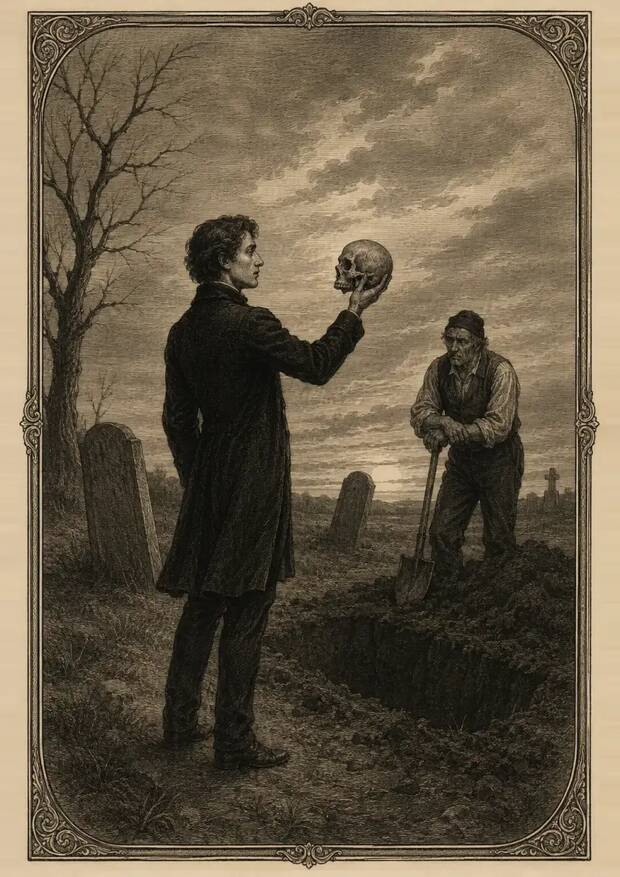
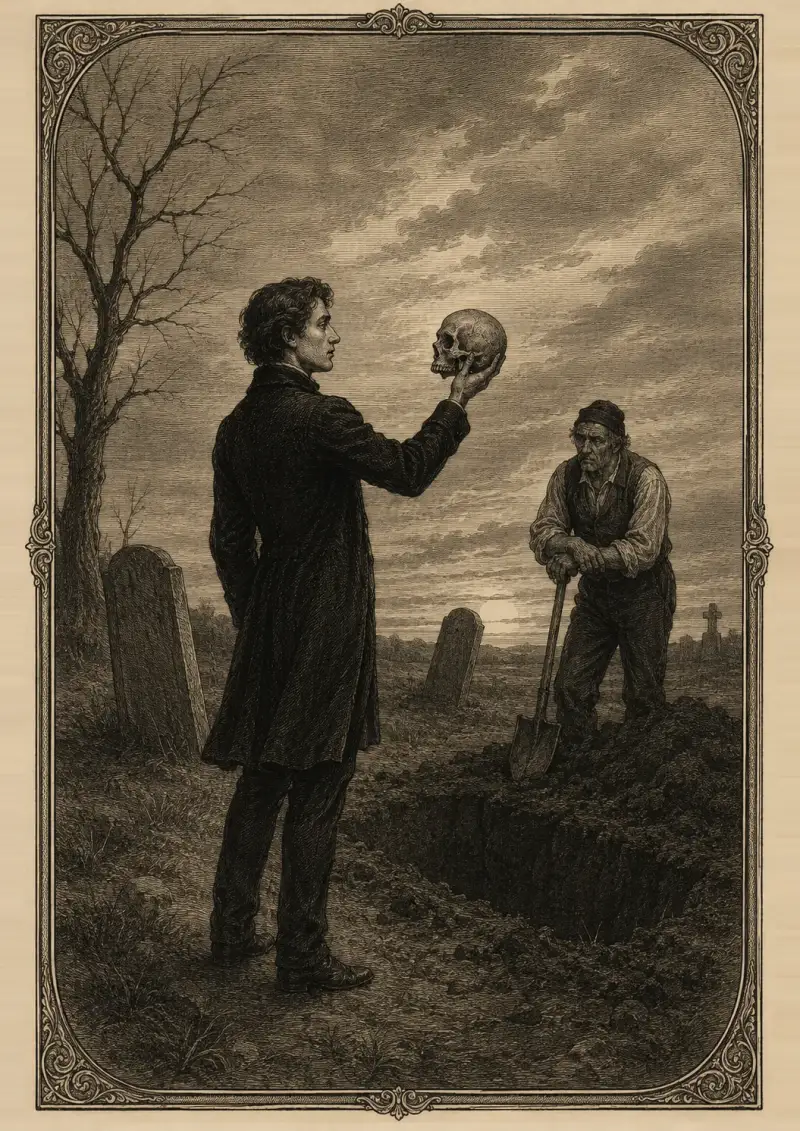
In the graveyard Hamlet jokes with a gravedigger, holds the skull of the jester Yorick, and discovers that the grave is Ophelia’s. He has sent Rosencrantz and Guildenstern to the death intended for him, and accepts the duel calmly. Gertrude drinks the poisoned cup; Hamlet and Laertes are both wounded with the poisoned blade; Hamlet kills Claudius at last and dies. Fortinbras takes the throne, and Horatio is left to tell the story.
Characters
Hamlet
Prince, student and reluctant avenger. His intelligence is his burden: he cannot act without examining the act. He moves from disgust and self-reproach, through the violence of Act 3, to a strange calm in Act 5. His own diagnosis is the habit of thinking too precisely on th’ event
.
Claudius
Murderer, usurper and a capable king. Shakespeare refuses to make him a monster: he is diplomatic, affectionate to Gertrude and tormented by guilt, admitting in private, O, my offense is rank, it smells to heaven
. He cannot repent because he will not give up what he gained, and his methods narrow to poison and plotting.
Gertrude
Hamlet’s mother, remarried within two months of her husband’s death. The play never tells us whether she knew of the murder, and that silence is deliberate. We mostly see her through Hamlet’s revulsion: frailty, thy name is woman
. She dies drinking the cup meant for her son.
Ophelia
Daughter of the spying counsellor Polonius, used by every man around her: as bait by her father and the King, as a target by Hamlet. Her obedience is summed up in I shall obey, my lord.
Only in madness does she speak freely, in songs of death and betrayed love.
Horatio
Hamlet’s fellow student and only confidant, the steady point against which Hamlet’s turmoil is measured. Hamlet praises in him the balance he lacks: Give me that man / That is not passion’s slave
. Horatio survives to report the truth.
Laertes and Fortinbras
Two more sons with dead fathers, and so two foils (characters whose likeness to the hero highlights a difference). Laertes acts at once and without scruple, ready To cut his throat i’ th’ church.
Fortinbras turns grievance into disciplined action and ends with the crown.
Themes
Revenge and delay
Claim: the play asks less why Hamlet fails to take revenge than whether revenge can ever be a clean act. The Ghost’s command is simple: Revenge his foul and most unnatural murder.
Hamlet’s objections are moral and practical by turns: the Ghost may lie; a killing at prayer would be hire and salary, not revenge
. Laertes shows unhesitating revenge, and it is ugly. By Act 5 Hamlet stops planning and lets the moment come.
Seeming and being
Claim: Elsinore is a court of performers, and Hamlet fights it with performance. He begins by rejecting whatever seems
, then feigns madness and uses a play as a lie detector. Claudius proves that one may smile and smile and be a villain
. The theme develops from an insistence on sincerity to an acceptance that truth must be caught indirectly.
Madness
Claim: Shakespeare sets a pretended madness beside a real one so that each questions the other. Hamlet says he is mad in craft
, but his cruelty to Ophelia and the killing of Polonius look less controlled than he claims. Note the politics: for Claudius, Madness in great ones must not unwatched go.
The label licenses surveillance.
Corruption and disease
Claim: one hidden crime poisons a whole state. King Hamlet died from poison poured in his ear, and the imagery spreads the infection: the world is an unweeded garden
, Denmark is rotten, Claudius’s guilt is rank. The pattern develops from metaphor to event. In the final scene poison is literally on the sword and in the cup.
Mortality
Claim: Hamlet’s thinking about death moves from abstraction to acceptance. In Act 1 he wishes his flesh would melt. In the “To be, or not to be” soliloquy death is an unknown that frightens the will. In the graveyard it is a skull he can hold. After that he can say Let be.
Compare the bleaker “Tomorrow” speech in Macbeth.
Key quotations
Ten short passages for almost any question. Meeting lines singly helps them stick, which is the idea behind Daily Bard: one passage a day, checked against the Folger text, with a plain-English reading on the back of the leaf.
But I have that within which passes show,
Hamlet · Act 1, Scene 2
These but the trappings and the suits of woe.
Plain English: What I feel inside is beyond any outward display; black clothes are only the costume of grief.
The vocabulary is theatrical: show
, trappings
, suits
. Hamlet separates inner truth from outward performance in a rhyming couplet that is itself a polished piece of public speaking. The irony is structural: the man who refuses to “seem” will soon adopt a disguise of madness.
O, that this too, too sullied flesh would melt,
Hamlet · Act 1, Scene 2
Thaw, and resolve itself into a dew,
Plain English: I wish my stained body would simply dissolve into water and vanish.
The first soliloquy opens with a wish not to exist, before Hamlet knows of any murder. Three verbs, melt
, Thaw
, resolve
, imagine a death without violence or sin. sullied
(the early texts differ, and some editors print “solid”) makes the body a contaminated thing. This supports reading his paralysis as grief and disgust that predate the Ghost.
Something is rotten in the state of Denmark.
Marcellus · Act 1, Scene 4
Plain English: There is a deep corruption in this country.
A soldier, not a prince, says it, so unease has spread beyond the royal family. rotten
is organic decay: hidden, spreading, smelt before it is seen. state
means both the nation and its condition. The line plants the play’s disease imagery and links private crime to public health.
The time is out of joint. O cursed spite
Hamlet · Act 1, Scene 5
That ever I was born to set it right!
Plain English: The age is dislocated like a bone, and it is my bad luck to be the one who has to reset it.
The metaphor is surgical. Hamlet sees his task as repairing a whole era, far larger than killing one man, and he resents it. The rhyme of spite
and right
binds duty to bitterness. Minutes after swearing vengeance he already calls it a curse.
The play’s the thing
Hamlet · Act 2, Scene 2
Wherein I’ll catch the conscience of the King.
Plain English: I will use the performance as a trap to expose the King’s guilt.
A confident couplet ends a soliloquy full of self-contempt. catch
is a hunting word; the play is bait. Hamlet chooses evidence over the Ghost’s word, a rational move that also postpones the killing.
To be or not to be - that is the question:
Hamlet · Act 3, Scene 1
Whether ’tis nobler in the mind to suffer
The slings and arrows of outrageous fortune,
Plain English: To live or not to live: is it nobler to endure what fortune throws at us?
The infinitives make this general, not personal: Hamlet never says “I”. The first line runs to eleven syllables, ending on an unstressed beat (a feminine ending) that leaves the question hanging. The speech concludes Thus conscience does make cowards of us all
: thought stops action. See the full essay on this soliloquy.
My words fly up, my thoughts remain below;
Claudius · Act 3, Scene 3
Words without thoughts never to heaven go.
Plain English: I said the prayer but did not mean it, and empty words do not reach heaven.
Antithesis (opposed ideas in balanced phrasing) splits the line: up
against below
, words against thoughts. The couplet delivers bitter dramatic irony. Hamlet spared Claudius because he seemed to be in a state of grace; we now learn he was not.
Alas, poor Yorick! I knew him, Horatio - a fellow of infinite jest,
Hamlet · Act 5, Scene 1
Plain English: Poor Yorick. I knew him, Horatio: a man of endless humour.
Often misquoted as “I knew him well”. The passage is prose, plain and intimate. Death has been an idea for four acts; now it is a particular person Hamlet knew as a child. infinite
sits against the finite object in his hand. The skull is a memento mori (a reminder of death) and prepares the acceptance of the final scene.
There is a special providence in the fall of a sparrow. ... The readiness is all.
Hamlet · Act 5, Scene 2
Plain English: Even a sparrow’s death is part of God’s design. What matters is to be ready.
The allusion is biblical: not a sparrow falls without God’s knowledge. Hamlet’s sentences become short, balanced and calm; the anguished questions are gone. Whether this is faith, fatalism or exhaustion, he no longer tries to script events, only to meet them.
Now cracks a noble heart. Good night, sweet prince,
Horatio · Act 5, Scene 2
And flights of angels sing thee to thy rest.
Plain English: A noble heart breaks. Good night, dear prince; may angels sing you to your rest.
After Hamlet’s last words, the rest is silence
, Horatio answers with sound: singing angels. The tenderness of sweet prince
offers a blessing the play cannot confirm, since Hamlet dies with several deaths on his hands. rest
echoes Hamlet’s final pun.
Language, form and structure
Verse and prose. Most of the play is in blank verse: unrhymed iambic pentameter, ten syllables alternating unstressed and stressed. Hamlet drops into prose when he plays the madman and when he talks to the players, the gravedigger and his false friends. Track when he changes and whom he is with.
Soliloquy. A soliloquy is a speech delivered alone, giving the audience direct access to thought. Hamlet’s are arguments with himself, full of questions and reversals. Because we hear them, and Claudius’s confession too, we know more than the court does. That gap is dramatic irony.
Wordplay. Hamlet’s first line is a pun: A little more than kin and less than kind
. Puns are his weapon in a court where he cannot speak openly. The play also likes pairs joined by “and”, as in the book and volume of my brain
.
Imagery. Follow three patterns: disease and rot, acting and costume, and ears (the poison enters through an ear, and the court is full of listeners). The close reading toolkit gives a method for annotating such patterns, and the guide to Shakespeare’s language explains the vocabulary.
Structure. The play within the play sits at the centre, dividing a first half of doubt from a second half of consequences. Three avenging sons form parallel plots.
Critical perspectives
The Romantic Hamlet
Goethe and Coleridge saw a fine, reflective mind unsuited to the brutal task laid on it; for Coleridge, endless thinking uses up the energy that action needs. The soliloquies support this; challenge it with the Hamlet who kills Polonius in an instant and sends two former friends to execution.
A. C. Bradley
Bradley argued that the cause is not thought itself but melancholy: his mother’s remarriage has sickened Hamlet’s view of life before the Ghost speaks. The first soliloquy is strong evidence. The objection is that Bradley treats a dramatic character as a patient with a case history.
Psychoanalytic readings
Freud, followed by Ernest Jones, proposed that Hamlet cannot kill Claudius because Claudius has done what the son unconsciously wished to do. This accounts for the intensity of the closet scene. It cannot be proved from the text, and it sets aside the reasons Hamlet gives.
Feminist readings
Feminist critics observe that Gertrude and Ophelia are known to us largely through what men say about them, and that Ophelia’s long history on stage and in painting has made her an image more than a voice. Test this by listing what each woman says for herself.
Historicist readings
Stephen Greenblatt and other new historicists read the Ghost against the Reformation: a spirit from purgatory in a culture told that purgatory did not exist. On this view the play is about how the living remember the dead.
Essay questions
GCSE style
- How does Shakespeare present Hamlet’s feelings about his mother’s remarriage?
- Explore how Shakespeare presents Claudius as both a villain and a capable king.
- How does Shakespeare use the Ghost to create tension and uncertainty?
A-level and IB style
- “Hamlet’s madness is less a disguise than a release.” How far do you agree?
- Examine the view that the women of the play are defined entirely by the men around them.
- To what extent is Hamlet a play about the impossibility of certain knowledge?
AP Literature style
- Choose a moment in which Hamlet decides not to act. Analyse how that choice illuminates the meaning of the work as a whole.
- Analyse how a foil character (Laertes, Fortinbras or Horatio) clarifies the values of the protagonist.
- Discuss how the play within the play contributes to the work’s treatment of truth and performance.
Undergraduate
- How does Hamlet use and resist the conventions of revenge tragedy?
- Discuss the significance of the play’s multiple early texts for interpretations of Hamlet’s delay.
- “The Ghost is the play’s central interpretative problem.” Discuss with reference to Reformation debates about the dead.
Planning a top-band answer
Decide your argument before you choose your quotations. A strong essay takes a position in its first sentence, analyses a few short quotations closely, and gives one paragraph to a counter-view. The essay planner gives you a one-page frame, and the assessment map shows what each course rewards. For a comparison of tragic conscience, read the Macbeth study guide: Hamlet thinks before a killing, Macbeth after one.
Revision checklist
- I can summarise each act in two sentences and name its turning point.
- I can explain why a Protestant prince might doubt a ghost from purgatory.
- I can give two interpretations of Hamlet’s delay, with evidence for and against each.
- I can compare Hamlet with Laertes and Fortinbras as avenging sons.
- I can trace the imagery of disease and poison from Act 1 to Act 5.
- I can discuss how Ophelia and Gertrude are presented, and by whom.
- I can quote ten short passages accurately and say one precise thing about each.
- I can explain how Hamlet’s attitude to death changes by Act 5.
Memorise little and often. Print the Hamlet quotation sheet and test yourself for five minutes a day, saying the lines aloud so that the rhythm does some of the remembering. Teachers will find the same passages in the Hamlet lesson plans, and this guide is available as a printable PDF. A daily page from the Daily Bard app keeps Shakespeare’s language in your ear between study sessions.

A page of Shakespeare, every day.
This resource comes from Daily Bard, an app for iPhone and iPad. Each morning it shows one engraved plate and one passage, exactly as Shakespeare wrote it, with a plain-English reading on the back of the leaf.
Free to download. The Full Edition is a one-time US$11.99: no subscription, no account, no ads, no tracking.
Get it on the App Store: apps.apple.com/app/id6792967225
More free study guides, lesson plans and close readings: dailybard.app