
- Level
- Ages 14-18 (GCSE, A-level, AP Lit, IB); adaptable for first-year seminars
- Sequence
- 3 lessons of 60 minutes
- Focus
- Hamlet’s delay: grief in Act 1, the prayer scene in Act 3, acceptance in Act 5
- You will need
- Copies of the play, the printed worksheet, highlighters, mini whiteboards or paper
Hamlet: three lesson plans (PDF)
PDF, 10 pages, 1.1 MB. Free, no sign-up, made to be printed.
Teach it alongside the Hamlet study guide and the quotation sheet (PDF).
Overview
This sequence tracks Hamlet at three points: before the Ghost speaks (Act 1, Scene 2), at the moment he could kill Claudius and does not (Act 3, Scene 3), and in the calm before the duel (Act 5, Scenes 1 and 2). Students build an argument about his delay from close reading, not from a ready-made label. It works best once the class knows the plot; the act summaries in the Hamlet study guide are enough preparation.
- Students will be able to analyse how Shakespeare’s choices of word, image and verse form present Hamlet’s state of mind.
- Students will be able to explain how beliefs about revenge, the afterlife and repentance shape the prayer scene.
- Students will be able to compare two moments in the play to show how a character develops.
- Students will be able to weigh at least two interpretations of Hamlet’s delay.
Assessment focus. The lessons practise the three things every literature course rewards: a clear personal argument supported by apt quotation (AO1), analysis of language, form and structure (AO2), and context used to illuminate meaning (AO3). Lesson 2 and the worksheet’s final question introduce competing interpretations for older students. The assessment map sets out how these skills are weighted in different courses.
Lesson 1: Before the Ghost - grief and performance in Act 1, Scene 2
Key question: What is wrong with Hamlet before he knows there has been a murder?
- Contrast Claudius’s public language with Hamlet’s private language.
- Analyse the first soliloquy for word choice, imagery and broken syntax.
| Time | Activity | Why |
|---|---|---|
| 0-8 min | Starter. Display Claudius’s phrase With an auspicious and a dropping eye. Ask: can one face do both? What kind of speaker balances a funeral and a wedding in one sentence? | Establishes the court as a place of polished performance. |
| 8-18 min | Teaching input. Read Hamlet’s reply to Gertrude ending But I have that within which passes show. Define soliloquy and blank verse. Model annotating the theatrical words (play, show, trappings, suits). | Gives the terms and a worked example before independent work. |
| 18-35 min | Main task. Pairs annotate the first soliloquy, from O, that this too, too sullied flesh would meltto But break, my heart, for I must hold my tongue.Three colours: words of decay, comparisons of the two kings, places where the sentence breaks off. | Students find the patterns themselves. |
| 35-47 min | Discussion. What disgusts Hamlet most: the death, the marriage or its speed? Why does Shakespeare let the sentences keep interrupting themselves? What can Hamlet not say in public? | Moves from spotting features to explaining effects. |
| 47-55 min | Writing. One paragraph using the stem: “Before the Ghost appears, Shakespeare presents Hamlet as ... through ..., which suggests ...”. | Secures the reading in analytical prose. |
| 55-60 min | Plenary. On whiteboards: one word for Hamlet’s state of mind and the quotation that proves it. | Quick check of every student. |
Differentiation
- Support: provide a glossed copy of the soliloquy and the first highlight in each colour.
- Core: annotate independently and write the paragraph with two embedded quotations.
- Stretch: consider A. C. Bradley’s view that Hamlet’s melancholy, caused by his mother’s remarriage, comes before and explains his later inaction. Does this soliloquy support it?
Assessment and homework
The whiteboard plenary and the paragraph show whether students can link a specific word to a state of mind. Homework: learn two lines from the soliloquy and write three sentences on why Shakespeare gives us Hamlet’s despair before the revenge plot begins.
Lesson 2: The prayer scene - why does Hamlet not strike?
Key question: Is Hamlet’s reason for sparing Claudius in Act 3, Scene 3 a reason or an excuse?
- Explain the religious ideas behind Hamlet’s decision.
- Analyse how dramatic irony shapes the audience’s judgement.
- Evaluate two interpretations of the delay.
| Time | Activity | Why |
|---|---|---|
| 0-8 min | Starter. Recap in pairs: what has the play within the play just proved? Then read Claudius’s line May one be pardoned and retain th’ offense?and ask what he would have to give up. | Fixes the situation: Hamlet now has proof, and Claudius has a conscience. |
| 8-18 min | Teaching input. Explain briefly: a soul’s fate was thought to depend on its state at death; the Ghost died without the chance to repent. Define dramatic irony. Read Hamlet’s speech aloud twice, once fast, once slowly. | Context is taught only as far as the passage needs it. |
| 18-35 min | Main task. Students complete questions 1 to 6 of the worksheet below, individually and then checking in pairs. | Structured close reading from comprehension to analysis. |
| 35-47 min | Discussion. Reveal Claudius’s final couplet. Take question 7 as a class. Then a line-up debate: stand nearer one wall for “reason”, the other for “excuse”, and justify your place with a quotation. | Makes interpretation visible and requires evidence. |
| 47-55 min | Writing. Question 8 as a short evaluative paragraph. | Practises weighing a view. |
| 55-60 min | Plenary. Exit ticket: “The most important word in Hamlet’s speech is ... because ...”. | Checks precision of analysis. |
Differentiation
- Support: a version of the passage with marginal glosses (pat: conveniently; scanned: examined; hent: occasion to seize); sentence stems for question 8.
- Core: all eight questions, with quotations embedded in answers.
- Stretch: compare Hamlet with Laertes, who says he would
cut his throat i’ th’ church
. Which of them does the play ask us to admire?
Assessment and homework
Collect the evaluative paragraphs and mark against the worksheet’s success criteria. Homework: read the essay on “To be, or not to be” and note one link between that soliloquy’s fear of the afterlife and Hamlet’s reasoning here.
Lesson 3: “The readiness is all” - how Hamlet changes in Act 5
Key question: Has Hamlet solved his problem by Act 5, or stopped trying to?
- Compare Hamlet’s language about death in Act 1 and Act 5.
- Analyse the effect of prose and short sentences in the graveyard and before the duel.
| Time | Activity | Why |
|---|---|---|
| 0-8 min | Starter. Project today’s page from Daily Bard (or any short passage). Students have two minutes to put it into plain English before you turn the leaf to compare. Then recall the two lines learned in Lesson 1. | A routine for unseen practice, and retrieval of earlier learning. |
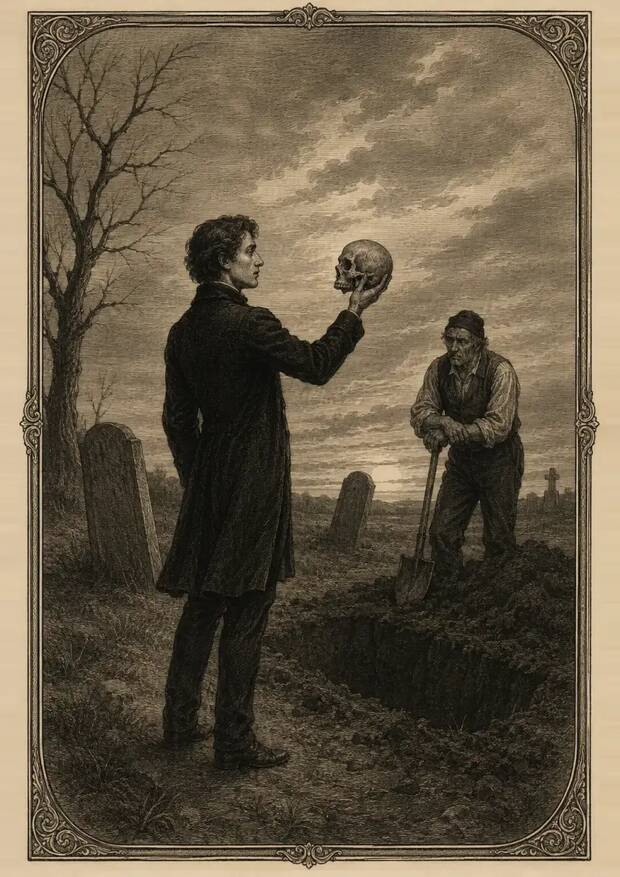
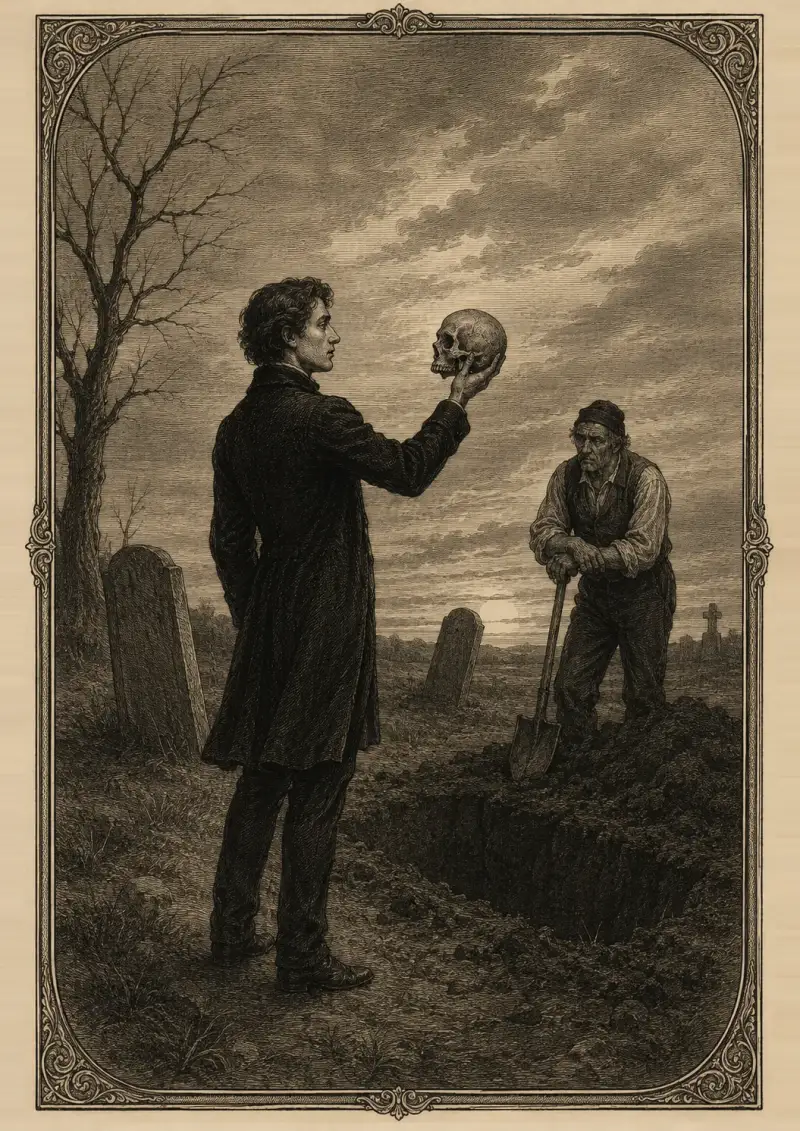
| 8-18 min | Teaching input. Read the Yorick passage in Act 5, Scene 1, from Alas, poor Yorick!to Make her laugh at that.Explain memento mori. Ask why this is prose. | Shows death becoming concrete and personal. |
| 18-35 min | Main task. Comparison grid in pairs. Left column: Act 1, Scene 2 soliloquy. Right column: Act 5, Scene 2, from We defy augury.to Let be.Rows: sentence length, questions or statements, attitude to death, attitude to God. | Structured comparison makes development visible. |
| 35-47 min | Discussion. Is The readiness is allfaith, fatalism or exhaustion? Does There’s a divinity that shapes our endsexcuse him from responsibility? Has he earned this calm? | Opens the interpretative question. |
| 47-55 min | Writing. A comparative paragraph: “In Act 1 Hamlet ..., whereas by Act 5 ...”. Success criteria: one quotation from each act, one comment on form, one interpretation. | Applies the whole sequence. |
| 55-60 min | Plenary. Vote, then justify: solved or stopped trying? | Forces a final judgement. |
Differentiation
- Support: a partly completed grid with quotations supplied.
- Core: complete the grid and write the comparative paragraph.
- Stretch: add a third column for the Act 3 passage from Lesson 2 and argue where the real change happens.
Assessment and homework
The comparative paragraph is the assessed outcome for the sequence. Homework: plan, in bullet points, an answer to “How does Shakespeare present Hamlet’s attitude to death?” using the essay planner. As a low-stakes continuing habit, students with an iPhone or iPad can read the day’s passage in the Daily Bard app and bring one unfamiliar word to the next lesson.
Student worksheet: Hamlet spares the King
Claudius has just tried to pray. Hamlet, on the way to his mother’s room, finds him kneeling and alone.
HAMLET Now might I do it pat, now he is a-praying,
Hamlet · Act 3, Scene 3
And now I’ll do ’t. And so he goes to heaven,
And so am I revenged. That would be scanned:
A villain kills my father, and for that,
I, his sole son, do this same villain send
To heaven.
Why, this is hire and salary, not revenge.
...
Up sword, and know thou a more horrid hent.
When he is drunk asleep, or in his rage,
Or in th’ incestuous pleasure of his bed,
At game, a-swearing, or about some act
That has no relish of salvation in ’t -
Then trip him, that his heels may kick at heaven,
And that his soul may be as damned and black
As hell, whereto it goes.
...
KING My words fly up, my thoughts remain below;
Words without thoughts never to heaven go.
- What does Hamlet intend to do in the first two lines?
- In your own words, why would killing Claudius now be
hire and salary, not revenge
? - What does the phrase
That would be scanned
suggest about the way Hamlet’s mind works? - List the occasions Hamlet says he will wait for. What do they have in common?
- How do the verb
trip
and the image of heels thatkick at heaven
present the revenge Hamlet imagines? - Find the very short line in the first half of the speech. What is the effect of the pause it creates?
- Read the King’s couplet. How does it change your view of the decision Hamlet has just made? Use the term dramatic irony.
- “Hamlet’s reason for sparing Claudius is only an excuse for not acting.” How far do you agree?
Writing task
Write one paragraph answering question 8. Success criteria:
- a clear opening judgement;
- at least two short quotations, embedded in your sentences;
- analysis of one specific word or image;
- one reference to beliefs about death and repentance;
- a sentence that considers the opposite view.
Teacher notes and indicative answers
- To kill Claudius immediately; the chance is convenient and he draws his sword.
- Claudius is praying, so his soul may be clean and would go to heaven. Hamlet would be doing him a service, like a paid servant, when his own father died unprepared.
- He stops to examine his own impulse. The decision becomes an argument, the habit of mind seen in every soliloquy.
- Drunkenness, rage, lust, gambling, swearing: all sins, moments with no trace of grace. Hamlet wants to choose the state of Claudius’s soul.
- The verb is physical and almost comic, the image grotesque: a body tumbling head first into hell. Hamlet takes on the role of a judge, which may shock us.
To heaven.
stands alone, and the silence after it is the moment the thought sinks in and the plan turns.- Claudius could not pray sincerely, so he was not in a state of grace. Hamlet’s reasoning rested on a false appearance, and the audience learns it seconds too late: dramatic irony.
- Reward any argued position. For “excuse”: the pattern of delay, the speed with which he finds an objection. For “reason”: the logic is consistent with the Ghost’s own complaint, and minutes later he stabs through the arras without hesitation.
Model paragraph
Hamlet’s decision to spare Claudius is better understood as a terrible kind of thoroughness than as an excuse. He rejects the easy killing as hire and salary, not revenge
, the language of wages reducing the act to a servant’s errand. What he wants instead is to trip him
in a moment of sin so that his soul is damned and black
, a wish that reaches beyond justice into cruelty. Some critics see only rationalised delay, and the pattern of postponement supports them. Yet the reasoning matches the Ghost’s grievance that he died unprepared, and Claudius’s closing couplet makes the scene’s irony plain: the hesitation was real, and it was wasted.
Extending the sequence
For a fourth lesson, set the same question against the Act 4 soliloquy and the foils Laertes and Fortinbras, using the character notes in the study guide. The Hamlet quotation sheet works well for weekly retrieval quizzes, and the close reading toolkit gives students a repeatable method for unseen passages. For comparative work on how tragic heroes face death, pair this sequence with the essay on “Tomorrow and tomorrow and tomorrow” or with the Macbeth lesson plans. A printable copy of these plans is available as a PDF.

A page of Shakespeare, every day.
This resource comes from Daily Bard, an app for iPhone and iPad. Each morning it shows one engraved plate and one passage, exactly as Shakespeare wrote it, with a plain-English reading on the back of the leaf.
Free to download. The Full Edition is a one-time US$11.99: no subscription, no account, no ads, no tracking.
Get it on the App Store: apps.apple.com/app/id6792967225
More free study guides, lesson plans and close readings: dailybard.app