
- Written
- c. 1595
- Genre
- Tragedy (with a comic first half)
- Setting
- Verona and Mantua, Italy
- Form
- Verse drama: blank verse, rhyme, sonnets and prose
- Structure
- Prologue and five acts; the action takes about four days
- Studied for
- GCSE, A-level, AP Literature, IB, undergraduate surveys
Romeo and Juliet: study guide (PDF)
PDF, 12 pages, 1.1 MB. Free, no sign-up, made to be printed.
Also for Romeo and Juliet: quotation sheet (PDF), three lesson plans.
Context
Shakespeare wrote Romeo and Juliet around 1595, early in his career and at the height of the English fashion for love sonnets. He did not invent the story. His main source was Arthur Brooke’s long narrative poem The Tragicall Historye of Romeus and Juliet (1562), itself drawn from Italian and French versions. Brooke’s story unfolds over months and his preface warns readers against disobedient lovers. Shakespeare made two decisive changes: he compressed the action into about four days, and he made Juliet younger, not yet fourteen. Both changes sharpen the play’s central feeling that everything happens too soon.
Petrarchan love
Elizabethan love poetry descended from the Italian poet Petrarch: a suffering lover, a cold and distant lady, and a stock of paradoxes about freezing fires. Romeo begins the play as this figure, sighing over Rosaline in borrowed phrases. When he meets Juliet the convention is rewritten, because she answers back. Their first exchange is a shared sonnet. Our guide to the Sonnets explains the form.
Fathers, daughters and marriage
In a patriarchal household a daughter’s marriage was her father’s business, and a good match advanced the family. Capulet at first tells Paris that Juliet’s consent matters; by Act 3 he is threatening to throw her into the street. The play does not simply condemn or endorse him. It shows how quickly a loving father becomes a tyrant when his authority is refused.
Fate, religion and honour
Many Elizabethans took astrology seriously, so star-crossed
is not a dead metaphor. At the same time the Church taught free will and treated suicide as a mortal sin, which gives the Friar’s schemes and the lovers’ deaths a moral charge a modern audience can miss. The feud runs on a code of masculine honour in which an insult must be answered with a sword.
Plot summary
Act 1
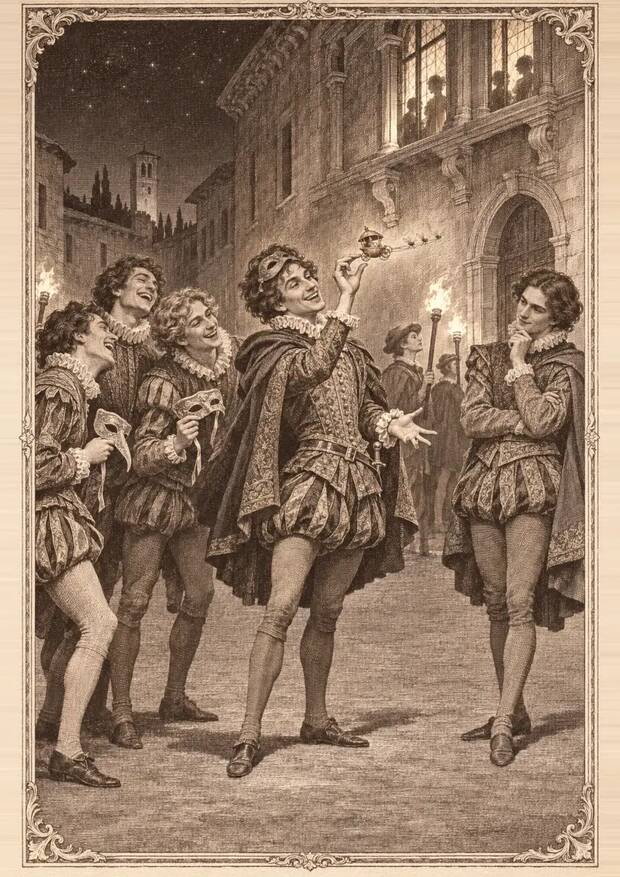
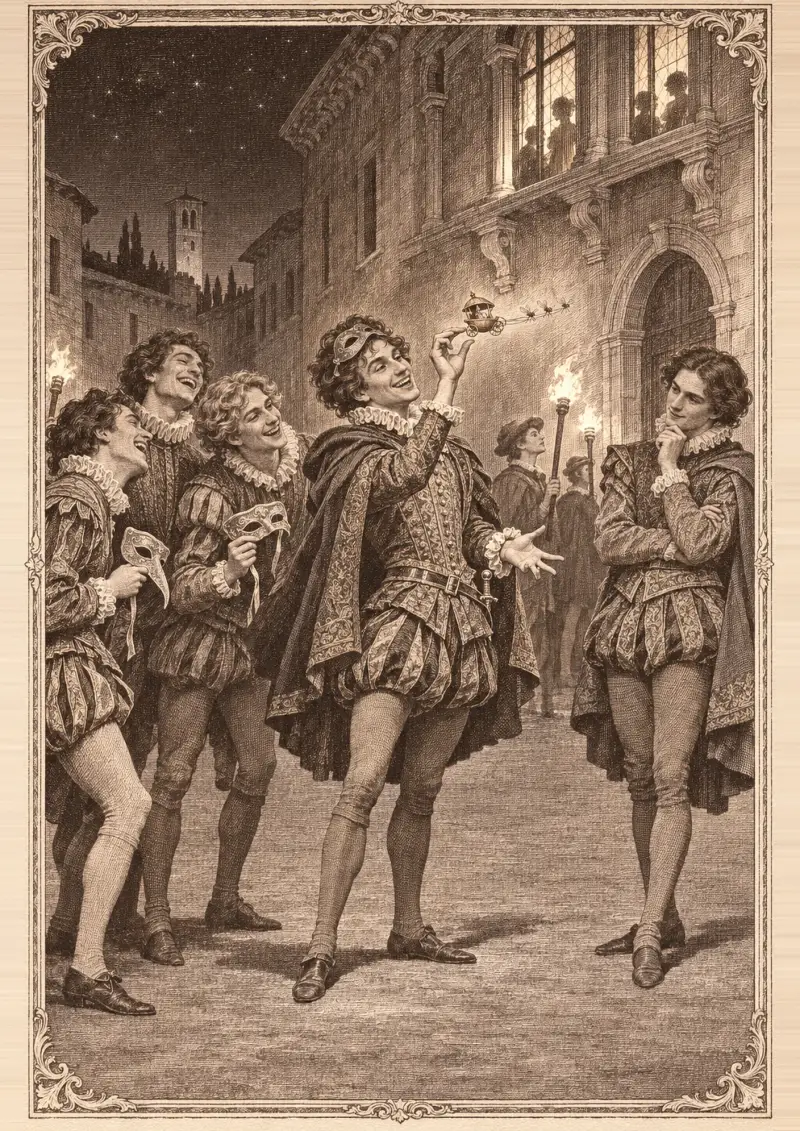
A street brawl between Montague and Capulet servants draws in Benvolio, Tybalt and both fathers. The Prince decrees death for anyone who fights again. Romeo is lovesick for Rosaline. Paris asks to marry Juliet, and Capulet invites him to that night’s feast. Romeo attends in a mask, sees Juliet and forgets Rosaline at once. They speak, kiss, and only afterwards learn each other’s names. The turning point is the meeting, where love arrives already entangled with the feud.
Act 2
Romeo climbs into the Capulet orchard and overhears Juliet at her window. They exchange vows, and it is Juliet who proposes marriage. Friar Lawrence agrees to marry them, hoping the match will end the feud. The Nurse carries messages, and the lovers are married in secret that afternoon. The turning point is the wedding: a private bond now exists that no one in public knows about.
Act 3
Tybalt challenges Romeo, who refuses to fight his new kinsman. Mercutio fights instead and is fatally wounded under Romeo’s arm. Romeo kills Tybalt in revenge and is banished. After one night together the lovers part at dawn. Capulet, unaware of the marriage, promises Juliet to Paris; when she refuses he rages, and the Nurse advises her to marry Paris anyway. Mercutio’s death is the hinge of the whole play: comedy stops and tragedy begins.
Act 4
Juliet goes to the Friar, ready to die. He gives her a potion that will counterfeit death for forty-two hours, and promises to send word to Romeo in Mantua. Juliet pretends to submit, and her delighted father brings the wedding forward a day. Alone, facing her terrors of the vault, she drinks. In the morning the household finds her apparently dead. The turning point is the potion: the plan now depends entirely on a letter.
Act 5
The letter never arrives, because Friar John is quarantined. Romeo hears only that Juliet is dead, buys poison and rides to Verona. At the tomb he kills Paris, drinks the poison and dies. Juliet wakes, the Friar flees, and she stabs herself with Romeo’s dagger. Over the bodies the Friar explains everything, and the fathers take hands.
Characters
Romeo
Romeo begins as a parody of the Petrarchan lover and becomes a man who acts. The change shows in his language, which moves from stale paradox to plain statement. His flaw is speed: he loves, marries, kills and dies in haste. After killing Tybalt he sees himself as a plaything, O, I am Fortune’s fool!
, but the audience has watched him choose.
Juliet
Juliet grows faster than anyone. The obedient child of Act 1, who promises I’ll look to like, if looking liking move
, becomes the play’s clearest thinker. She questions names, proposes marriage, defies her father and takes the potion alone. Her isolation is complete by the end of Act 3, when she concludes myself have power to die
.
Mercutio
Kinsman to the Prince and neither Montague nor Capulet, Mercutio is the play’s wit and its sceptic. He mocks love as appetite and dreams as the children of an idle brain
. His death removes the comic voice from the play, and his curse on both houses names the feud, not fate, as the killer.
Tybalt
Tybalt is the feud in a single body. He has few lines and one mode: What, drawn and talk of peace? I hate the word
. He matters structurally more than psychologically, because his challenge forces Romeo to choose between love and honour.
Friar Lawrence
The Friar is a well-meaning schemer. He preaches moderation, Wisely and slow. They stumble that run fast
, yet marries the lovers within a day and stakes two lives on a potion and a letter. At the tomb he runs away. He is the play’s test case for whether good intentions excuse bad judgement.
The Nurse and Capulet
These are Juliet’s two failed protectors. The Nurse is warm, bawdy and practical, and her advice to marry Paris ends Juliet’s trust in her: Ancient damnation
. Capulet swings from indulgence to fury.
Themes
Love and its languages
The play argues that true love is recognised by a change in speech. Romeo’s love for Rosaline is all oxymoron and self-display. With Juliet the imagery becomes shared and reciprocal, and she repeatedly pulls him towards plain truth: O, swear not by the moon
. Love then develops from a holy game in Act 1 to a marriage in Act 2 and a deathbed in Act 5, where the same images of light return in a tomb.
Fate and free will
The Prologue tells us the ending, so the question is never what will happen but why. The lovers blame the stars, and accidents (an illiterate servant, an undelivered letter) certainly matter. Yet at every crisis someone makes a hasty choice. The strongest essays hold both ideas: Shakespeare builds a world where chance is deadly because people are rash.
Violence, honour and the feud
Nobody in the play knows what the ancient grudge
is about. It survives as habit, passed from masters to servants and from old men to young ones, and it is bound up with a sexual swagger audible in the first scene’s jokes. The feud escalates from thumb-biting to five deaths, and it ends only when it has nothing left to spend.
Youth, age and haste
The play sets impatient young people against slow, forgetful elders. Time is the pressure in almost every scene: Juliet waiting for the Nurse, the dawn after the wedding night, the wedding moved forward. Shakespeare’s compression of the source makes haste itself the tragic condition, summed up in Juliet’s own warning that their contract is too rash, too unadvised, too sudden
.
Key quotations
Ten short quotations, chosen because each one opens onto a theme. For a single famous line studied slowly, a daily page is a useful habit: Daily Bard shows one passage a day on iPhone and iPad, verified against the Folger text, with a plain-English reading on the back of the leaf.
From forth the fatal loins of these two foes
Chorus · Prologue
A pair of star-crossed lovers take their life;
Plain English: From these two enemy families come two lovers whom the stars oppose.
The Prologue is a sonnet, a love form used to announce deaths. The alliteration of forth the fatal
binds birth to doom, and take their life
is a pun: they are born from their parents and they kill themselves. Knowing the end, the audience watches every hopeful moment with dramatic irony.
Why then, O brawling love, O loving hate,
Romeo · Act 1, Scene 1
O anything of nothing first create!
Plain English: Love is a fight and hatred is a passion; everything is made out of nothing.
A string of oxymorons (contradictory terms yoked together) marks Romeo as the conventional Petrarchan lover, more in love with the pose than with Rosaline. Yet the lines are spoken as he surveys the brawl, so the clichés are accidentally accurate: in Verona love and hate really are tangled.
My only love sprung from my only hate!
Juliet · Act 1, Scene 5
Too early seen unknown, and known too late!
Plain English: The one man I love is the son of the one family I hate; I saw him before I knew who he was.
Antithesis (balanced opposites) organises both lines: love and hate, early and late, unknown and known. The rhyming couplet makes the discovery sound like a verdict. Juliet’s first response to love is to see its danger, which sets her apart from Romeo at once.
But soft, what light through yonder window breaks?
Romeo · Act 2, Scene 2
It is the East, and Juliet is the sun.
Plain English: Quiet: what is that light at the window? It is the dawn, and Juliet is the sun.
The metaphor makes Juliet the source of light and life, lifting her above the pale, chaste moon Romeo associated with Rosaline. The regular iambic pentameter sounds like wonder slowing into certainty. Our essay on “But soft, what light” follows the image through the scene.
What’s in a name? That which we call a rose
Juliet · Act 2, Scene 2
By any other word would smell as sweet.
Plain English: A name is only a label; a rose would smell the same whatever we called it.
Juliet reasons like a philosopher: names are arbitrary, so “Montague” should not matter. The tragedy proves her wrong, because in Verona a name can get you killed. Quote this to show her intelligence and her innocence together. See “What’s in a name?” for the full argument.
My bounty is as boundless as the sea,
Juliet · Act 2, Scene 2
My love as deep. The more I give to thee,
The more I have, for both are infinite.
Plain English: My generosity and my love are as limitless as the sea; giving them only increases them.
The simile replaces the Petrarchan economy of scarcity, where the lady withholds, with one of abundance. The paradox that giving creates more is the play’s best definition of mutual love, and it is spoken by the woman, plainly, in monosyllables.
These violent delights have violent ends
Friar Lawrence · Act 2, Scene 6
And in their triumph die, like fire and powder,
Which, as they kiss, consume.
Plain English: Intense pleasures end as intensely as they begin, like fire meeting gunpowder.
The repeated violent
ties passion to destruction, and the simile turns a kiss into an explosion. This is foreshadowing, spoken minutes before the wedding by the man conducting it, so it also exposes the Friar: he sees the danger and proceeds.
A plague o’ both your houses!
Mercutio · Act 3, Scene 1
Plain English: A curse on both your families.
Mercutio repeats the curse as he dies, and he dies in prose, joking about being a grave man
. He belongs to neither house, so his judgement has authority: the feud is the guilty party. The word “plague” becomes literal in Act 5, when quarantine stops the letter.
Hang thee, young baggage, disobedient wretch!
Capulet · Act 3, Scene 5
I tell thee what: get thee to church o’ Thursday,
Or never after look me in the face.
Plain English: Marry Paris on Thursday, you worthless girl, or I disown you.
Insults that reduce Juliet to goods, blunt imperatives and a flat ultimatum reveal patriarchal power stripped of affection. Compare the gentle father of Act 1, Scene 2. The contrast is the point: his love was conditional on obedience.
Then I deny you, stars!
Romeo · Act 5, Scene 1
Plain English: Then I reject you, fate.
Five monosyllables after the news of Juliet’s death. Romeo believes he is rebelling against destiny, yet by rushing to the tomb he completes exactly what the Prologue foretold. Many editions print “defy”; the Folger text used here reads deny
. Either way the irony holds.
Language, form and structure
Verse and prose. Most of the play is in blank verse: unrhymed iambic pentameter, ten syllables alternating unstressed and stressed. Servants, the Nurse at her most gossipy and Mercutio at his most mocking tend to speak prose. When Mercutio dies in prose the form itself refuses to dignify the feud.
Rhyme and the sonnet. This is one of Shakespeare’s most heavily rhymed plays. The Prologue is a sonnet, and so is the lovers’ first conversation in Act 1, Scene 5, where they share fourteen lines and seal them with a kiss. As the tragedy tightens, rhyme thins out and the verse grows plainer.
Imagery. Track three patterns: light against dark, religious language (pilgrims, saints, shrines) and the joining of love to death. Juliet’s early line My grave is like to be my wedding bed
is realised literally in the tomb, which Romeo calls a womb of death
.
Structure. The first two acts follow the shape of comedy: young lovers, obstructive parents, comic servants, a wedding. Act 3, Scene 1 breaks that shape. Scenes of public violence alternate with private love, and dramatic irony (the audience knowing more than the characters) governs the second half, most painfully when Romeo notes that Juliet does not look dead. For a method to apply to any passage, use the close reading toolkit; for terms, see the guide to Shakespeare’s language.
Critical perspectives
Tragedy of fate or tragedy of character?
The oldest debate about the play. Some critics have thought it a lesser tragedy because accident, not inner flaw, causes the catastrophe; A. C. Bradley left it out of his study of the four great tragedies. You can use this to frame an argument, then challenge it by showing how often haste, a quality of character, turns chance into disaster.
Feminist readings
Feminist critics such as Coppélia Kahn have read the feud as an expression of patriarchal masculinity, in which young men prove themselves through violence and daughters are exchanged between households. On this view Juliet’s wit and defiance are the play’s real rebellion. Test the reading against the ending, where she dies and the fathers speak.
Performance as interpretation
Franco Zeffirelli’s 1968 film cast very young actors and stressed youthful innocence; Baz Luhrmann’s 1996 film moved the feud to a modern city of guns and news broadcasts. Each is an argument about where blame lies.
Essay questions
GCSE style
- Starting with Juliet’s speech beginning
What’s in a name?
, explore how Shakespeare presents Juliet as a strong character in the play. - How does Shakespeare present the relationship between parents and children in Romeo and Juliet?
- Starting with Act 3, Scene 1, explore how Shakespeare presents conflict and its consequences.
A-level and IB style
- “The lovers are destroyed by their society, not by the stars.” How far do you agree?
- Examine the view that Juliet, not Romeo, is the tragic protagonist of the play.
- How does Shakespeare use the conventions of comedy to intensify the tragedy?
AP Literature style
- Choose a character who must reconcile a private loyalty with a public one. Analyse how that conflict contributes to the meaning of the work as a whole.
- Analyse how Shakespeare’s treatment of time shapes the audience’s understanding of the lovers’ choices.
- Discuss how a minor character serves as a foil to a major one and what the contrast reveals.
Undergraduate
- How does the play use and criticise the Petrarchan tradition?
- Consider the relationship between sonnet form and dramatic form in Romeo and Juliet.
- “The play manufactures the romantic ideal it appears to record.” Discuss.
Planning a top-band answer
Decide your argument before you choose your quotations, and make each paragraph a step in that argument. Move between a close detail and the whole play, and let context enter only where it explains a choice. The essay planner gives a one-page structure for this, and the assessment map shows in general terms what each course rewards.
Revision checklist
- I can summarise each act in two sentences and name its turning point.
- I can explain how Shakespeare changed his source and why the changes matter.
- I can trace how Romeo’s language changes after he meets Juliet.
- I can explain why Act 3, Scene 1 is the hinge of the play.
- I can argue both sides of the fate and free will debate with evidence.
- I can analyse the shared sonnet in Act 1, Scene 5 using correct terms.
- I can follow light and dark imagery from the feast to the tomb and explain why night becomes the lovers’ ally.
- I can compare Capulet in Act 1, Scene 2 with Capulet in Act 3, Scene 5.
- I can use one critical view and one staging choice to support an argument.
- I can recall ten short quotations and say something about method for each.
Learn quotations in fragments of four to eight words, grouped by theme, and test yourself by writing one sentence of analysis for each from memory. The printable Romeo and Juliet quotation sheet is laid out for exactly this, and the lesson plans include a worksheet on the shared sonnet. Little and often works better than cramming: reading the day’s page in Daily Bard keeps Shakespeare’s rhythms in your ear between revision sessions. It is a companion to the play, not a substitute for rereading it.

A page of Shakespeare, every day.
This resource comes from Daily Bard, an app for iPhone and iPad. Each morning it shows one engraved plate and one passage, exactly as Shakespeare wrote it, with a plain-English reading on the back of the leaf.
Free to download. The Full Edition is a one-time US$11.99: no subscription, no account, no ads, no tracking.
Get it on the App Store: apps.apple.com/app/id6792967225
More free study guides, lesson plans and close readings: dailybard.app