
- Written
- c. 1605-06
- Genre
- Tragedy
- Setting
- Ancient, pre-Christian Britain
- Form
- Blank verse, with prose and song for the Fool, Poor Tom and Lear’s madness
- Structure
- Five acts; a main plot (Lear and his daughters) mirrored by a subplot (Gloucester and his sons)
- Studied for
- A-level, AP Literature, IB, undergraduate surveys; sometimes GCSE
King Lear: study guide (PDF)
PDF, 12 pages, 1.1 MB. Free, no sign-up, made to be printed.
Also for King Lear: quotation sheet (PDF), three lesson plans.
Context
Shakespeare wrote King Lear around 1605-06, after Othello and close in time to Macbeth. It was performed at the court of James I in the Christmas season of 1606.
Sources, and the ending Shakespeare invented
The story of Lear and his three daughters was old and familiar, told in Holinshed’s Chronicles and staged in an earlier anonymous play, King Leir. In those versions the good daughter wins the war and the king is restored. Shakespeare denied his audience that ending. He also added the Gloucester subplot, adapted from an episode in Sidney’s Arcadia, so that the story of a father who misjudges his children happens twice.
Kingship and a divided kingdom
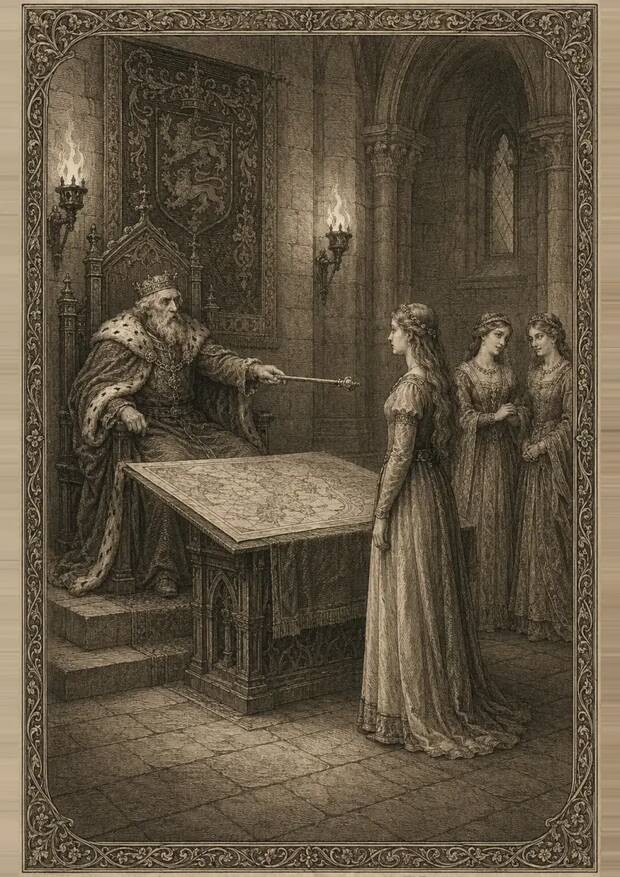
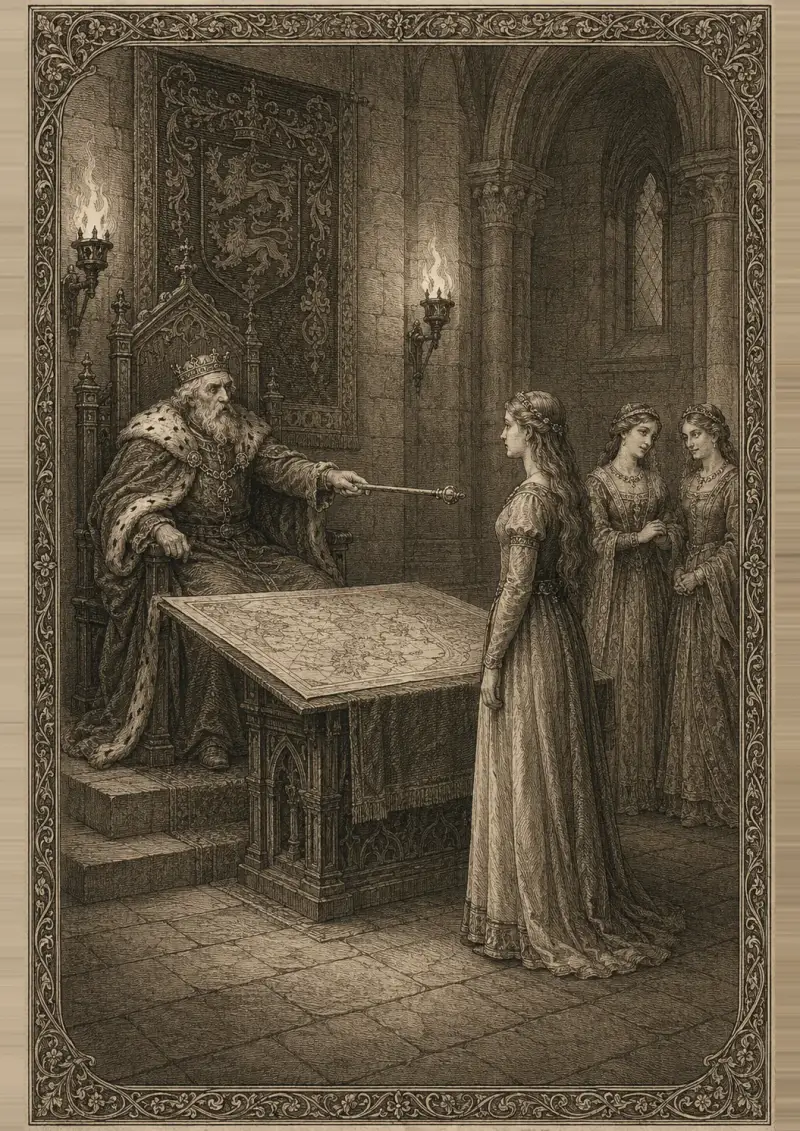
James I had recently united the crowns of England and Scotland and argued publicly for one Britain. A play that opens with a king cutting a map of Britain into pieces was showing the court its worst fear. Lear’s plan to keep The name and all th’ addition to a king
while giving away the power is a contradiction from the start.
Order, nature and the gods
Many in Shakespeare’s audience believed in a divinely ordered hierarchy, often called the Great Chain of Being, in which subjects owed obedience to kings and children to fathers. Lear and Gloucester assume this order is natural; Edmund argues that “nature” means appetite and ability, not custom. The pagan setting matters here: characters appeal to gods who never answer, so the play can ask whether justice is built into the universe without directly questioning Christian doctrine.
Two texts
The play survives in two early versions, the Quarto of 1608 and the Folio of 1623, which differ in hundreds of lines. Most modern editions, including the Folger text quoted here, combine them. It is worth knowing that the last speech is Edgar’s in the Folio and Albany’s in the Quarto.
Plot summary
Act 1
Lear divides his kingdom by a public love test. Goneril and Regan flatter him; Cordelia will not, and is disinherited. France marries her without a dowry, and Kent is banished for defending her. Gloucester’s bastard son Edmund forges a letter to turn his father against the legitimate Edgar. Kent returns in disguise to serve Lear. Turning point: Goneril demands that Lear reduce his hundred knights; he curses her and leaves for Regan.
Act 2
Edmund tricks Edgar into flight, and Gloucester names Edmund his heir. Edgar disguises himself as the mad beggar Poor Tom. Cornwall puts the disguised Kent in the stocks, an open insult to the King. Regan and Goneril join forces and bargain Lear’s followers down from a hundred to none. Turning point: Lear refuses their terms and walks out into the gathering storm; the doors are shut behind him.
Act 3
On the heath Lear rages at the storm, attended by the Fool and Kent. In a hovel he meets Poor Tom and his mind gives way; he begins, for the first time, to think about the poor. Gloucester helps the King escape towards Dover and is betrayed by Edmund. Turning point: Cornwall and Regan blind Gloucester on stage. A servant, appalled, fatally wounds Cornwall, and Gloucester learns too late that Edgar was innocent.
Act 4
Edgar, still disguised, leads his blind father to Dover and cures his despair by letting him believe he has survived a fall from the cliff. Goneril and Regan become rivals for Edmund; Albany turns against his wife. Mad Lear, crowned with weeds, meets blind Gloucester. Edgar kills Oswald and finds Goneril’s letter plotting Albany’s death. Turning point: Lear wakes in Cordelia’s care, kneels and asks her forgiveness.
Act 5
Cordelia’s French army is defeated, and she and Lear are captured. Edmund secretly orders their deaths. Edgar defeats Edmund in single combat and reports Gloucester’s death. Goneril poisons Regan and kills herself. The dying Edmund tries to cancel his order. Turning point: it comes too late. Lear enters carrying Cordelia’s body and dies over it. Albany, Kent and Edgar are left to sustain the state.
Characters
Lear
He begins as an absolute ruler who measures love in words and acres. Stripped of knights, shelter and sanity, he learns to see himself as a very foolish fond old man
and to feel for others. Regan’s cool remark that he hath ever but slenderly known himself
is the play’s diagnosis.
Cordelia
On stage in only a handful of scenes, yet the moral centre. Her refusal to flatter can be read as integrity or as a stubbornness inherited from her father. She returns with an army to rescue him and forgives without conditions: No cause, no cause.
Her death is the hardest fact in the play.
Goneril and Regan
Fluent in the love test, practical afterwards. Their first complaints about a hundred riotous knights are not unreasonable; their cruelty escalates as their power does, until Regan helps to blind an old man and Goneril poisons her sister. Goneril leads; Regan follows and outdoes.
Edmund
The subplot’s villain and the play’s most modern voice: witty, self-made, contemptuous of custom and astrology. His opening soliloquy wins the audience. Dying, he attempts one good act, Some good I mean to do / Despite of mine own nature
, and fails.
Gloucester and Edgar
Gloucester repeats Lear’s error: he believes the wrong child, and pays with his eyes. I stumbled when I saw
sums up his story. Edgar moves through disguises, from naive heir to naked beggar to armed avenger, and ends as a survivor who has learnt endurance.
The Fool and Kent
Two forms of loyalty. Kent is banished for plain speech and serves on in disguise. The Fool tells Lear the truth in riddles and songs, Thou shouldst not have been old till thou hadst been wise
, then vanishes from the play after Act 3, once Lear’s own madness has taken over his role.
Themes
Sight and blindness
Those who have eyes cannot see, and insight comes only with loss. Kent’s See better, Lear
in the first scene sets the pattern; Gloucester’s blinding makes the metaphor horribly literal. In 4.6 the mad king tells the blind earl to Look with thine ears
.
Nothing, need and what a human is worth
The word “nothing” tolls through the play from Cordelia’s first answer. Lear begins by counting: land, knights, words. On the heath he meets a naked beggar and decides that unaccommodated man is no more but such a poor, bare, forked animal
. The play strips its characters to test whether dignity depends on possessions.
Nature and the unnatural
Everyone appeals to nature, and means something different by it. For Lear it is the bond between parent and child, so his daughters are unnatural hags
. For Edmund it is the law of the strong. The storm, the animal imagery and Albany’s fear that humanity will prey on itself, / Like monsters of the deep
ask which account is true.
Justice and the gods
Characters keep announcing that the heavens are just, and events keep contradicting them. Edgar’s The gods are just
is answered within the same scene by Cordelia’s death, which follows directly on Albany’s prayer for her safety. Lear’s mad speeches on authority argue that human justice is no better: a dog’s obeyed in office
.
Madness and wisdom
Sanity in this play belongs to the calculating; truth is spoken by a fool, a pretended madman and a king out of his wits. Lear’s mind breaks at the point where he can no longer deny what he has done.
Key quotations
Learn who says each line, and when. For practice in close reading outside your set text, Daily Bard shows one Folger-verified passage a day with a plain-English reading on the back of the leaf.
Nothing will come of nothing. Speak again.
Lear · Act 1, Scene 1
Plain English: You will get nothing if you say nothing. Try again.
Lear turns a philosophical proverb into a threat about money. The line treats love as a transaction, words in and land out. The terse imperative Speak again
shows a king unused to refusal. Ironically, the whole tragedy comes from this “nothing”.
I love your Majesty
Cordelia · Act 1, Scene 1
According to my bond, no more nor less.
Plain English: I love you as a daughter should love her father, exactly that much.
Bond
means the natural tie of child to parent, but to Lear it sounds like a legal contract. The measured no more nor less
rejects her sisters’ hyperbole with precision that sounds cold in a public ceremony. The line supports both readings of Cordelia: honest, or needlessly unbending.
Thou, Nature, art my goddess. To thy law
Edmund · Act 1, Scene 2
My services are bound.
Plain English: Nature, you are the goddess I serve. I follow your law and no other.
A soliloquy that opens like a prayer. Edmund’s apostrophe to Nature
replaces custom and legitimacy with energy and merit, and the echo of Cordelia’s bond
in bound
shows how differently the two children understand obligation. His argument against the label “bastard” is persuasive, which makes his methods more disturbing.
LEAR Who is it that can tell me who I am?
Lear and the Fool · Act 1, Scene 4
FOOL Lear’s shadow.
Plain English: Can anyone tell me who I am? Fool: You are only the shadow of Lear.
Lear means the question as sarcasm; the Fool answers it seriously. Without power a king is a shadow
, a title with nothing behind it. The exchange turns the political plot into a question of identity, answered only in Act 4.
O, reason not the need! Our basest beggars
Lear · Act 2, Scene 4
Are in the poorest thing superfluous.
Plain English: Do not argue about what I need. Even the poorest beggar owns something more than bare necessity.
Lear’s daughters have asked why he needs even one follower. His answer is the play’s best defence of human dignity: if life is reduced to need, it is cheap as beast’s
. Ironically, he will soon meet a beggar who has nothing superfluous at all.
I am a man
Lear · Act 3, Scene 2
More sinned against than sinning.
Plain English: Others have wronged me more than I have wronged anyone.
The balanced phrasing sounds like a legal verdict, delivered by the accused. It is true as far as his daughters go, but he has not yet reckoned with Cordelia or Kent. Compare it with his language in the same scene’s opening, discussed in our essay on “Blow winds, and crack your cheeks”: still commanding, still the centre of his own story.
O, I have ta’en
Lear · Act 3, Scene 4
Too little care of this. Take physic, pomp.
Expose thyself to feel what wretches feel
Plain English: I have neglected this. Let the powerful take their medicine and feel what the poor feel.
The moral turning point. For the first time Lear’s attention moves from his own injuries to the Poor naked wretches
of his kingdom. The imperatives are now aimed at himself: pomp
is personified and prescribed physic
, medicine.
As flies to wanton boys are we to th’ gods;
Gloucester · Act 4, Scene 1
They kill us for their sport.
Plain English: The gods treat us as careless boys treat flies. They kill us for fun.
The simile shrinks humanity to insects and the gods to idle children. The play’s darkest view of providence, it is spoken by a man just blinded, and it is one voice among several: Edgar insists the gods are just. Quote it as Gloucester’s despair, not as Shakespeare’s settled belief.
I am a very foolish fond old man,
Lear · Act 4, Scene 7
Fourscore and upward, not an hour more nor less
Plain English: I am a silly, doting old man, eighty and more, not an hour more or less.
Plain monosyllables replace the thunder of the early acts. The man who asked who could tell him who he was now tells us, without title. no more nor less
echoes Cordelia’s words in the love test, so the reunion answers the first scene: he has learnt her language of exact truth.
Thou ’lt come no more,
Lear · Act 5, Scene 3
Never, never, never, never, never.
Plain English: You will never come back. Never.
A whole pentameter line made of one word. The rhythm is reversed, five trochees (stressed then unstressed) falling where iambs normally rise, so the verse itself seems to collapse. After a play full of eloquence, grief is reduced to repetition. It refuses any consolation of an afterlife.
The weight of this sad time we must obey,
Edgar · Act 5, Scene 3
Speak what we feel, not what we ought to say.
Plain English: We must bear this grief and say what we truly feel, not what is expected.
The closing couplet returns to the love test, where Goneril and Regan said what they ought and Cordelia what she felt. The muted rhyme offers order of a kind, but no triumph.
Language, form and structure
Verse and prose. The court speaks blank verse (unrhymed iambic pentameter). Prose marks plotting, as in Edmund’s scenes with his father, and breakdown: Lear’s mad speeches in 4.6 slide between verse and prose as his thought leaps. The Fool’s rhymes and Poor Tom’s fragments make 3.4 a chorus of real, professional and pretended madness.
The storm. Lear’s commands to the weather, Blow winds, and crack your cheeks!
, are full of imperatives and harsh consonants. This is pathetic fallacy (weather reflecting feeling) on the grandest scale, but it is also literal: an old man is outside in the rain. Read more in the essay on that speech.
Imagery patterns. Follow four: animals (predatory daughters), eyes and sight, clothing and nakedness (Off, off, you lendings!
), and the body in pain, culminating in Lear’s wheel of fire
.
Structure. The double plot is the play’s distinctive form. Gloucester’s story is a parallel plot, a second action that mirrors the first: a father’s physical blinding shadows a king’s mental one, which makes the suffering seem a general law and not one family’s bad luck. The reunion in 4.7 feels like an ending, and the play goes on past it.
Critical perspectives
Samuel Johnson found Cordelia’s death so painful that he could hardly bear to reread the final scenes, and thought it offended the natural wish for justice. For about a century and a half the stage agreed: Nahum Tate’s adaptation, with a happy ending, replaced Shakespeare’s. Use this to show how shocking the ending was felt to be.
A. C. Bradley read the play as a kind of redemption: Lear is purified by suffering and dies in a moment of joy, believing Cordelia lives. Test this against Look there, look there!
, which can be played as hope or as delusion.
Jan Kott compared the play to the absurdist theatre of Beckett: a grotesque world in which suffering teaches nothing and the gods are absent. The Dover cliff scene, a fall from no height on a bare stage, is his strongest evidence. Challenge it with the servant who dies defending Gloucester.
Feminist critics have questioned a play that equates female power with monstrosity and makes its one good daughter silent and sacrificed. Others answer that the play exposes the patriarchal demand that starts the disaster.
Political and materialist readings focus on property and power: the love test as a sale, and Lear’s discovery of the houseless
poor.
Essay questions
GCSE style
- How does Shakespeare present the relationship between Lear and Cordelia?
- Explore how Shakespeare presents Edmund as a villain.
- How does Shakespeare use the storm to show changes in Lear?
A-level and IB style
- “Lear learns nothing that justifies his suffering.” How far do you agree?
- Examine the dramatic significance of the Gloucester subplot.
- To what extent does the play present a universe without justice?
AP Literature style
- Choose a character whose understanding of himself or herself changes. Analyse how that change contributes to the meaning of the work as a whole.
- Analyse how Shakespeare uses the motif of sight and blindness to develop a central idea.
- Read Lear’s speech in 3.4 beginning “Poor naked wretches” and analyse how its language conveys a shift in his perspective.
Undergraduate
- Consider the meanings of “nature” in King Lear.
- “The play’s ending is its argument.” Discuss.
- How does the existence of two early texts affect interpretation of the final scene?
Planning a top-band answer. Take a position on the ending early, since most questions lead there. Draw evidence from both plots and from at least three acts, and let a critic sharpen your argument, not replace it: Bradley against Kott is the most useful pairing. The essay planner gives a one-page structure for timed writing.
Revision checklist
- I can summarise each act and name its turning point.
- I can explain how Shakespeare changed the ending of his sources and why it matters.
- I can map the parallels between the Lear plot and the Gloucester plot.
- I can trace Lear’s self-knowledge from 1.1 to 4.7 in four quotations.
- I can explain three different meanings of “nature” in the play.
- I can follow the imagery of sight, animals and clothing with examples.
- I can explain the roles of the Fool, Kent and Poor Tom.
- I can argue for and against a redemptive reading of the ending.
- I can define blank verse, parallel plot and pathetic fallacy, with examples.
- I can quote ten short lines accurately, with speaker, act and scene.
Memorise quotations as echoes: no more nor less
in Act 1 and Act 4, the “nothing” of the love test and the “never” of the last scene. Cover the line, write it out, check it. The King Lear quotation sheet is laid out for this, and the King Lear lesson plans include a worksheet on the heath scenes that doubles as a self-test.
The other study guides follow the same plan. When a line you know appears as the day’s page in the Daily Bard app, gloss it yourself before you turn the leaf.
A page of Shakespeare, every day.
This resource comes from Daily Bard, an app for iPhone and iPad. Each morning it shows one engraved plate and one passage, exactly as Shakespeare wrote it, with a plain-English reading on the back of the leaf.
Free to download. The Full Edition is a one-time US$11.99: no subscription, no account, no ads, no tracking.
Get it on the App Store: apps.apple.com/app/id6792967225
More free study guides, lesson plans and close readings: dailybard.app