
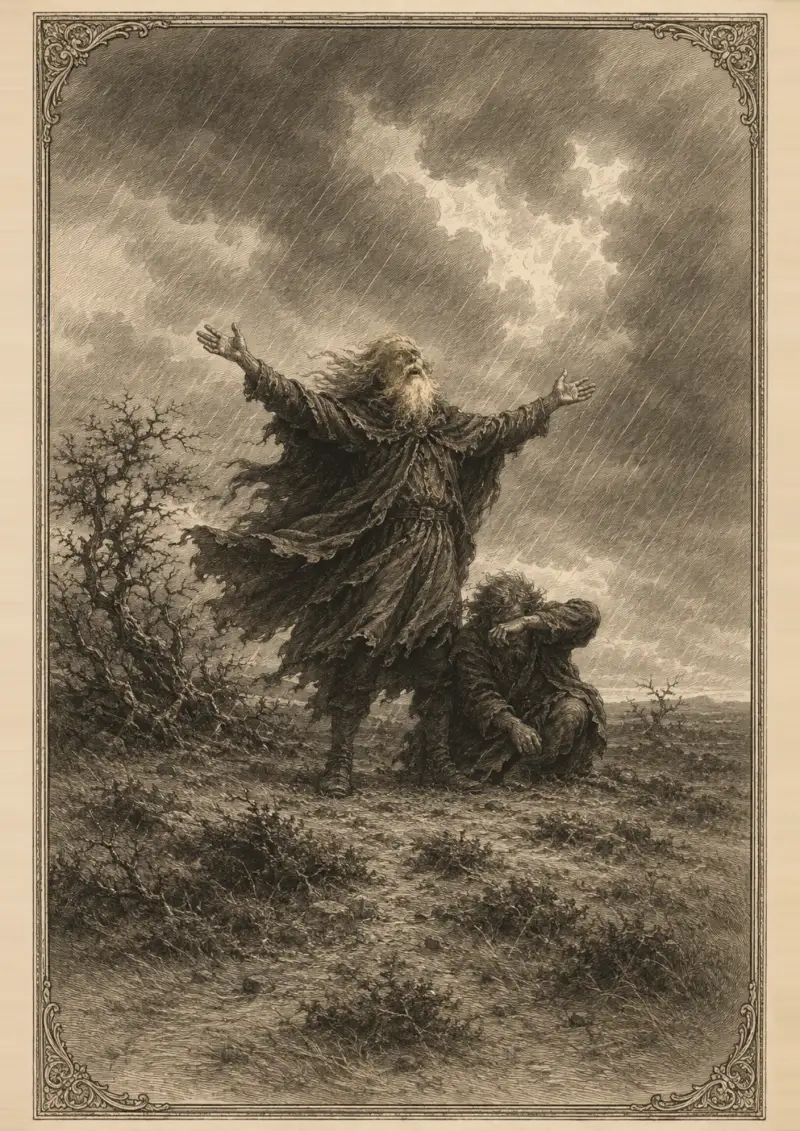
The passage
Blow winds, and crack your cheeks! Rage, blow!
King Lear · Act 3, Scene 2
You cataracts and hurricanoes, spout
Till you have drenched our steeples, drowned the cocks.
You sulph’rous and thought-executing fires,
Vaunt-couriers of oak-cleaving thunderbolts,
Singe my white head. And thou, all-shaking thunder,
Strike flat the thick rotundity o’ th’ world.
Crack nature’s molds, all germens spill at once
That makes ingrateful man.
In plain English
Blow, winds, until your cheeks burst. Rage. You waterspouts and torrents, pour down until you have soaked the church steeples and drowned the weathercocks on top of them. You sulphurous lightning, quick as thought, forerunner of the thunderbolts that split oak trees, scorch my white head. And you, thunder that shakes everything, beat the round, swollen world flat. Break the moulds in which nature shapes living things, and spill all at once the seeds from which ungrateful humanity is made.
Where it comes in the play
These are the opening words of Act 3, Scene 2 of King Lear (c. 1605-06). Lear has divided his kingdom between Goneril and Regan and disowned Cordelia, the daughter who loved him. The two he rewarded have now stripped him of his followers, and at the end of the previous act he walked out into a gathering storm while they barred the doors behind him.
His last words indoors matter here. He swore he would not cry: let not women’s weapons, water drops, / Stain my man’s cheeks
. He threatened revenges he could not name. And he ended with a fear: O Fool, I shall go mad!
Now he is out in the storm with only the Fool for company. The man who refused to weep calls down a flood.
Close reading
Commands
The speech is made of imperatives: Blow
, crack
, Rage
, spout
, Singe
, Strike
, Crack
, spill
. Lear’s habit of speech has always been command, from the first scene’s Nothing will come of nothing. Speak again.
He has no subjects left, so he gives orders to the sky. The storm cannot hear him, and it is doing all these things already: he commands what he cannot prevent. It is a picture of authority with nothing behind it.
The first line
Blow winds, and crack your cheeks! Rage, blow!
is eight syllables, every word a monosyllable, most of them stressed. It is not a smooth pentameter. The actor has to punch each word out against the noise. The image comes from old maps and pictures, where the winds are faces with puffed cheeks. Lear wants them to blow until their faces split.
Water, fire, thunder
The speech then moves through the elements in order: water, fire, then the thunder that shakes the earth. The vocabulary swells with the weather. After the blunt monosyllables come cataracts and hurricanoes
(both mean violent downpours or waterspouts), and Lear imagines a second Flood rising over the highest things a town has, its steeples
and the weathercocks on them.
For the lightning Shakespeare builds compound adjectives: thought-executing
, oak-cleaving
, all-shaking
. Each packs an action into a single word. thought-executing
probably means acting as fast as thought. Vaunt-couriers
are the soldiers sent ahead of an army: the lightning is the advance guard, the thunder the main force.
Then the target appears: Singe my white head
. Three plain words after all that grandeur: Lear asks the storm to strike him, and reminds us how old he is.
Uncreation
The last three lines are the most extreme. Strike flat the thick rotundity o’ th’ world
: the earth is imagined as a round, swollen body, and many readers hear pregnancy in thick rotundity
. Crack nature’s molds
asks for the forms in which life is cast to be smashed. germens
are seeds. Lear wants every seed of human life spilled and wasted, so that no more people can be made.
The reason comes in the final two words: ingrateful man
. Two daughters have been ungrateful, and for that Lear would end the species. This is the measure of his egotism at this point, and also of his pain. The speech breaks off on a half line, as if he has run out of breath.
The second speech
The Fool answers in prose, begging him to go indoors and make peace: Here’s a night pities neither wise men nor fools.
Lear carries on:
Rumble thy bellyful! Spit, fire! Spout, rain!
King Lear · Act 3, Scene 2
Nor rain, wind, thunder, fire are my daughters.
I tax not you, you elements, with unkindness.
I never gave you kingdom, called you children;
You owe me no subscription. Then let fall
Your horrible pleasure. Here I stand your slave,
A poor, infirm, weak, and despised old man.
Here the thought underneath the rage surfaces. The elements are not his daughters. They owe him no subscription
(allegiance), because he gave them nothing. unkindness
carries its older sense as well as ours: to be unkind is to act against one’s kind, one’s kin. The storm cannot be unnatural, because it is nature. (The guide to Shakespeare’s language has more on words whose meanings have shifted.)
For one line Lear sees himself exactly: A poor, infirm, weak, and despised old man
. The word slave
has replaced the word king. Then he cannot hold the insight. In the next lines he accuses the elements of being servile ministers
who have joined with two pernicious daughters
against him. He swings between seeing clearly and feeling persecuted, and that instability is the first sign of the madness he feared.
What it tells us about the play
The storm is the centre of the play’s enquiry into nature. In the first two acts “nature” means the bond between parent and child, and Lear calls his daughters unnatural. On the heath he meets nature in another sense: weather that has no regard for kings. As he says later, the storm outside is less than This tempest in my mind
.
The speech is also a beginning. In this scene Lear is still wholly occupied with his own wrongs: I am a man / More sinned against than sinning.
But before the scene ends he notices somebody else: Come on, my boy. How dost, my boy? Art cold?
Two scenes later, outside the hovel, he prays for the Poor naked wretches
of his kingdom and admits, O, I have ta’en / Too little care of this.
The route from cursing mankind to that prayer is the moral journey of the play, and the rain is what teaches it.
How consoling that journey is remains disputed. For A. C. Bradley, Lear’s suffering purifies him. For Jan Kott, who read the play beside the theatre of the absurd, the heath shows a world in which suffering teaches nothing. The speech supports both: it is heroic, and nobody answers.
What people get wrong
The storm is not simply a reflection of Lear’s mind. Students often call it pathetic fallacy and stop. Lear himself denies the connection: the elements are not his daughters and owe him nothing. The storm’s indifference is the point, and his attempt to make it mean something is the drama.
Lear is not yet mad. He fears madness before the scene and says My wits begin to turn
during it, but these speeches are furious, not deranged. Their logic is cruel and clear.
He is not only a titan. The great opening is often performed and quoted as pure defiance. Within twenty lines the same voice calls itself weak and despised. Any account of the speech needs both.
Using it in an essay
The storm speeches suit questions on power, nature, madness or justice. Examiners reward attention to verbs and to the shape of Lear’s thought, especially the turn from commanding the storm to describing himself. The King Lear quotation sheet gives the lines to learn from the surrounding scenes, and the King Lear lesson plans build a lesson around the heath.
Fragments worth memorising:
Blow winds, and crack your cheeks!
- imperatives from a king with no one left to command.Singe my white head
- the grand style drops to three plain words, and to his age.Crack nature’s molds
- private injury becomes a wish to end creation.I tax not you, you elements, with unkindness
- nature is not kin, so it cannot betray.A poor, infirm, weak, and despised old man
- a moment of exact self-knowledge.
To practise this kind of analysis, use the close reading toolkit, and plan the wider argument with the essay planner. Two companion essays show other tragic heroes at their limit: Macbeth in “Tomorrow and tomorrow and tomorrow”, where the voice goes numb instead of raging, and Hamlet in “To be, or not to be”.
Say the first speech aloud and notice how hard it is to keep going. That effort is written into the lines. For a daily habit of reading Shakespeare closely, the Daily Bard app is free to download, and the Full Edition, a one-time purchase, adds margin notes for your own observations. You can get Daily Bard on the App Store; use it beside the play, not instead of it.