
The passage
You do look, my son, in a moved sort,
Prospero · The Tempest · Act 4, Scene 1
As if you were dismayed. Be cheerful, sir.
Our revels now are ended. These our actors,
As I foretold you, were all spirits and
Are melted into air, into thin air;
And like the baseless fabric of this vision,
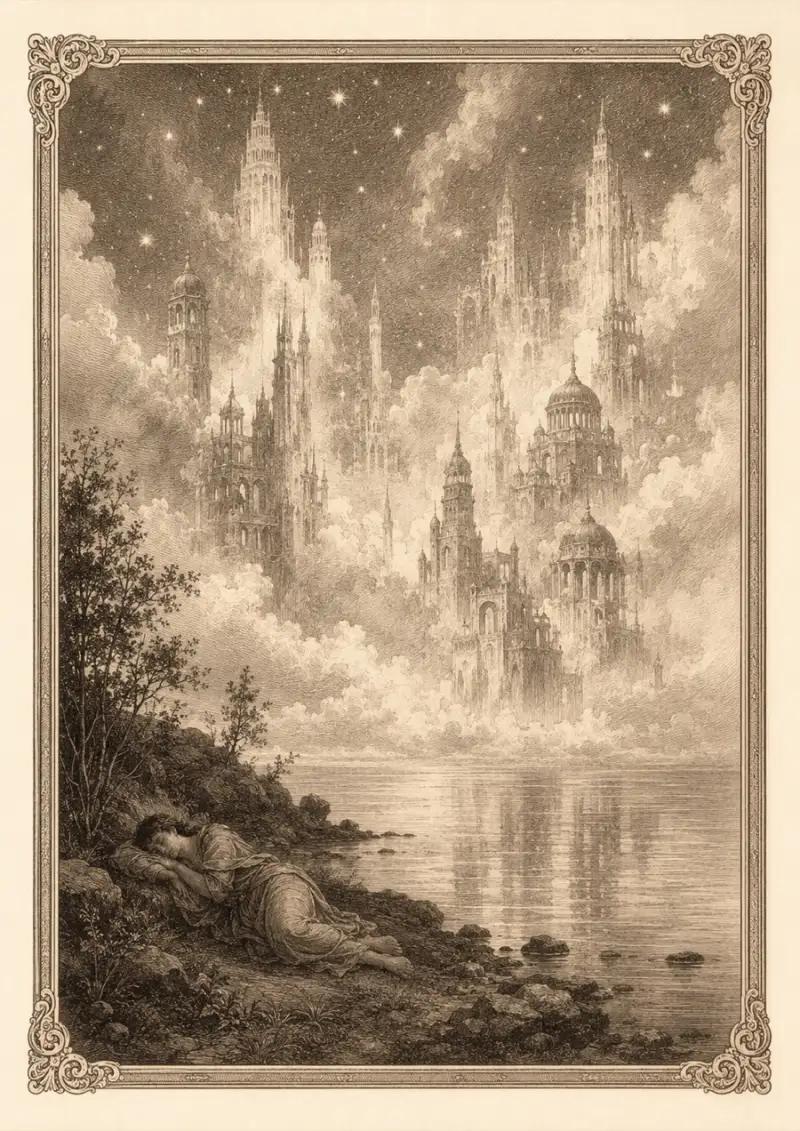
The cloud-capped towers, the gorgeous palaces,
The solemn temples, the great globe itself,
Yea, all which it inherit, shall dissolve,
And, like this insubstantial pageant faded,
Leave not a rack behind. We are such stuff
As dreams are made on, and our little life
Is rounded with a sleep. Sir, I am vexed.
Bear with my weakness. My old brain is troubled.
Be not disturbed with my infirmity.
In plain English
You look upset, my son. Cheer up. Our entertainment is over. The actors, as I told you, were spirits, and they have melted into thin air. And just as this vision had no foundation, so the towers that touch the clouds, the splendid palaces, the solemn temples, the great globe itself and everyone who lives on it will dissolve, and, like this unreal show, will not leave even a wisp of cloud behind. We are made of the same material as dreams, and our short life is surrounded by sleep. I am troubled, sir. Bear with me. My old mind is disturbed. Do not let my weakness upset you.
Where it comes in the play
The Tempest (c. 1610-11) is one of Shakespeare’s last plays. Prospero, the deposed Duke of Milan, rules an island by magic. By Act 4 his plans are nearly complete: his enemies are in his power, and his daughter Miranda is betrothed to Ferdinand, the son of the King of Naples. To celebrate, he has his spirits perform a masque, a courtly entertainment of music, dance and goddesses. The study guide to The Tempest sets out the full plot.
Then, in the middle of the dance, Prospero suddenly remembers something: I had forgot that foul conspiracy / Of the beast Caliban and his confederates / Against my life
. He stops the masque, and the spirits vanish in confusion. Ferdinand and Miranda are alarmed. Miranda says she has never seen her father touched with anger, so distempered
.
That is the situation in which the famous lines are spoken. They are addressed to a frightened young man by an older one who is trying to reassure him and to master himself.
Close reading
From a show to the world
The speech begins small and practical. Our revels now are ended
is a monosyllabic statement of fact: the party is over. revels
was the ordinary word for court entertainments. The actors were all spirits
, and they Are melted into air, into thin air
. The repetition with one added word makes the air seem to thin as we listen, and melted
gives solid bodies the nature of snow.
Then the speech widens with a simile: like the baseless fabric of this vision
. A fabric
here is a building or structure, and baseless
means without foundations. What follows is a rising list of everything human beings build to last: The cloud-capped towers, the gorgeous palaces, / The solemn temples, the great globe itself
. Power, wealth, religion, and finally the planet. The list has no “and” between its items (a device called asyndeton), so each monument is piled on the last without pause.
the great globe itself
carries a second meaning. Shakespeare’s company played at the Globe theatre. An actor speaking the line gestures at the world and at the playhouse together, and the audience is included in all which it inherit
, all who occupy it.
The long sentence and the short one
Syntax does much of the work. The main verb is held back for line after line while the towers and temples accumulate, and when it arrives it is quiet: shall dissolve
. No fire, no collapse. Things simply stop being solid, as the spirits did. The sentence ends Leave not a rack behind
, where a rack
is a drifting shred of cloud. The cloud-capped towers will not leave so much as a cloud.
After that enormous sentence comes a short, plain one, beginning mid-line after a strong caesura: We are such stuff / As dreams are made on
. The pronoun changes everything. Until now Prospero has spoken of actors, buildings, the globe. Now it is We
. The word stuff
is deliberately humble: it means material, cloth, the raw matter of something. Human beings are the material out of which dreams are made, no more substantial than the masque.
The next clause completes the thought: our little life / Is rounded with a sleep
. rounded
can mean surrounded, with sleep before birth and after death, or rounded off, finished. The adjective little
is tender, not contemptuous. Where Hamlet in “To be, or not to be” fears what dreams may come in the sleep of death, Prospero imagines a sleep with nothing in it to fear.
The collapse of the verse
Then the tone breaks. Sir, I am vexed. / Bear with my weakness. My old brain is troubled
. After the long, flowing period, the speech falls into brief sentences that stop and start inside the lines. The philosopher disappears and an agitated old man stands in his place. He ends by saying he will walk A turn or two
to still my beating mind
. A beating
mind is one that throbs like a pulse or a storm. The tempest of the title is now inside him.
What it tells us about the play
The speech is the hinge of Prospero’s story. Up to this point he has used illusion as a tool of power: the storm, the vanishing banquet, the masque. Here he sees that illusion is all there is, and that his own power is as temporary as the pageant. That recognition prepares for the choices of Act 5: mercy instead of revenge, since The rarer action is / In virtue than in vengeance
, and then the surrender of magic itself, when he promises I’ll drown my book
.
It also shows the cost of his control. What breaks the masque is the memory of Caliban, the islander Prospero has enslaved and cannot wholly command. Postcolonial readings of the play, which see in Prospero and Caliban the relationship of coloniser and colonised, find it telling that a vision of harmony is shattered by the thought of the person excluded from it. Whether you use that reading or challenge it, the speech’s serenity begins in anger.
Finally, the speech is about theatre. A play is a baseless fabric
: actors appear, an audience believes, and at the end nothing is left. Jaques makes it satirical in “All the world’s a stage”, and Macbeth makes it despairing in “Tomorrow and tomorrow and tomorrow”. Prospero’s version is the only one of the three that is offered as comfort.
This is the sort of page Daily Bard is designed around: one engraved plate and one passage a day, with a plain-English reading on the back of the leaf.
What people get wrong
- “Made of.” The line is
made on
, not “made of”. The sense is similar, but quote it accurately. - “The stuff of dreams means something wonderful.” In modern use the phrase suggests glamour. Prospero means that we are insubstantial and brief.
- “It is Shakespeare’s farewell to the stage.” This is an attractive tradition, not a fact. Prospero is a character, and Shakespeare went on to write further plays in collaboration. Present it as an interpretation.
Using it in an essay
Do not quote the speech as detached wisdom. Examiners reward answers that connect it to the interrupted masque and to Prospero’s development. Analyse the movement from long sentence to short, and the shift of pronoun to We
. For method, see the close reading toolkit; for the surrounding lines, the Tempest quotation sheet.
Fragments worth memorising:
Our revels now are ended
- plain statement; theatre as a figure for life.the baseless fabric of this vision
- illusion as a building with no foundations.the great globe itself
- the world and the playhouse in one phrase.such stuff / As dreams are made on
- humanity as insubstantial material.my beating mind
- the storm moved inside Prospero.
Teachers will find a ready sequence in the Tempest lesson plans, and the essay planner is useful for shaping an argument about Prospero’s change across the play.
For a daily habit of this kind of attention, get Daily Bard for iPhone and iPad. It is free to download, and the Full Edition’s Catalogue lets you browse your pages by play. The app is a companion to study, not a substitute for the text.