
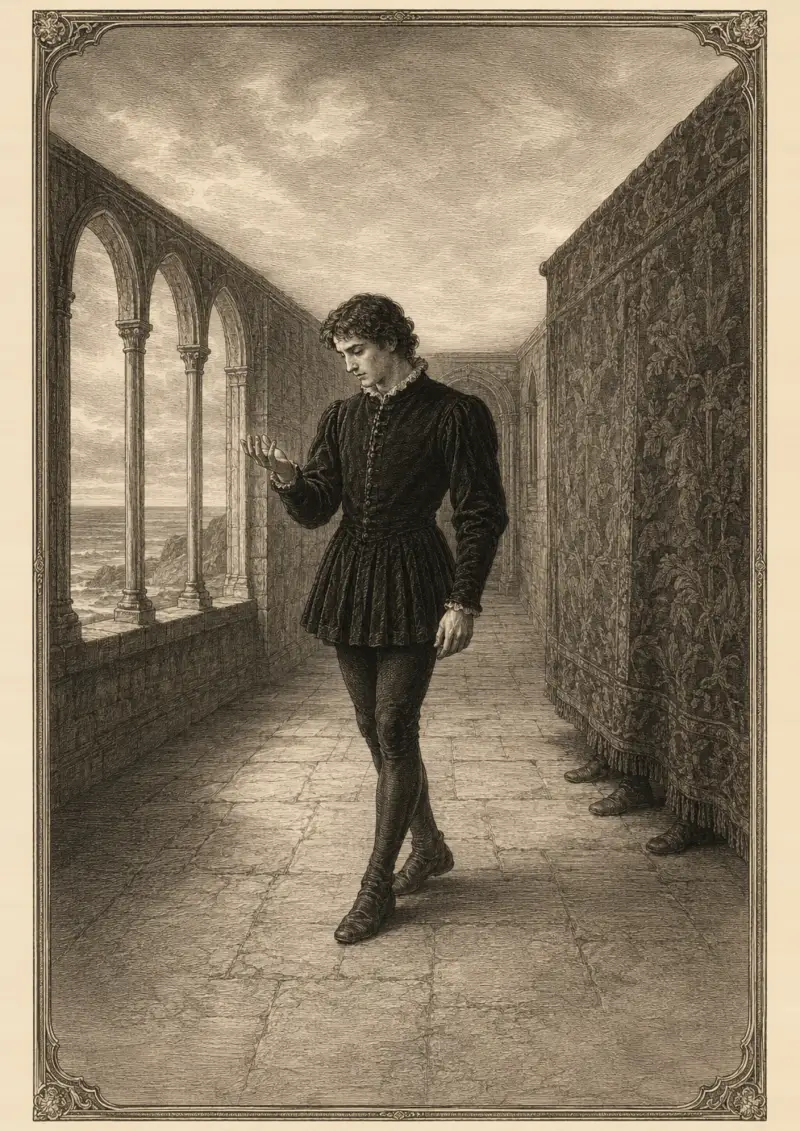
The passage
To be or not to be, that is the question:
Hamlet · Act 3, Scene 1
Whether ’tis nobler in the mind to suffer
The slings and arrows of outrageous fortune,
Or to take arms against a sea of troubles
And, by opposing, end them. To die, to sleep,
No more, and by a sleep to say we end
The heartache and the thousand natural shocks
That flesh is heir to, ’tis a consummation
Devoutly to be wished. To die, to sleep,
To sleep, perchance to dream. Ay, there’s the rub,
For in that sleep of death what dreams may come,
When we have shuffled off this mortal coil,
Must give us pause.
In plain English
To exist or not to exist: that is the issue. Is it more honourable to endure whatever a cruel fortune throws at us, or to fight back against an ocean of troubles and, by fighting, finish them? Dying is only sleeping. If sleep could end the heartbreak and the countless blows that come with having a body, that would be an ending to pray for. But sleep brings dreams. The thought of what we might dream in death, once we have thrown off the turmoil of this life, is what makes us hesitate.
Where it comes in the play
The speech stands at the centre of Hamlet. Hamlet has been told by his father’s ghost that Claudius is a murderer, has sworn revenge, and has done nothing. At the end of the previous act he seemed to find a way forward: he will stage a play to test the King’s guilt. Yet he walks on next thinking about death.
He is also not alone, though he believes he is. Claudius and Polonius have just hidden themselves to spy on him, and Ophelia has been placed in his path as bait. The audience watches a man reasoning in what he takes to be solitude while knowing that the two most powerful men in Denmark are listening. Even the soliloquy (a speech in which a character voices their thoughts alone) is no longer private.
Close reading
A question without an “I”
The first thing to notice is a word that is missing. Hamlet never says “I” or “my” in the body of the speech. His first soliloquy was painfully personal: O, that this too, too sullied flesh would melt
. This one is written in infinitives and plurals: to suffer
, to say we end
, makes us rather bear those ills we have
. There is no mention of his father, of Claudius, or of revenge. Hamlet has turned his own situation into a philosophical problem that applies to everybody, and that move is itself the subject of the speech. He escapes from his task into thought.
The opening line sets out the problem as a formal debating question. It is built on antithesis (two opposed ideas set in balance), and the grammar keeps offering pairs: to suffer or to take arms, to be or not to be. The line has eleven syllables rather than the ten of a regular iambic pentameter, so it ends on an extra unstressed syllable, called a feminine ending. So do the next three lines, on suffer
, fortune
and troubles
. The verse keeps trailing away instead of closing firmly, which suits a mind that cannot settle.
Metaphors that undo themselves
Hamlet’s image of action is strange. To take arms against a sea of troubles
is to fight the tide with a sword. The metaphor quietly admits that resistance is hopeless, and the phrase by opposing, end them
is ambiguous in a way that matters: the troubles may end because we defeat them, or because fighting them kills us.
Death, by contrast, is made gentle. To die, to sleep
turns dying into the most ordinary thing we do, and No more
shrugs at it. Then Hamlet repeats himself, and the repetition trips him: To die, to sleep, / To sleep, perchance to dream
. If death is sleep, sleep has dreams. Ay, there’s the rub
uses a term from the game of bowls, where a rub is an unevenness in the ground that sends the ball off its line. The thought is knocked off course by a full stop in the middle of the line, a caesura that makes the actor halt exactly where the argument does.
The list and the conclusion
Later the speech becomes a catalogue of everyday injustice: Th’ oppressor’s wrong, the proud man’s contumely, / The pangs of despised love, the law’s delay, / The insolence of office
. These are not a prince’s troubles but anyone’s, and they widen the speech from one man to a whole society. Against them Hamlet sets a brutally simple remedy: a man might his quietus make / With a bare bodkin
. A quietus is the settling of a debt; a bodkin is a small dagger.
What stops us is the dread of something after death, / The undiscovered country from whose bourn / No traveler returns
. A bourn is a border: death is a land nobody comes back from. Then comes the verdict: Thus conscience does make cowards of us all
. For Shakespeare’s audience conscience
could mean both moral sense and consciousness, the act of reflecting. The final image is medical: the native hue of resolution / Is sicklied o’er with the pale cast of thought
. Resolve has a healthy, ruddy colour; thinking makes it sick and pale.
What it tells us about the play
The speech states the play’s central problem in general terms. Its last sentence says that great enterprises lose the name of action
once they are thought about too much. Hamlet does not say he is describing his own delay, but the audience can hardly miss it. Coleridge saw in Hamlet a man in whom thought had outgrown the power to act, and A. C. Bradley traced the delay to a deep melancholy. This speech is the main evidence for both readings, and you can use it to weigh one against the other.
It also exposes a contradiction. Hamlet calls death a country from which no traveller returns, yet he has spoken to his father’s ghost. Either he doubts the Ghost, which is exactly why he needs the play he has just planned, or, in the grip of the argument, he has put it out of mind.
Finally, the speech begins a journey that ends in Act 5. Here the unknown paralyses him. By the last scene he can say The readiness is all
and then, simply, Let be
, which answers the opening question with a calm he does not have here. Compare how differently a later tragic hero meets the same thoughts in Macbeth’s “Tomorrow and tomorrow and tomorrow”, where life is a story that means nothing, and how gently Prospero imagines the sleep of death in “We are such stuff as dreams are made on”.
What people get wrong
- The skull. Hamlet does not hold a skull during this speech. Yorick’s skull belongs to the graveyard scene in Act 5, Scene 1.
- “He is deciding whether to kill himself.” That is too narrow. He asks why anyone endures life, and concludes with a claim about action in general. Suicide is one case of the larger question.
Using it in an essay
Examiners reward students who treat the speech as drama: say where it falls and who is listening, then analyse two or three short phrases closely. The close reading toolkit sets out a method, the guide to Shakespeare’s language glosses the older vocabulary, and the Hamlet quotation sheet gathers the other lines you will want beside it.
Fragments worth memorising:
that is the question
- the speech is framed as a debate, not a confession.a sea of troubles
- a metaphor in which action is already futile.Ay, there’s the rub
- the turn of the argument, marked by a mid-line pause.The undiscovered country
- death as unknowable, despite the Ghost.the pale cast of thought
- reflection imagined as an illness that weakens resolve.
If you are teaching the scene, the Hamlet lesson plans build a full sequence around the soliloquies, and the essay planner helps students turn a reading like the one above into an argument. For keeping lines in your head, the Daily Bard app puts one passage on your iPhone or iPad each day, and the Full Edition keeps every page you have seen in a Commonplace Book you can browse again.
If you would like the habit made easy, get Daily Bard for iPhone and iPad; it is a companion to reading the play, not a replacement for it.