
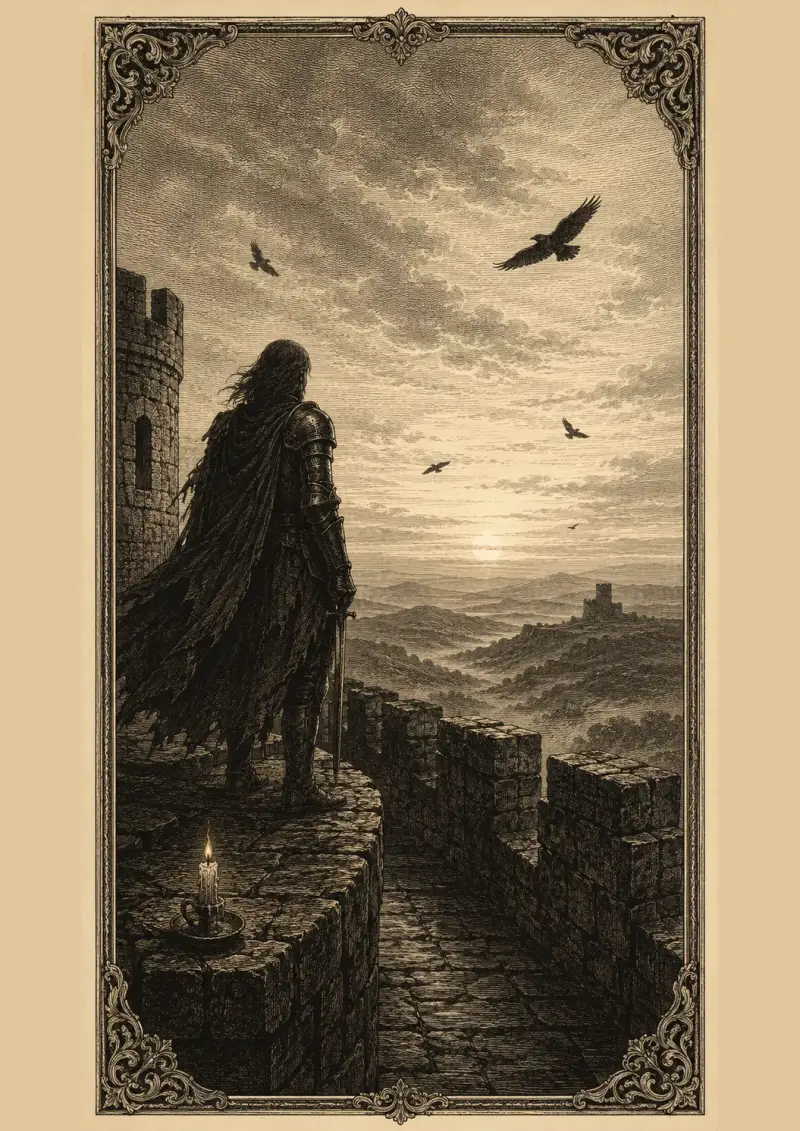
The passage
SEYTON The Queen, my lord, is dead.
Macbeth · Act 5, Scene 5
MACBETH She should have died hereafter.
There would have been a time for such a word.
Tomorrow and tomorrow and tomorrow
Creeps in this petty pace from day to day
To the last syllable of recorded time,
And all our yesterdays have lighted fools
The way to dusty death. Out, out, brief candle!
Life’s but a walking shadow, a poor player
That struts and frets his hour upon the stage
And then is heard no more. It is a tale
Told by an idiot, full of sound and fury,
Signifying nothing.
In plain English
She would have died at some point anyway; or, she ought to have died later, when there would have been time to mourn. One tomorrow follows another, crawling along at this trivial pace, day after day, until the final syllable of history is written. And every day that has already passed has only served to light fools on their way to death and dust. Go out, short candle. Life is nothing but a moving shadow, a bad actor who swaggers and worries through his hour on stage and then is never heard again. It is a story told by an idiot, full of noise and rage, and it means nothing.
Where it comes in the play
Macbeth is besieged in Dunsinane castle. His thanes have deserted, an English army is approaching, and he is holding on to the witches’ promises that he cannot be defeated until Birnam Wood comes to Dunsinane and that no man born of woman can harm him. Moments before the speech he hears the cry of women
offstage and notes, that it does not frighten him: I have almost forgot the taste of fears
.
Then the news comes. Lady Macbeth, last seen sleepwalking in “Out, damned spot”, is dead. The speech is Macbeth’s whole response, and the instant it ends a messenger arrives to report that the wood has begun to move. The Macbeth study guide sets this final movement in the context of the whole tragedy.
Close reading
“She should have died hereafter”
The first line is one of the most debated in the play because it can be read in two ways. It may be a shrug: she would have died sooner or later. Or it may be a regret: she ought to have died at a later time, when there would have been a time for such a word
, room for the news and for grief. An actor has to choose, and the choice decides how much feeling Macbeth has left. The line is also metrically short, leaving a silence after it. That gap is where mourning should be.
Whichever reading you prefer, the word hereafter
triggers the speech.
Time that creeps
Tomorrow and tomorrow and tomorrow
is a line built almost entirely from one word. The repeated “and” (a device called polysyndeton) joins identical units, so the line goes nowhere. It ends on an unstressed syllable, a feminine ending, and trails off. Then the verb arrives, and it is singular: all those tomorrows are one thing, which Creeps in this petty pace from day to day
. Creeps
gives time the movement of something low and slow. petty
makes it small and mean, and the alliteration of petty pace
and day to day
ticks like a clock.
The destination is the last syllable of recorded time
. Time is imagined as a written record, and a tedious one, read out syllable by syllable. For this speaker the future was once everything. The witches’ prophecies were all about what would be, and in Act 1 he spoke of being willing to jump the life to come
for the sake of a crown. Now the future is merely more of the same.
The past is no better: all our yesterdays have lighted fools / The way to dusty death
. History is a servant holding a light for people walking to their graves, and those people are fools
. The heavy alliteration of dusty death
lands like a dull blow, and dusty
recalls the burial service’s dust to dust without any of its promise of resurrection.
Candle, shadow, player, tale
The thought of light produces the next image: Out, out, brief candle!
The stresses crowd together, breaking the creeping rhythm with a moment of force. Life is a small flame, and Macbeth wants it extinguished. The audience may recall that Lady Macbeth, at the end, kept a light by her continually, and that her own cry was Out, damned spot
.
Then the metaphors come quickly, each less substantial than the one before. Life is a walking shadow
: what a candle casts, with no body of its own. It is a poor player / That struts and frets his hour upon the stage
. To strut is to show off; to fret is to fuss and wear oneself away. The actor is poor
in both senses, bad and pitiable, and afterwards he is heard no more
. Jaques makes a comic version of the same comparison in “All the world’s a stage”; here there is no comedy left.
Finally life is a tale / Told by an idiot, full of sound and fury, / Signifying nothing
. The long Latinate word Signifying
raises an expectation of meaning that the final word cancels. The last line is only six syllables long. The pentameter stops less than two-thirds of the way through, and the remaining beats are silence.
What it tells us about the play
This is the end of the road that began with Vaulting ambition
. Macbeth has gained everything he wanted and found it worthless; he has already said that honour, love and friends are things I must not look to have
. The speech turns that private emptiness into a statement about all human life.
The crucial question for an essay is whether the play agrees with him. Arguably it does not. Macbeth’s life signifies nothing because he has destroyed what gave it meaning: trust, loyalty, sleep, his marriage. The play around him is full of consequence. Each crime leads to the next, and within minutes the prophecies he relied on will unravel with terrible logic. His tale is not told by an idiot. It has a strict moral shape, and he is the one person who can no longer see it.
At the same time, the speech is the reason audiences cannot simply dismiss Macbeth as the dead butcher
Malcolm calls him. A. C. Bradley stressed that Macbeth has the imagination of a poet, and it is true that the man who has done the worst things in the play is given its finest expression of despair.
Compare Hamlet, who weighs existence and stops at the fear of what follows death in “To be, or not to be”. Macbeth has no such fear and no questions. His speech contains only statements.
These lines are the kind of passage Daily Bard presents on a single leaf, with the verse on the front and a plain-English reading on the back.
What people get wrong
- “This is Shakespeare’s philosophy.” It is the view of a particular man at a particular moment, a murderer whose choices have emptied his life. The play does not ask us to share it.
- “He feels nothing for his wife.” The speech is his reaction to her death. Whether it shows numbness or grief too deep for mourning is open, and you should argue for a reading.
- “After this he gives up.” He does not. He goes out to fight, and dies fighting. Despair and defiance sit side by side in the final scenes.
Using it in an essay
Examiners look for analysis of how the verse creates meaning, and this speech offers unusually clear examples: repetition, monosyllables, a broken final line. The close reading toolkit shows how to write about rhythm without guesswork, and the Macbeth quotation sheet collects the lines to pair with it.
Fragments worth memorising:
Creeps in this petty pace
- time as slow, small and mean.dusty death
- alliteration; death with no hint of afterlife.Out, out, brief candle!
- life as a short flame; echoes Lady Macbeth.a poor player
- the theatre metaphor turned to contempt.Signifying nothing
- a short last line that enacts its own meaning.
Teachers can find a full sequence on the play’s ending in the Macbeth lesson plans. For the whole arc from ambition to emptiness, the essay planner helps keep the argument in control.
If you like meeting Shakespeare in small pieces, get Daily Bard for iPhone and iPad; each day brings one engraved plate and one passage, and there is no account to create and no subscription. In the Full Edition, the Daily Plate widget puts the day’s page on your Home Screen.