
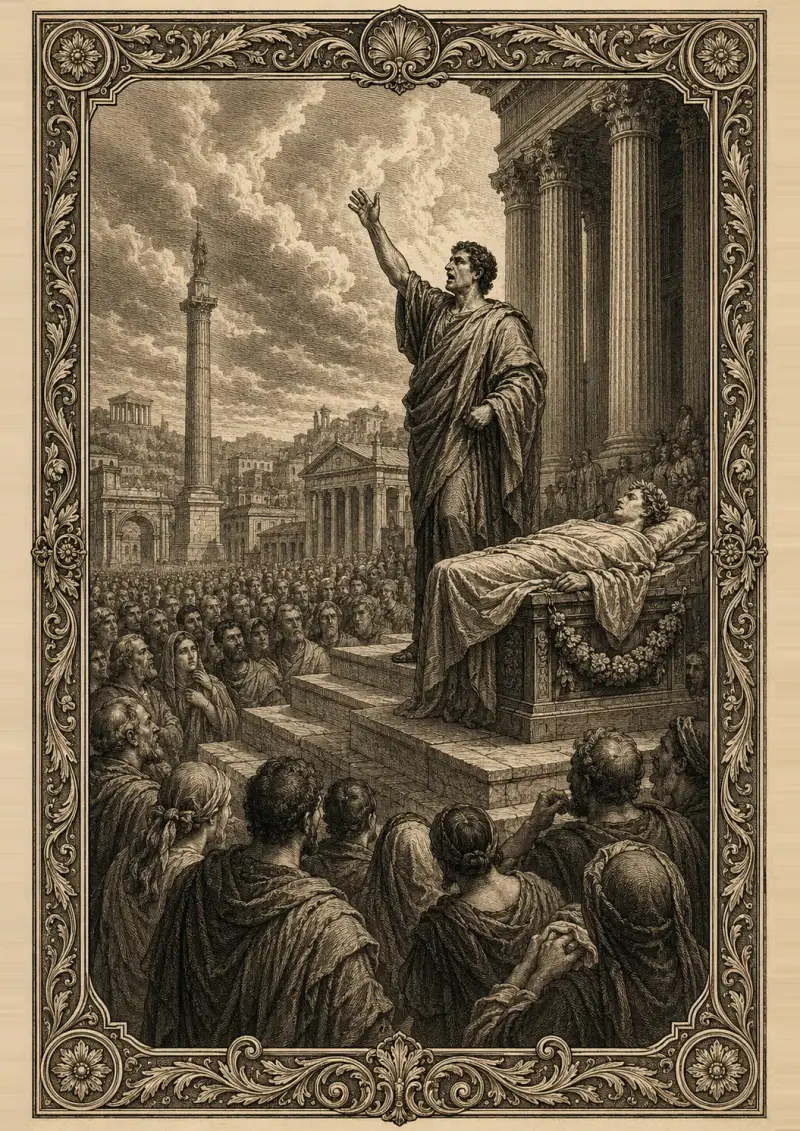
The passage
Friends, Romans, countrymen, lend me your ears.
Julius Caesar · Act 3, Scene 2
I come to bury Caesar, not to praise him.
The evil that men do lives after them;
The good is oft interred with their bones.
So let it be with Caesar. The noble Brutus
Hath told you Caesar was ambitious.
If it were so, it was a grievous fault,
And grievously hath Caesar answered it.
Here, under leave of Brutus and the rest
(For Brutus is an honorable man;
So are they all, all honorable men),
Come I to speak in Caesar’s funeral.
He was my friend, faithful and just to me,
But Brutus says he was ambitious,
And Brutus is an honorable man.
In plain English
Friends, Romans, fellow citizens, listen to me. I am here to bury Caesar, not to sing his praises. The wrong that people do is remembered after they die, and the good is often buried with them. Let that be so for Caesar. Brutus has told you that Caesar was ambitious. If he was, it was a serious fault, and he has paid for it seriously. I speak at this funeral by permission of Brutus and the others, for Brutus is an honourable man, as they all are. Caesar was my friend, loyal and fair to me. But Brutus says he was ambitious, and Brutus is an honourable man.
Where it comes in the play
Caesar has been stabbed to death in the Capitol. In Julius Caesar (c. 1599) the assassination comes at the midpoint, and the question that follows is who will control what it means. Brutus has just addressed the crowd and won them completely.
Brutus has also made an error. Against the advice of Cassius, he has allowed Mark Antony to speak at the funeral, on two conditions: Antony must not blame the conspirators, and he must say that he speaks by their permission. Then Brutus leaves. Antony faces a hostile crowd, bound by rules. The audience knows what the plebeians do not: alone with the corpse in the previous scene, Antony promised to let slip the dogs of war
.
Close reading
The first line
Brutus began Romans, countrymen, and lovers
, and spoke in balanced prose, asking the crowd to Censure me in your wisdom
. Antony speaks verse, and he changes the order. Friends
comes first: the personal bond before the civic one. The three terms of address grow by a syllable each time (one, two, three), so the line gathers momentum as it gathers the crowd.
lend me your ears
is metonymy, the ear standing for attention, and it is modest. Brutus told them to be silent
. Antony asks for a loan.
Saying what he will not say
I come to bury Caesar, not to praise him
is an antithesis, and it disarms a crowd that has just been told Caesar was a tyrant. The next two lines sound like proverbial wisdom, but by conceding that The good is oft interred with their bones
, Antony plants the idea that there was good to bury.
The conditional is his sharpest tool. If it were so, it was a grievous fault
accepts Brutus’s charge only hypothetically. The echo of grievous
in grievously hath Caesar answered it
turns the crowd’s eyes from Caesar’s fault to Caesar’s wounds. And the charge itself is reported, never endorsed: Brutus Hath told you
, Brutus says
. Antony makes ambition a matter of one man’s word.
How one word changes
The first time Antony says Brutus is an honorable man
, it is tucked inside a parenthesis and sounds like courtesy. He is keeping his bargain. It is not sarcastic yet. If it were, the crowd would turn on him.
What changes the word is its company. Each time, Antony sets a piece of evidence against the claim of ambition, then repeats the refrain:
When that the poor have cried, Caesar hath wept;
Julius Caesar · Act 3, Scene 2
Ambition should be made of sterner stuff.
Yet Brutus says he was ambitious,
And Brutus is an honorable man.
The evidence is chosen for this audience. The ransoms filled the general coffers
, their treasury. Caesar wept for the poor
, which is to say for them. The crown was thrice refused where You all did see
. Antony makes the crowd its own witness, then asks Was this ambition?
and lets them supply the answer.
Notice the small conjunctions. But Brutus says
becomes Yet Brutus says
: the contradiction is now in the open. And the refrain finally shifts to And sure he is an honorable man
, where sure
introduces the doubt it pretends to exclude. By repetition alone, a word of praise has become an accusation. Antony never withdraws it, so he never breaks his promise.
The denial and the pause
I speak not to disprove what Brutus spoke, / But here I am to speak what I do know
is an untruth presented as plain dealing, and it sets what Brutus spoke
against what Antony knows: opinion against fact.
Then the argument breaks into feeling. O judgment, thou art fled to brutish beasts, / And men have lost their reason!
may glance at Brutus’s name. Antony stops: My heart is in the coffin there with Caesar, / And I must pause till it come back to me.
The pause is the most effective move in the speech, because it hands the stage to the crowd. They begin to persuade each other: Methinks there is much reason in his sayings.
Whether the tears are real the play leaves open. Antony loved Caesar. He also knows what weeping is worth.
What it tells us about the play
Julius Caesar is a play about persuasion. Cassius works on Brutus, and Brutus works on himself. This scene sets two kinds of rhetoric side by side. Brutus offers reasons and trusts the crowd to weigh them. Antony offers objects and emotions: tears, then Caesar’s torn cloak, then the body, then the will. He claims I am no orator, as Brutus is, / But, as you know me all, a plain blunt man
, which is the oldest trick an orator has.
The play does not pretend that the better argument wins. It also does not let Antony off. Once the crowd has run to burn the conspirators’ houses, he says, alone: Mischief, thou art afoot; / Take thou what course thou wilt.
In the next scene the mob murders a harmless poet who shares a conspirator’s name. Shakespeare shows the speech’s brilliance and then shows its price.
The crowd, flattered by Brutus as rational and by Antony as feeling (You are not wood, you are not stones, but men
), changes sides twice in one scene. Readers who know Portia’s courtroom speech in “The quality of mercy” can compare a persuader who fails with one who succeeds too well, and Richard’s opening address in “Now is the winter of our discontent” shows a speaker winning over the theatre audience itself.
Short daily reading is a good way to hear such turns. That is the idea behind Daily Bard: one passage a day, verified against the Folger text, with a plain-English reading on the back of the leaf.
What people get wrong
It is not a spontaneous outburst of grief. Antony has planned to turn the crowd since the previous scene. The grief may be sincere. The structure is calculated.
honorable
is not sarcastic from the start. The skill lies in the gradual change: the irony is built by the listeners, one repetition at a time.
Antony is not simply the hero. He manipulates the people he calls friends, withholds and then deploys the will, and by the next act is coolly marking men for death.
Using it in an essay
This is the passage to choose when a question asks about power, persuasion or the crowd. Do not list devices. Show a device changing meaning over time, as honorable
does, and contrast Antony’s verse with Brutus’s prose. The close reading toolkit sets out a method for this kind of tracking, and the guide to Shakespeare’s language covers the difference between verse and prose and why it matters.
Fragments worth memorising:
I come to bury Caesar, not to praise him
- a promise made in order to be broken without seeming to.If it were so
- the conditional that accepts Brutus’s charge only as a hypothesis.And Brutus is an honorable man
- the refrain whose meaning reverses through repetition.My heart is in the coffin there with Caesar
- the pause that lets the crowd convince itself.
The speech also works well in comparison. Iago, in the scene discussed in “O, beware, my lord, of jealousy”, persuades one man in private by the same method of saying what he claims not to say, and the Othello study guide follows that technique through the play. If you are planning a comparative answer, the essay planner will help you structure it.
Read the scene aloud if you can, and mark the moment you first hear the irony. For other great speeches, see the full list of quote essays, or download Daily Bard for iPhone and iPad and meet them one page at a time alongside your reading of the plays.