
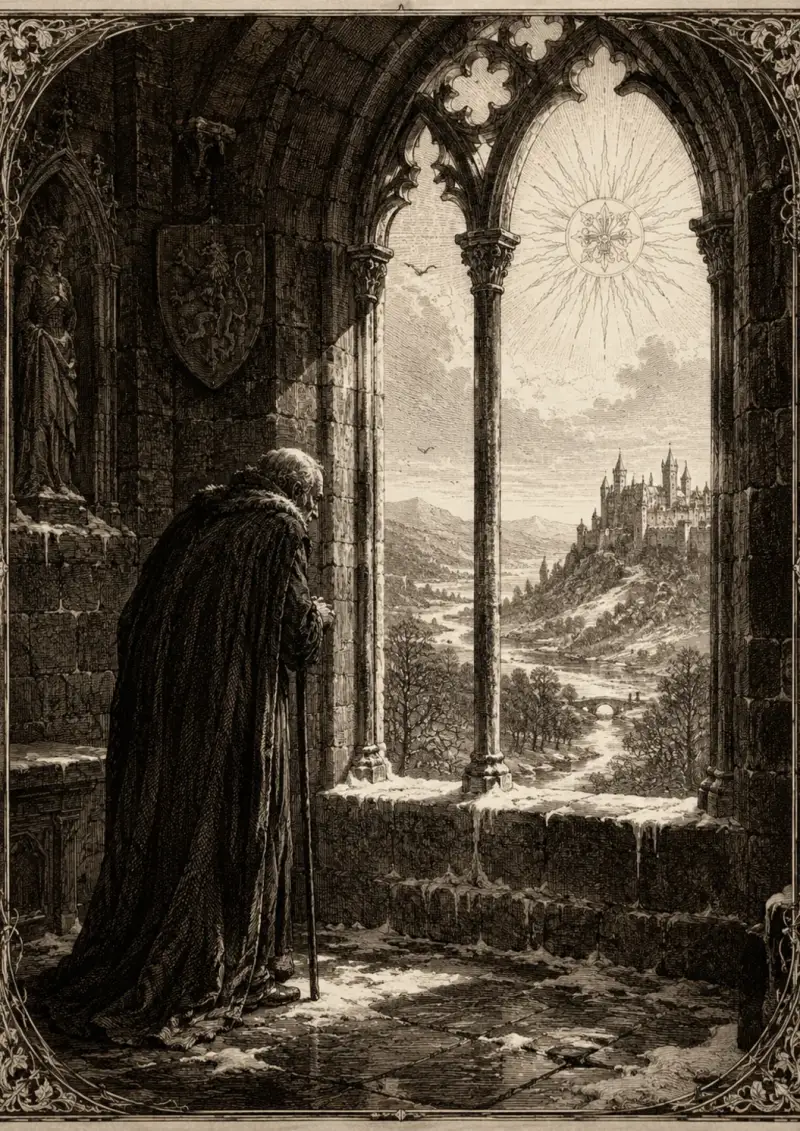
The passage
Now is the winter of our discontent
Richard III · Act 1, Scene 1
Made glorious summer by this son of York,
And all the clouds that loured upon our house
In the deep bosom of the ocean buried.
Now are our brows bound with victorious wreaths,
Our bruised arms hung up for monuments,
Our stern alarums changed to merry meetings,
Our dreadful marches to delightful measures.
Grim-visaged war hath smoothed his wrinkled front;
And now, instead of mounting barbed steeds
To fright the souls of fearful adversaries,
He capers nimbly in a lady’s chamber
To the lascivious pleasing of a lute.
In plain English
Our family’s winter of misery has been turned into summer by my brother, the Yorkist king, and the clouds that hung over our house are sunk in the sea. We wear the victors’ garlands. Our dented armour hangs up as a trophy, our calls to battle have become parties, our marches dances. War himself has relaxed his frown, and instead of riding armoured horses to terrify the enemy he skips about in a lady’s bedroom to the sound of a lute.
The speech then turns: Richard is not made for such games, and since he cannot be a lover he will be a villain. He has already begun.
Where it comes in the play
These are the first words of Richard III (c. 1592-93). Richard, Duke of Gloucester, walks on alone and talks to the audience. The protagonist takes possession of the stage, and of us, before anyone else can speak.
The house of York has won the Wars of the Roses. Richard’s eldest brother reigns as Edward IV, and the country is at peace. An Elizabethan audience knew the ending: Richard would seize the crown and lose it at Bosworth to Henry VII, grandfather of their own queen. They arrive expecting a monster. What they get is a monster who is the wittiest person in the theatre.
Close reading
A sentence that turns on a line break
The first line seems complete: now is a winter of discontent. Then the verb arrives in line two. The winter is ... Made glorious summer
. The sentence runs over the line ending (enjambment), and the meaning reverses as it does. We mishear Richard for a moment, and the mishearing is truthful: for him the discontent is not over.
Now
takes the stress at the very start of the line, reversing the usual iambic pattern, and returns twice: Now are our brows
, And now, instead
. The speech is about a present that Richard cannot bear.
this son of York
is a pun. Edward is the son of the Duke of York, and he is also the sun whose warmth makes the glorious summer
and disperses the clouds
. Edward’s badge was a blazing sun, so the compliment is exact, and it comes from a brother who means to destroy him.
The music of peace, played with contempt
Lines 5 to 8 are a display of balance. Four phrases begin with Our
(anaphora), and the last two set war against peace within a single line (antithesis): stern alarums
against merry meetings
, dreadful marches
against delightful measures
. It is the public style of a victory oration.
Then the tone curdles. War is personified as a soldier who has smoothed his wrinkled front
and now capers nimbly in a lady’s chamber / To the lascivious pleasing of a lute
. The verbs shrink him: a warrior who capers
is ridiculous. The light, tripping sounds of lascivious pleasing of a lute
mimic the thing they sneer at. Notice too that our
has quietly stopped. Richard is about to speak only for himself.
The turn to the self
The turn comes with two monosyllables, But I
: But I, that am not shaped for sportive tricks
. Richard says I, that am
three times, piling clause on clause, and the main verb does not arrive for a dozen lines, until Why, I, in this weak piping time of peace, / Have no delight to pass away the time
. The suspended syntax keeps the pronoun ringing.
The language of his body is the language of manufacture. He is rudely stamped
like a badly struck coin, Cheated of feature by dissembling nature
, Deformed, unfinished, sent before my time
. Nature, in his account, is a cheat and a liar, which licenses him to be both. The detail that dogs bark at me as I halt by them
is grimly comic: Richard invites pity and refuses it in the same breath.
His only pleasure is to see my shadow in the sun / And descant on mine own deformity
. To descant
is to improvise a melody over a set theme, which is what this soliloquy does.
A conclusion without an argument
The conclusion is And therefore, since I cannot prove a lover ... I am determined to prove a villain
. And therefore
presents villainy as the end of an argument. It is not a good argument. Being unable to prove a lover
obliges nobody to commit murder, and in the very next scene Richard woos Lady Anne over a coffin and wins her, then crows about it: Was ever woman in this humor wooed?
The reason he gives us is a performance of a reason.
determined
carries two meanings. Richard is resolved to be a villain: a free choice. He may also have been determined, fixed in advance, by nature or providence. The play never settles which. Finally, the tense changes: Plots have I laid, inductions dangerous
. While we were being charmed, a crime was already in progress.
What it tells us about the play
The soliloquy makes the audience Richard’s accomplice. He tells us everything and tells the other characters nothing, so every later scene is watched with guilty foreknowledge. Later he compares himself to the formal Vice, Iniquity
, the gleeful tempter of the old morality plays who joked with the crowd, and he describes his method frankly: And seem a saint when most I play the devil
. The line of descent runs forward to Iago, discussed in our essay on the green-eyed monster, and the persuasive public voice Richard parodies here is used in earnest by Antony in “Friends, Romans, countrymen”.
The speech also sets up the play’s shape. Richard is magnetic while he is climbing. When he soliloquises on the night before Bosworth, the self-possession has gone: I am a villain. Yet I lie; I am not.
The man who said I
so confidently ends by arguing with himself. Macbeth travels a similar road, as “Tomorrow and tomorrow and tomorrow” shows.
A speech like this rewards slow rereading. Daily Bard is built for that habit: one passage a day, checked against the Folger text, with a plain-English reading on the back of the leaf.
What people get wrong
The line does not mean “this is a time of discontent”. Headline writers use “winter of discontent” for any season of trouble. In the play the sentence continues, and says the winter has been turned to summer. Always quote the first two lines together.
The deformity is not a simple explanation. Richard offers the case history himself (rejected, therefore cruel), which is a reason to distrust it. Shakespeare’s limping figure is a theatrical creation shaped by Tudor sources hostile to the last Yorkist king, and critics interested in disability point out that Richard uses his body as a rhetorical resource, an excuse and a disguise, as much as he suffers from it.
Using it in an essay
Examiners reward analysis of how the speech positions the audience, not the observation that Richard is evil. Write about structure (public celebration, private grievance, plan), the pronouns, and the gap between the stated motive and what Richard does. The close reading toolkit gives you a method for moving from a single word to a claim about the whole play, and the guide to Shakespeare’s language explains the terms.
Fragments worth memorising:
Made glorious summer by this son of York
- the pun that makes Edward the sun, and the half of the sentence people forget.Cheated of feature by dissembling nature
- nature as a liar, which becomes his licence to lie.I am determined to prove a villain
- choice or fate, held in one ambiguous word.
If you are comparing Shakespeare’s villains, read this speech beside Iago’s soliloquies in the Othello study guide and Macbeth’s in the Macbeth study guide: Richard enjoys himself, Iago improvises, Macbeth suffers. The essay planner will help you organise the comparison.
For more famous lines read closely, browse the other quote essays, or get Daily Bard for iPhone and iPad as a daily companion to the plays, not a substitute for reading them.