
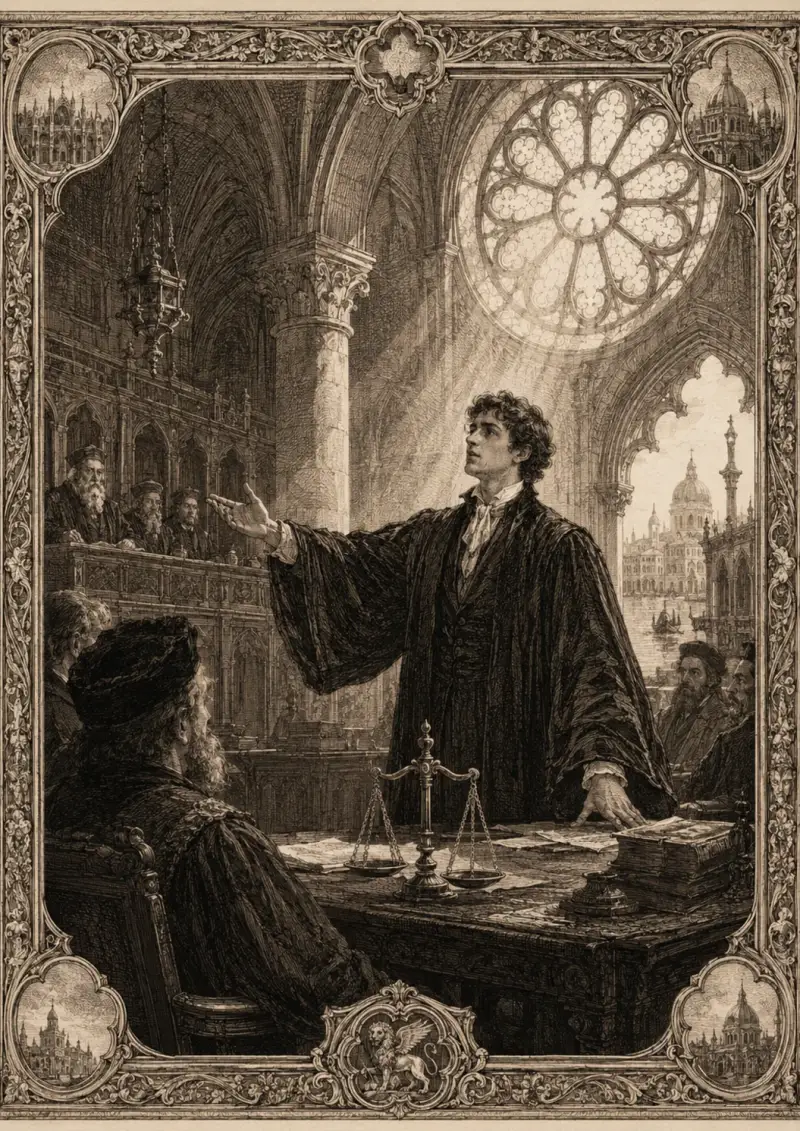
The passage
The quality of mercy is not strained.
Portia · The Merchant of Venice · Act 4, Scene 1
It droppeth as the gentle rain from heaven
Upon the place beneath. It is twice blest:
It blesseth him that gives and him that takes.
’Tis mightiest in the mightiest; it becomes
The throned monarch better than his crown.
His scepter shows the force of temporal power,
The attribute to awe and majesty
Wherein doth sit the dread and fear of kings;
But mercy is above this sceptered sway.
It is enthroned in the hearts of kings;
It is an attribute to God Himself;
And earthly power doth then show likest God’s
When mercy seasons justice.
In plain English
Mercy, by its nature, cannot be forced. It falls like gentle rain from the sky onto the ground below. It carries a double blessing: it blesses the person who gives it and the person who receives it. It is at its most powerful in the most powerful people, and it suits a king on his throne better than his crown does. A king’s sceptre stands for worldly power, the thing that makes people fear and respect him. But mercy is higher than the rule of the sceptre. Its throne is in the hearts of kings. It is a quality of God Himself, and human power is most like God’s when justice is tempered with mercy.
Where it comes in the play
The Merchant of Venice (c. 1596-97) turns on a bond. The merchant Antonio has borrowed three thousand ducats from Shylock, a Jewish moneylender whom he has publicly insulted and spat upon, agreeing that if he fails to repay on time Shylock may cut a pound of his flesh. Antonio’s ships are lost, the date passes, and Shylock, whose daughter has just eloped with a Christian and taken his money, demands his bond in open court.
Portia, a wealthy heiress newly married to Antonio’s friend Bassanio, arrives disguised as a young male lawyer called Balthazar. She establishes that the bond is legally valid, and then says: Then must the Jew be merciful
.
Shylock seizes on one word: On what compulsion must I? Tell me that
. The famous speech is her answer. Remember who is speaking: a woman dressed as a man, with no real standing as a judge, addressing a man the court calls by his religion and not his name (on the weight names carry, see “What’s in a name?”).
Close reading
“Not strained”
The first line replies directly to Shylock’s compulsion
. strained
means constrained or forced, and quality
means nature or character. Portia concedes his point and turns it: you are right that you cannot be made to show mercy, because mercy that is forced is not mercy.
Rain
The simile that follows is the centre of the speech: mercy droppeth as the gentle rain from heaven / Upon the place beneath
. Rain is not earned. It falls freely, from above to below, and it gives life to what it lands on. The sense runs over the line end without pause (enjambment), so the sentence itself descends like the thing it describes. And the direction matters: mercy comes down, from the one with power to the one without.
Mercy is twice blest: / It blesseth him that gives and him that takes
. The balanced line is also a quiet appeal to self-interest. In a play full of loans and interest, Portia presents mercy as the one transaction in which both sides profit.
The king and the crown
Next the argument turns to power: ’Tis mightiest in the mightiest
. The repetition of the superlative is a form of flattery. Shylock, an outsider all his life, holds a Christian merchant’s life in his hands. Portia tells him that this is exactly the position in which mercy is most impressive.
Mercy becomes / The throned monarch better than his crown
, where becomes
means suits or adorns. The sceptre represents the force of temporal power
, that is, power belonging to time and this world, the source of the dread and fear of kings
. Against this Portia sets an antithesis introduced by But
: mercy is above this sceptered sway
. The image of the throne is then moved inward. Mercy is enthroned in the hearts of kings
.
The climax is theological: mercy is an attribute to God Himself
, and human rulers resemble God most When mercy seasons justice
. To season is to moderate a flavour. Portia does not ask for justice to be abolished, only tempered.
The turn to Shylock
The speech continues past the lines usually quoted, and its sharpest move comes there: Therefore, Jew, / Though justice be thy plea, consider this: / That in the course of justice none of us / Should see salvation
. If God dealt with human beings strictly according to what they deserve, nobody would be saved. She adds: We do pray for mercy, / And that same prayer doth teach us all to render / The deeds of mercy
. The allusion is to the Lord’s Prayer, with its request to be forgiven as we forgive.
Two details complicate the effect. The pronouns us
and We
claim common ground, but the argument rests on a Christian prayer and a Christian idea of salvation, addressed to a man she calls Jew
. Shylock replies: My deeds upon my head! I crave the law
.
What it tells us about the play
The trial stages a contest between two principles, justice and mercy, or the letter of the law and its spirit. Shylock says I stand here for law
. Portia speaks for mercy.
But look at how. Portia does not defeat Shylock with mercy. She defeats him with a reading of the bond more literal than his own: This bond doth give thee here no jot of blood
. Having praised what cannot be strained, she strains the text. She then promises The Jew shall have all justice
, and the court turns the law on him: his goods are forfeit, his life lies at the Duke’s discretion, and as a condition of leniency Antonio requires that He presently become a Christian
. To the Christians on stage this may be mercy, since his life is spared. To Shylock it is the loss of his identity, and his last words in the play are I am not well
.
So the speech raises the play’s hardest question: do the Christians practise what Portia preaches? Shylock has already accused them of teaching him his cruelty: The villainy you teach me I will execute
. Modern productions and critics have found the play’s treatment of Shylock deeply troubling, and a good essay will hold both things together: the speech is sincere and beautiful, and the scene around it is full of irony.
In The Tempest, Prospero has his enemies at his mercy and decides that The rarer action is / In virtue than in vengeance
; the Tempest study guide discusses that choice. For another great piece of public persuasion, and one that succeeds, compare Mark Antony’s oration in “Friends, Romans, countrymen”.
What people get wrong
strained
means stretched or filtered. It means forced. The line answers Shylock’s question about compulsion.- “The speech works.” It does not persuade Shylock. Portia wins the case by a legal technicality.
Using it in an essay
Top-band answers analyse the speech’s persuasive method and then place it against the outcome of the trial. The close reading toolkit gives a method for rhetoric as well as poetry, and the essay planner helps you build a two-sided argument without losing your own line.
Fragments worth memorising:
is not strained
- mercy cannot be compelled; a direct answer to Shylock.the gentle rain from heaven
- simile: free, life-giving, descending from power.It is twice blest
- mercy as mutual profit in a play about bonds.When mercy seasons justice
- justice tempered, not abandoned.none of us / Should see salvation
- the Christian basis of the appeal.
Long speeches reveal their structure on rereading, one reason to try Daily Bard, which shows a single passage each day with a plain-English reading on the back of the leaf. For terms such as droppeth
and blesseth
, the guide to Shakespeare’s language explains the older verb endings, and the assessment map shows how analysis of this kind is credited across courses.
If questions of justice and revenge interest you, the Hamlet study guide follows another character who must decide what a wrong deserves. And if you would like these speeches to become familiar company, the Daily Bard app for iPhone and iPad is free to download; in the Full Edition, the Catalogue lets you browse by play. It is a companion to reading, not a shortcut around it.