
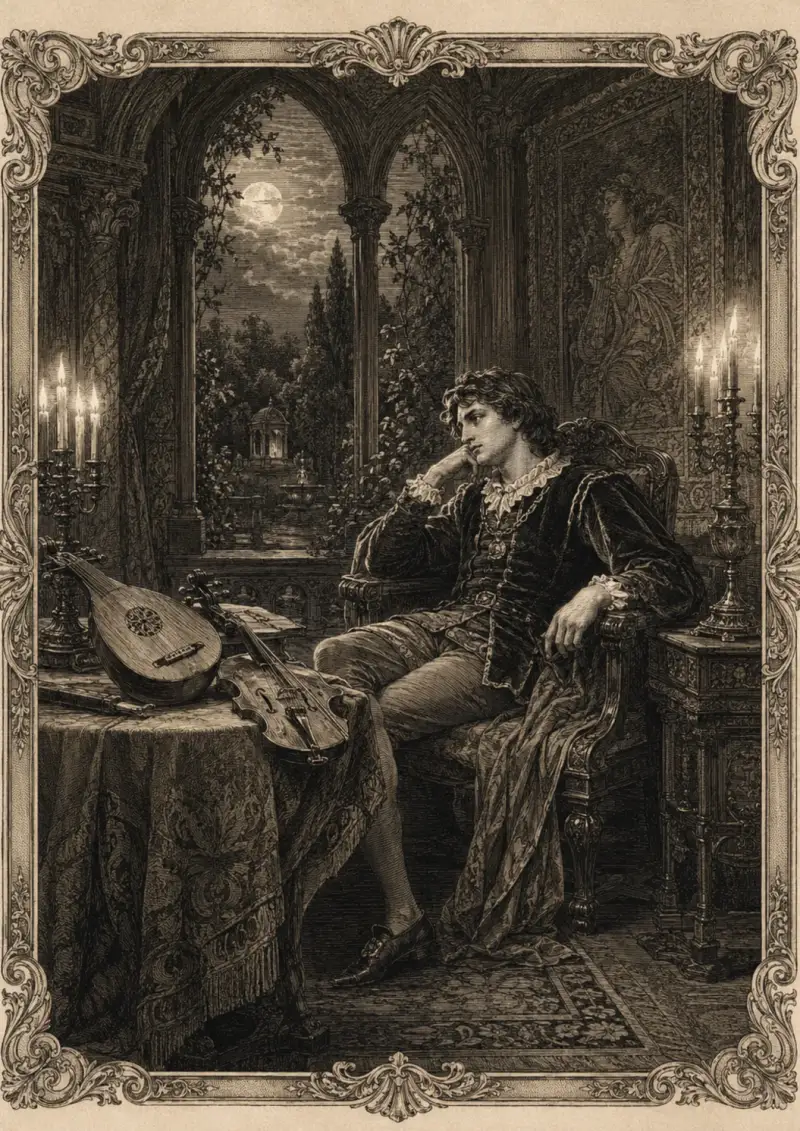
The passage
If music be the food of love, play on.
Twelfth Night · Act 1, Scene 1
Give me excess of it, that, surfeiting,
The appetite may sicken and so die.
That strain again! It had a dying fall.
O, it came o’er my ear like the sweet sound
That breathes upon a bank of violets,
Stealing and giving odor. Enough; no more.
’Tis not so sweet now as it was before.
O spirit of love, how quick and fresh art thou,
That, notwithstanding thy capacity
Receiveth as the sea, naught enters there,
Of what validity and pitch soe’er,
But falls into abatement and low price
Even in a minute. So full of shapes is fancy
That it alone is high fantastical.
In plain English
If music feeds love, keep playing. Give me too much of it, so that my appetite, overfed, grows sick and dies. Play that phrase again: it had a falling, fading close. It came over my ear like the sweet sound of a breeze on a bank of violets, taking their scent and giving it out again. Enough, stop. It is not as sweet now as it was. Spirit of love, how lively and hungry you are. You can take in as much as the sea, and yet nothing enters you, however valuable or exalted, without losing its worth within a minute. Love is so full of imagined shapes that nothing else is so wildly fanciful.
Where it comes in the play
These are the first lines of Twelfth Night (c. 1601-02). The play opens on music already playing, in the court of Orsino, Duke of Illyria. He is in love with the Countess Olivia, who will not see him. The speech is addressed to his musicians and to the air.
The audience knows nothing yet, and what the speech establishes is a mood: luxurious, melancholy and restless. Only afterwards do we learn the facts. Olivia has vowed to mourn her dead brother for seven years, veiled like a nun. In the next scene Viola is washed ashore from a shipwreck, and the plot begins.
Close reading
The first word
The play’s first word is a conditional. Orsino does not say that music is the food of love. He supposes it, and draws a consequence. The line is regular iambic pentameter with a pause (caesura) after love
, so that the two blunt monosyllables play on
arrive as a command at the end.
Feeding in order to starve
The next two lines reverse what the first seems to promise. Orsino wants excess
so that, surfeiting
, his appetite may sicken and so die
. To surfeit is to eat until you are ill. He is asking to be cured of love by overdose.
The metaphor of love as appetite runs through the play. Later Orsino boasts that women’s love is mere appetite
that suffers surfeit, cloyment, and revolt
, while his own is all as hungry as the sea
. The first speech has already shown whose love behaves like appetite.
Seven lines, three moods
That strain again!
One musical phrase has caught him, and he wants it repeated. A dying fall
is a cadence that sinks away, and the word dying
picks up die
from the line before. What he enjoys is the sound of dying.
Then comes the loveliest image in the speech. The music is like a sweet sound / That breathes upon a bank of violets, / Stealing and giving odor
. The senses blur: a sound that breathes, and carries scent. This mixing of senses is called synaesthesia. (Some editors have altered sound
to “south”, meaning the south wind. Folger keeps the reading of the earliest text.)
Then, halfway through a line: Enough; no more.
The pauses break the rhythm, and a rhyme snaps the mood shut: ’Tis not so sweet now as it was before.
In seven lines Orsino has demanded music, relished it and tired of it. We have watched his attention fail in real time.
The sea that cheapens everything
The second half of the speech turns from music to love itself, addressed as a spirit: O spirit of love, how quick and fresh art thou
. quick
means lively and fresh
means eager, hungry. Love has the capacity
of the sea, which receives everything.
But the vocabulary shifts to the market. Whatever enters love, Of what validity and pitch soe’er
(of whatever value and height), falls into abatement and low price / Even in a minute
. validity
, abatement
, price
: these are words for goods losing their worth. Orsino is generalising what has just happened with the music. Desire, for him, swallows everything and values nothing for long.
The sea is not a neutral image in this play. Within minutes we meet Viola, who has just escaped it and fears her brother has drowned. For Orsino the sea is a figure of speech. For her it is a fact.
Fancy
The speech ends with a definition: So full of shapes is fancy / That it alone is high fantastical
. fancy
meant both love and imagination, and the double sense matters. Orsino’s love is a work of imagination. In fifteen lines about love he has not mentioned the woman he loves. When Olivia’s name does come, it leads at once into a pun on hart and heart, and he pictures himself as a deer torn by his own desires, like fell and cruel hounds
. Orsino is the hero of his own suffering. Olivia is hardly in the picture.
What it tells us about the play
The speech introduces a play about excess. Its title names the last night of the Christmas season, the final feast before ordinary life resumes, and nearly everyone in it has too much of something: Orsino of love-melancholy, Olivia of mourning, Sir Toby of drink, Malvolio of self-love. Each is, in the opening metaphor, surfeiting.
It also establishes changeableness as Orsino’s nature. Feste later tells him to his face that his mind is a very opal
, a stone that shifts colour with the light. He admits that men’s fancies are more giddy and unfirm
than women’s, and then claims the opposite within the same scene. At the end of the play he transfers his love from Olivia to Viola in a matter of lines. The opening speech has prepared us to believe it.
Against him the play sets Viola. Where he talks, she conceals. Her account of a love that is never spoken, of a woman who sat like Patience on a monument, / Smiling at grief
, is the constancy Orsino lacks, and she is describing, in disguise, her own love for him. Her question, Was not this love indeed?
, is the play’s reply to its first speech.
Orsino is a version of the Petrarchan lover, pining ornamentally for an unreachable lady, the same pose Romeo strikes over Rosaline before he meets Juliet (see our essay on “But soft, what light through yonder window breaks?”). For the ideal that Orsino fails, a love that does not alter, read Sonnet 116.
Finally, music frames the play. It begins with an instrumental phrase cut off by a duke who has had enough, and it ends with Feste alone, singing that the rain it raineth every day
. The first music feeds a mood. The last tells the truth about the weather.
What people get wrong
It is not a celebration of music or of love. On posters and concert programmes the first line stands alone and sounds joyful. The sentence continues, and its aim is to kill the appetite by overfeeding it.
play on
is not the conclusion. Seven lines later Orsino says Enough; no more
. Quoting only the opening misses the reversal that defines him.
The speech is not about Olivia. She is not named in it. Its subject is Orsino’s own sensations, which is Shakespeare’s first joke at his expense.
Using it in an essay
Opening speeches let you write about how a dramatist sets up expectations. Use this one for questions on love, on excess and festivity, or on the presentation of Orsino. Comment on the conditional, the appetite metaphor and the abrupt change of mind. The close reading toolkit offers a method for analysing an opening, and the guide to Shakespeare’s language explains terms such as caesura.
Fragments worth memorising:
If music be the food of love, play on
- a conditional, not a declaration.The appetite may sicken and so die
- the real aim: a cure by excess.Enough; no more
- the mid-line reversal that shows his inconstancy.So full of shapes is fancy
- love as imagination, and as self-absorption.
To develop this into a full answer, the essay planner sets out a structure. For another Shakespearean comedy that tests the language of lovers, see “The course of true love never did run smooth” and the study guide to A Midsummer Night’s Dream, and for another comic speech usually quoted out of context, “All the world’s a stage”.
If you would like a short daily meeting with Shakespeare’s language, the Daily Bard app is free to download, with no subscription, and you can get it for iPhone and iPad as a companion to the plays themselves.