
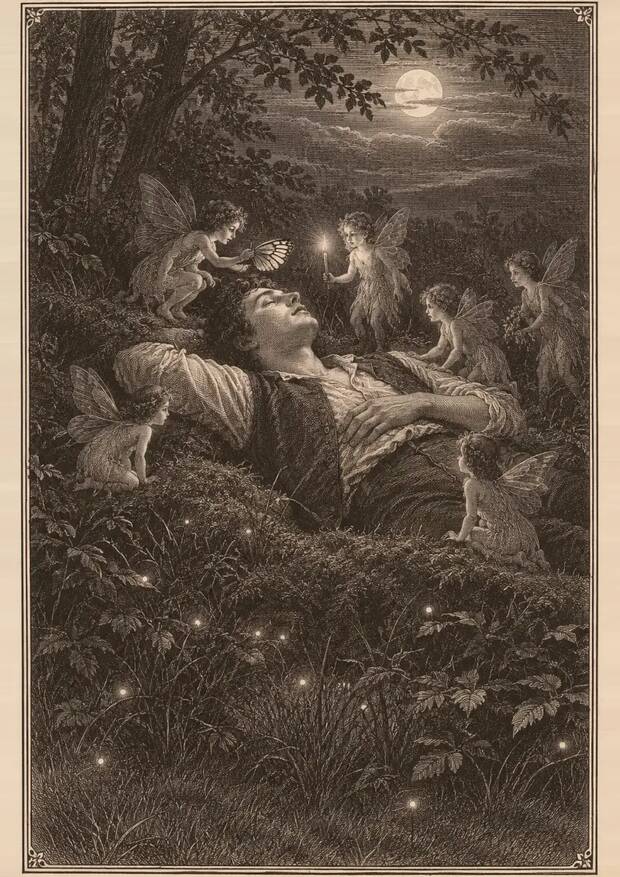
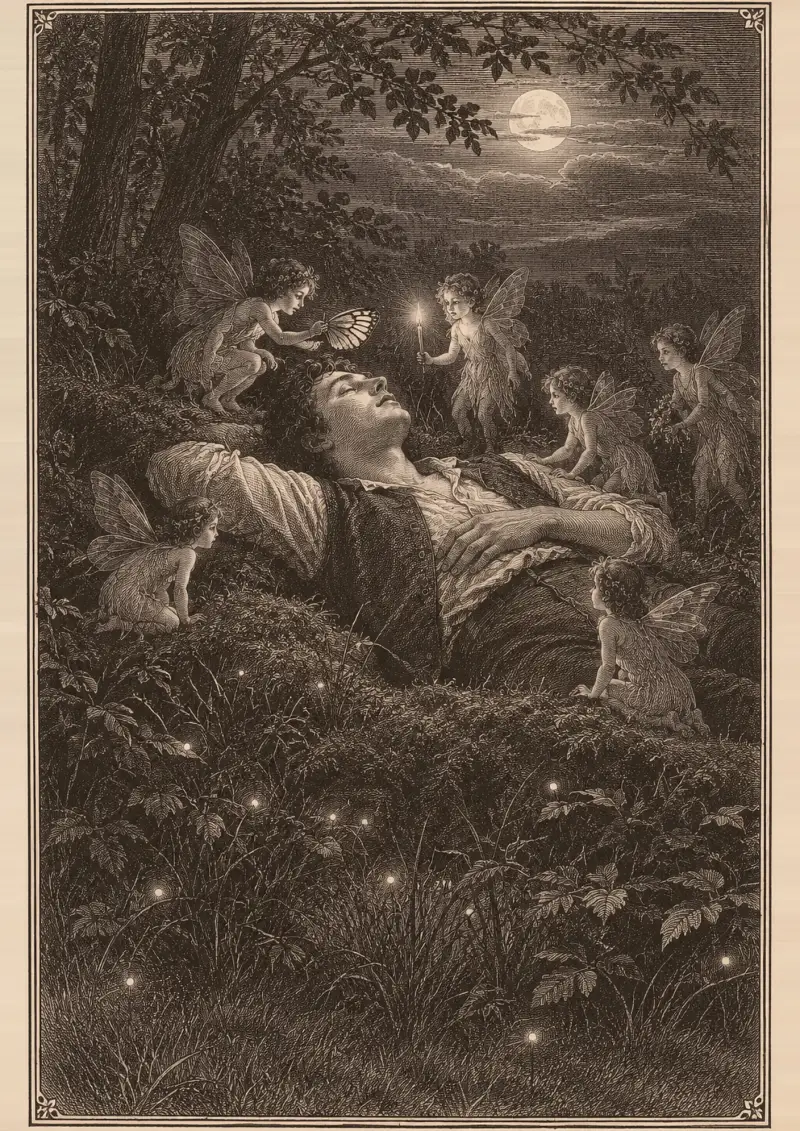
A Midsummer Night’s Dream: study cards (PDF)
PDF, 11 pages, 959 KB. Free, no sign-up, made to be printed.
Also for A Midsummer Night’s Dream: the study guide and the quotation sheet (PDF).
How to use the cards
Each card has one quotation from A Midsummer Night’s Dream on the front. Say who speaks it, where it comes in the play, and what it means, then turn the card to check. Mark the ones you know and the deck will skip them next time on this device; keep turning the rest until they stick.
Every card comes from the study guide and the quotes-by-theme pages, so each one links back to the full analysis. On paper, print the PDF, cut along the dashed lines and fold each strip down the middle.
The cards
-
Card 1 of 38
Hippolyta, I wooed thee with my sword
And won thy love doing thee injuries,Who says it, when, and what does it mean?
Card 1 of 38
Theseus · Act 1, Scene 1
I courted you by conquering you, and won your love by harming you.
-
Card 2 of 38
As she is mine, I may dispose of her,
Who says it, when, and what does it mean?
Card 2 of 38
Egeus · Act 1, Scene 1
She belongs to me, so I can do what I like with her.
-
Card 3 of 38
The course of true love never did run smooth.
Who says it, when, and what does it mean?
Card 3 of 38
Lysander · Act 1, Scene 1
True love has always met with obstacles.
-
Card 4 of 38
Love looks not with the eyes but with the mind;
And therefore is winged Cupid painted blind.Who says it, when, and what does it mean?
Card 4 of 38
Helena · Act 1, Scene 1
Love sees what the mind imagines, not what is there, which is why Cupid is shown blind.
-
Card 5 of 38
Things base and vile, holding no quantity,
Love can transpose to form and dignity.Who says it, when, and what does it mean?
Card 5 of 38
Helena · Act 1, Scene 1
Love can take worthless, shapeless things and give them beauty and value.
In an essay: Use it as the play’s theory of love, stated before the fairies arrive. The flower later does literally what Helena describes, most plainly when Titania finds an ass beautiful.
Quotes about love
-
Card 6 of 38
I would my father looked but with my eyes.
Rather your eyes must with his judgment look.Who says it, when, and what does it mean?
Card 6 of 38
Hermia and Theseus · Act 1, Scene 1
Hermia: I wish my father could see with my eyes. Theseus: No. Your eyes must see with his judgement.
In an essay: This is love’s first obstacle, authority, and the start of the play’s eye imagery. Note the irony that Hermia trusts her eyes in a play where eyes are about to be drugged.
Quotes about love
-
Card 7 of 38
Swift as a shadow, short as any dream,
Brief as the lightning in the collied night,Who says it, when, and what does it mean?
Card 7 of 38
Lysander · Act 1, Scene 1
As quick as a shadow, as short as a dream, as brief as lightning in a coal-black night.
In an essay: Use it as the baseline. At the start, dream means brevity and loss. Our essay on “The course of true love” reads the whole speech.
Quotes about dreams and illusion
-
Card 8 of 38
To you, your father should be as a god,
One that composed your beauties, yea, and one
To whom you are but as a form in wax
By him imprinted, and within his power
To leave the figure or disfigure it.Who says it, when, and what does it mean?
Card 8 of 38
Theseus · Act 1, Scene 1
You should treat your father as a god. He made you, and you are like a wax figure he has stamped, which he may keep or destroy as he pleases.
In an essay: Use it to establish that order in Athens is patriarchal (ruled by fathers) and backed by death. The audience is made to dislike it, which is why the flight to the wood feels justified.
Quotes about order and misrule
-
Card 9 of 38
There, gentle Hermia, may I marry thee;
And to that place the sharp Athenian law
Cannot pursue us.Who says it, when, and what does it mean?
Card 9 of 38
Lysander · Act 1, Scene 1
There I can marry you, Hermia, and the harsh law of Athens cannot follow us.
In an essay: Use it to show misrule beginning as a reasonable escape. Then note the irony: they never reach the aunt, and the wood they enter is already under another ruler’s quarrel.
Quotes about order and misrule
-
Card 10 of 38
An you should do it too terribly, you would fright the Duchess and the ladies that they would shriek, and that were enough to hang us all.
Who says it, when, and what does it mean?
Card 10 of 38
Quince · Act 1, Scene 2
If you roared too frighteningly, you would scare the Duchess and the ladies into screaming, and that would be enough to get us all hanged.
In an essay: Order in the play includes rank as well as family. Use this to show that even holiday entertainment is shaped by fear of superiors.
Quotes about order and misrule
-
Card 11 of 38
And this same progeny of evils comes
From our debate, from our dissension;
We are their parents and original.Who says it, when, and what does it mean?
Card 11 of 38
Titania · Act 2, Scene 1
All these disasters are the offspring of our quarrel; we are their cause.
-
Card 12 of 38
I am your spaniel, and, Demetrius,
The more you beat me I will fawn on you.Who says it, when, and what does it mean?
Card 12 of 38
Helena · Act 2, Scene 1
I am your dog; the worse you treat me, the more I will adore you.
-
Card 13 of 38
We cannot fight for love as men may do.
We should be wooed and were not made to woo.Who says it, when, and what does it mean?
Card 13 of 38
Helena · Act 2, Scene 1
Women cannot fight for love as men can. We are supposed to be courted, not to do the courting.
In an essay: Use it to show that love in the play has rules, and that the rules differ for men and women. The reversal is comic, but Demetrius’s threat of
mischief in the wood
is not.Quotes about love
-
Card 14 of 38
The juice of it on sleeping eyelids laid
Will make or man or woman madly dote
Upon the next live creature that it sees.Who says it, when, and what does it mean?
Card 14 of 38
Oberon · Act 2, Scene 1
Put this flower’s juice on a sleeper’s eyelids and he or she will fall madly in love with the next living thing seen.
In an essay: Treat the flower as a stage picture of an idea already stated in Act 1, that lovers see what the mind supplies. It also shows that illusion in this play is something the powerful do to others. For that side of it, see order and misrule.
Quotes about dreams and illusion
-
Card 15 of 38
Tarry, rash wanton. Am not I thy lord?
Then I must be thy lady.Who says it, when, and what does it mean?
Card 15 of 38
Oberon and Titania · Act 2, Scene 1
Oberon: Stay, you reckless, wilful creature. Am I not your husband and master? Titania: Then I must be your wife.
In an essay: A quotation that complicates the theme. The wood is supposed to be the place without rules, but its first quarrel is the Athenian one again: a male ruler who expects obedience.
Quotes about order and misrule
-
Card 16 of 38
The spring, the summer,
The childing autumn, angry winter, change
Their wonted liveries, and the mazed world
By their increase now knows not which is which.Who says it, when, and what does it mean?
Card 16 of 38
Titania · Act 2, Scene 1
Spring, summer, fruitful autumn and angry winter have swapped their usual clothes, and the bewildered world can no longer tell them apart by what they produce.
In an essay: Use it to show that misrule is not only festive. Its cost falls on
human mortals
who never appear, such as the ploughman who haslost his sweat
.Quotes about order and misrule
-
Card 17 of 38
The will of man is by his reason swayed,
And reason says you are the worthier maid.Who says it, when, and what does it mean?
Card 17 of 38
Lysander · Act 2, Scene 2
A man’s desire is ruled by his reason, and reason tells me you are the better woman.
In an essay: Argue that the flower exposes an ordinary habit. Lovers choose first and find reasons afterwards. The magic only removes the delay.
Quotes about love
-
Card 18 of 38
Methought a serpent ate my heart away,
And you sat smiling at his cruel prey.Who says it, when, and what does it mean?
Card 18 of 38
Hermia · Act 2, Scene 2
I dreamed a snake was eating my heart while you sat by and smiled.
In an essay: A quotation that complicates the theme. Hermia’s dream is more accurate than her waking belief in the next act that Lysander was as true as
The sun
is tothe day
.Quotes about dreams and illusion
-
Card 19 of 38
And yet, to say the truth, reason and love keep little company together nowadays.
Who says it, when, and what does it mean?
Card 19 of 38
Bottom · Act 3, Scene 1
To be honest, reason and love do not have much to do with each other these days.
In an essay: Bottom doubts that he deserves to be loved and is not carried away when he is, which makes him the sanest lover in the play. Set his prose against Lysander’s couplet to show the play siding with the clown.
Quotes about love
-
Card 20 of 38
And, for the more better assurance, tell them that I, Pyramus, am not Pyramus, but Bottom the weaver.
Who says it, when, and what does it mean?
Card 20 of 38
Bottom · Act 3, Scene 1
To make quite sure, tell the audience that I am not really Pyramus but Bottom the weaver.
In an essay: Use it to connect dreams to theatre. The workmen do not trust an audience to imagine, while Shakespeare’s own play builds a moonlit wood out of words.
Quotes about dreams and illusion
-
Card 21 of 38
Lord, what fools these mortals be!
Who says it, when, and what does it mean?
Card 21 of 38
Robin · Act 3, Scene 2
How foolish human beings are.
-
Card 22 of 38
So we grew together
Like to a double cherry, seeming parted,
But yet an union in partition,
Two lovely berries molded on one stem;Who says it, when, and what does it mean?
Card 22 of 38
Helena · Act 3, Scene 2
We grew up like a double cherry: two fruits that look separate but share one stalk.
In an essay: A quotation that complicates the theme. The most convincing union in the play is between two girls, and romantic love breaks it. No reconciliation is written for them, and in Act 5 neither woman speaks.
Quotes about love
-
Card 23 of 38
Am not I Hermia? Are not you Lysander?
I am as fair now as I was erewhile.Who says it, when, and what does it mean?
Card 23 of 38
Hermia · Act 3, Scene 2
Am I not still Hermia? Are you not still Lysander? I am as beautiful now as I was a few hours ago.
In an essay: Use it for the pain inside the farce. Hermia now stands exactly where Helena stood, which shows the lovers’ positions are interchangeable.
Quotes about love
-
Card 24 of 38
Then will two at once woo one.
That must needs be sport alone.
And those things do best please me
That befall prepost’rously.Who says it, when, and what does it mean?
Card 24 of 38
Robin · Act 3, Scene 2
Now two men will court one woman at the same time. That will be entertainment in itself. I like best the things that turn out back to front.
In an essay: Robin is the play’s spirit of misrule, and the audience shares his pleasure, which implicates us in the lovers’ distress.
Quotes about order and misrule
-
Card 25 of 38
Jack shall have Jill;
Naught shall go ill;
The man shall have his mare again, and all shall be well.Who says it, when, and what does it mean?
Card 25 of 38
Robin · Act 3, Scene 2
Every boy will get his girl, nothing will go wrong, each man will have what is his, and all will be well.
In an essay: Argue that the resolution is done to the lovers, not by them, and that the order restored is still one in which men have and women are had.
Quotes about order and misrule
-
Card 26 of 38
So doth the woodbine the sweet honeysuckle
Gently entwist; the female ivy so
Enrings the barky fingers of the elm.
O, how I love thee! How I dote on thee!Who says it, when, and what does it mean?
Card 26 of 38
Titania · Act 4, Scene 1
This is how climbing plants twine together, and how ivy circles the branches of the elm. How I love you. How I adore you.
In an essay: Ask whether enchanted love is any less felt. The speech is tender and absurd together.
Quotes about love
-
Card 27 of 38
And I have found Demetrius like a jewel,
Mine own and not mine own.Who says it, when, and what does it mean?
Card 27 of 38
Helena · Act 4, Scene 1
I have come upon Demetrius like a jewel someone finds: mine, and yet not really mine.
In an essay: The best single quotation for a qualified reading of the ending. Helena has what she wanted and does not quite trust it, and the audience knows she has reason.
Quotes about love
-
Card 28 of 38
My Oberon, what visions have I seen!
Methought I was enamored of an ass.Who says it, when, and what does it mean?
Card 28 of 38
Titania · Act 4, Scene 1
Oberon, what strange sights I have seen. I dreamed I was in love with a donkey.
In an essay: Show that “dream” is a label that suits the powerful. Oberon wants the night remembered as a dream. Titania asks how these things came to pass and is told
Silence awhile
.Quotes about dreams and illusion
-
Card 29 of 38
Are you sure
That we are awake? It seems to me
That yet we sleep, we dream.Who says it, when, and what does it mean?
Card 29 of 38
Demetrius · Act 4, Scene 1
Are you certain we are awake? It feels to me as if we are still asleep and dreaming.
In an essay: Use it to argue that waking does not restore certainty.
Quotes about dreams and illusion
-
Card 30 of 38
I have had a dream past the wit of man to say what dream it was. Man is but an ass if he go about to expound this dream.
Who says it, when, and what does it mean?
Card 30 of 38
Bottom · Act 4, Scene 1
I have had a dream beyond anyone’s power to describe. A man would be a fool to try to explain it.
In an essay: Bottom is the counterweight to Theseus. He treats the dream as beyond reason, not beneath it, and his instinct is to make art from it.
Quotes about dreams and illusion
-
Card 31 of 38
I never heard
So musical a discord, such sweet thunder.Who says it, when, and what does it mean?
Card 31 of 38
Hippolyta · Act 4, Scene 1
I never heard such a tuneful clash of sounds, such pleasant thunder.
In an essay: Use it to define the play’s idea of order. It is discord arranged, not discord removed. Link it to Act 5, where Theseus asks of the workmen’s play
How shall we find the concord of this discord?
Quotes about order and misrule
-
Card 32 of 38
Egeus, I will overbear your will,
For in the temple by and by, with us,
These couples shall eternally be knit.Who says it, when, and what does it mean?
Card 32 of 38
Theseus · Act 4, Scene 1
Egeus, I am overruling you. These couples will be married in the temple shortly, alongside us, for ever.
In an essay: The key quotation for a sceptical reading of the ending. Order is restored by breaking it, which reveals that Athenian law was always the Duke’s decision. Hermia is saved by power, not by principle.
Quotes about order and misrule
-
Card 33 of 38
The lunatic, the lover, and the poet
Are of imagination all compact.Who says it, when, and what does it mean?
Card 33 of 38
Theseus · Act 5, Scene 1
Madmen, lovers and poets are all made entirely of imagination.
-
Card 34 of 38
If we shadows have offended,
Think but this and all is mended:
That you have but slumbered here
While these visions did appear.Who says it, when, and what does it mean?
Card 34 of 38
Robin · Act 5, Scene 1
If our play has displeased you, pretend you were asleep and dreamed it.
In an essay: End on this to show the theme reaching the audience. Shakespeare returns to the idea in Prospero’s “such stuff as dreams”, where the comparison turns from a play to life itself.
Quotes about dreams and illusion
-
Card 35 of 38
So shall all the couples three
Ever true in loving be,Who says it, when, and what does it mean?
Card 35 of 38
Oberon · Act 5, Scene 1
So all three couples will be faithful in love for ever.
In an essay: Use it to close an argument: the play ends with love made constant by blessing, not by nature. Contrast “Pyramus and Thisbe”, the tragic version of the same story, played an hour earlier as
very tragical mirth
.Quotes about love
-
Card 36 of 38
And as imagination bodies forth
The forms of things unknown, the poet’s pen
Turns them to shapes and gives to airy nothing
A local habitation and a name.Who says it, when, and what does it mean?
Card 36 of 38
Theseus · Act 5, Scene 1
Imagination gives a body to things that do not exist, and the poet’s pen gives this empty air a shape, a place to live and a name.
In an essay: Do not quote this as the play’s view. Argue that Shakespeare lets a sceptic give the best account of art, and that the audience, having seen the fairies, knows he is wrong about the night.
Quotes about dreams and illusion
-
Card 37 of 38
But all the story of the night told over,
And all their minds transfigured so together,
More witnesseth than fancy’s images
And grows to something of great constancy,Who says it, when, and what does it mean?
Card 37 of 38
Hippolyta · Act 5, Scene 1
But the whole story, and the way all their minds were changed together, is evidence of more than fantasy, and adds up to something solid.
In an essay: The essential counter-quotation to Theseus. The structure gives the woman the last word in the argument, and the play’s events side with her.
Quotes about dreams and illusion
-
Card 38 of 38
Not a mouse
Shall disturb this hallowed house.
I am sent with broom before,
To sweep the dust behind the door.Who says it, when, and what does it mean?
Card 38 of 38
Robin · Act 5, Scene 1
Not even a mouse will disturb this blessed house. I have been sent ahead with a broom to sweep the dust behind the door.
In an essay: Use it for the ending’s balance. Misrule is not expelled from Athens. It is brought indoors and given a job.
Quotes about order and misrule
Next steps
When the deck is easy, write with it: take three cards and turn them into a paragraph with the essay planner, or test yourself on the quotation sheet and the questions and answers. For one passage a day without trying, Daily Bard puts a quotation and its plain-English reading on your phone each morning.
A page of Shakespeare, every day.
This resource comes from Daily Bard, an app for iPhone and iPad. Each morning it shows one engraved plate and one passage, exactly as Shakespeare wrote it, with a plain-English reading on the back of the leaf.
Free to download. The Full Edition is a one-time US$11.99: no subscription, no account, no ads, no tracking.
Get it on the App Store: apps.apple.com/app/id6792967225
More free study guides, lesson plans and close readings: dailybard.app