King Lear: key quotes and analysis (PDF)
PDF, 11 pages, 835 KB. Free, no sign-up, made to be printed.
The ten core quotations for King Lear, each with plain English, analysis and a fill-the-gap test. Or read the full study guide.
Nature in King Lear
King Lear argues that “nature” is the word people reach for to justify themselves, and it tests every version of the idea until none is left standing unqualified. For Lear and Gloucester, nature is a moral order: children are bound to parents, subjects to kings, and anyone who breaks the bond is unnatural
. For Edmund, nature is the opposite of that order. It is energy, appetite and ability, what a person has before law and custom rank them, and he takes it as his goddess
. Both men call on the same deity in the same act, for opposite ends.
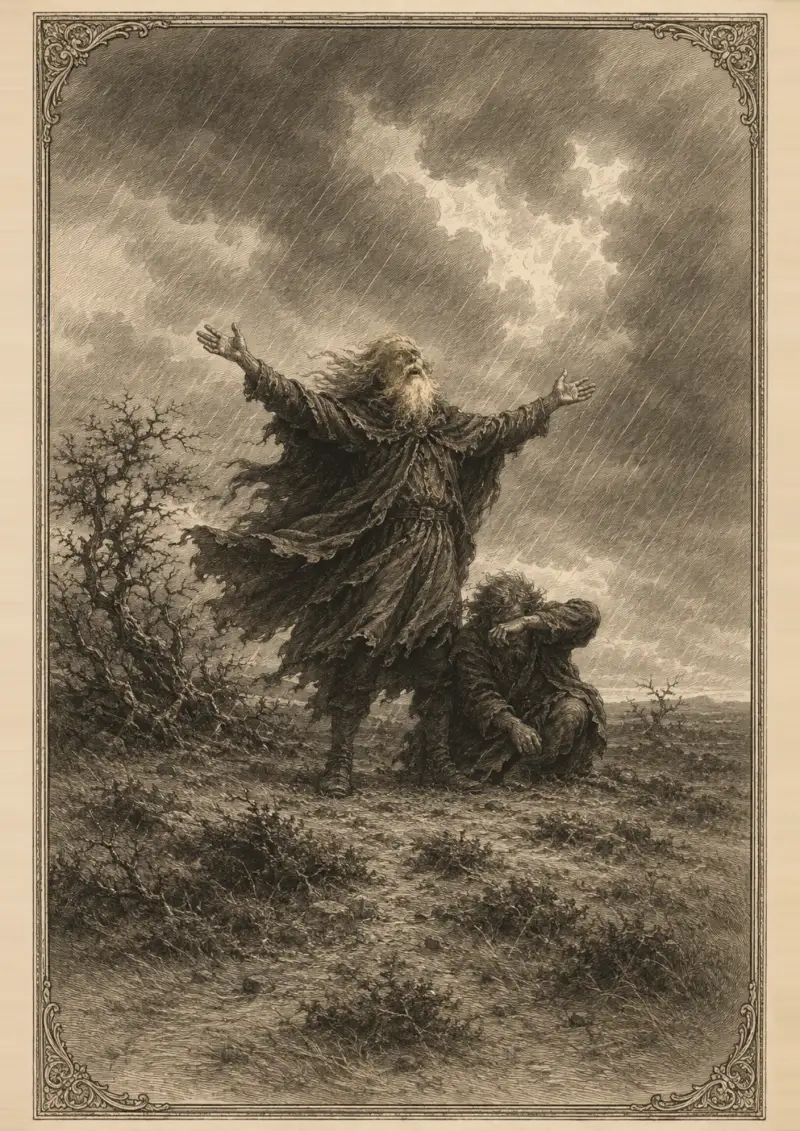
The play then sends its characters out of doors to see which account is true. The storm obeys nobody and takes no side. On the heath Lear meets a naked beggar and decides that the natural human being is a poor, bare, forked animal
, with no dignity that is not borrowed. Cruelty looks natural too: the daughters are called tigers, the future is imagined as creatures eating each other, and Lear asks whether there is any cause in nature
for a hard heart.
Yet Edmund’s creed does not hold either. Cordelia is said to redeem nature; a servant dies protecting an old man; Edmund’s own last act is attempted Despite of mine own nature
. The play ends without a verdict. Kindness and cruelty both grow in it, and nothing outside human beings enforces the difference.
Key quotations about nature
The quotations are in play order; for each one, ask which meaning of “nature” the speaker is using and what they gain by it.
Thou, Nature, art my goddess. To thy law
Edmund · Act 1, Scene 2 1.2.1-3
My services are bound. Wherefore should I
Stand in the plague of custom
Plain English: Nature, you are my goddess, and yours is the law I serve. Why should I put up with the curse of mere custom?
Context: Edmund’s first soliloquy (a speech of private thought, spoken alone on stage). As a younger and illegitimate son he can inherit nothing. He holds the forged letter that will ruin his brother.
Methods: The speech opens as a prayer, an apostrophe (a direct address to an absent thing or idea) to Nature
, and the religious and legal words goddess
, law
, services
, bound
are all transferred from society to something outside it. Against nature Edmund sets custom
, and the metaphor plague
makes inherited rules a disease. His “nature” is what he was born with, a body and a mind as good as anyone’s, and he rejects every rule laid on top of it.
In an essay: This is the challenge the rest of the play answers. In Shakespeare’s English an illegitimate child was a “natural” child, and Edmund turns the word into a philosophy. Set his goddess beside Lear’s in Act 1, Scene 4.
This is the excellent foppery of the world, that when we are sick in fortune (often the surfeits of our own behavior) we make guilty of our disasters the sun, the moon, and stars
Edmund · Act 1, Scene 2 1.2.125-128
Plain English: This is the world’s supreme foolishness: when things go badly for us, often through our own excesses, we blame the sun, moon and stars.
Context: Gloucester has just left, blaming family breakdown on These late eclipses in the sun and moon
. Edmund, alone, mocks him.
Methods: Edmund speaks prose here, the form of cool commentary, and his tone is satirical: excellent foppery
praises stupidity as if it were an achievement. The bracketed aside often the surfeits of our own behavior
gives the real cause in the language of overeating, so that sick in fortune
becomes a self-inflicted illness. make guilty
pictures people putting the heavens on trial for their own offences. He denies that the natural world sends signs or shapes character at all.
In an essay: The speech sounds modern and sensible, and the speaker is the villain. Use it to show that the play gives scepticism real force, then cite Kent’s opposite view in Act 4: It is the stars, / The stars above us govern our conditions
. Shakespeare stages the debate without settling it.
Hear, Nature, hear, dear goddess, hear!
Lear · Act 1, Scene 4 1.4.289-291
Suspend thy purpose if thou didst intend
To make this creature fruitful.
Plain English: Hear me, Nature, dear goddess. If you meant this creature to have children, change your plan.
Context: Goneril has demanded that Lear cut down his followers. In front of her husband he curses her with sterility.
Methods: Lear uses Edmund’s form of address, Nature
as goddess
, two scenes later, and the echo shows that the two men worship different things under one name. The threefold hear
and the imperative Suspend thy purpose
are commands: he expects nature to act as his officer. The irony is in what he asks. To punish an unnatural daughter he calls for the most unnatural thing, a womb made barren, and creature
removes her humanity before the curse begins.
In an essay: Use it to argue that Lear’s “nature” is really an extension of his own authority. He assumes the universe shares his sense of injury, an assumption the storm will destroy.
O sir, you are old.
Regan · Act 2, Scene 4 2.4.164-166
Nature in you stands on the very verge
Of his confine.
Plain English: Sir, you are old. Your life has reached the very edge of its allotted limit.
Context: Lear has fled to Regan expecting sympathy. She tells him instead to go back to Goneril and apologise, and that he should be ruled and led
by others.
Methods: Regan gives the word a third meaning: nature as the body’s span, the life that is running out. The spatial metaphor of verge
and confine
puts Lear at the edge of a territory, a cold image to use on a man who has just given his territory away. The flat statement you are old
is true and is used as a weapon. Nature, which Lear thought guaranteed a father’s rights, is now cited against him.
In an essay: A quotation that complicates the theme: the “unnatural” daughter argues from nature too, and from a fact nobody can deny. Lear’s bitter reply, Age is unnecessary
, shows he has understood her.
Nor rain, wind, thunder, fire are my daughters.
Lear · Act 3, Scene 2 3.2.17-19
I tax not you, you elements, with unkindness.
I never gave you kingdom, called you children
Plain English: Rain, wind, thunder and lightning are not my daughters. I do not accuse you elements of unkindness. I never gave you a kingdom or called you my children.
Context: On the heath in the storm. Lear has ordered the weather to destroy the world, in the speech discussed in our essay on “Blow winds, and crack your cheeks”. Now he reconsiders.
Methods: The list rain, wind, thunder, fire
names the elements one by one and then acquits them. unkindness
carries a double sense, cruelty and a failure of kinship, and the weather cannot be guilty of the second because it is not his kind. The negatives pile up, Nor
, not
, never
, as Lear works out that nature owes him nothing: obligation exists only where something was given. Seconds later he reverses himself and calls the elements servile ministers
of his daughters. He cannot yet bear a sky that is simply indifferent.
In an essay: The storm is often described as pathetic fallacy (weather mirroring feeling). This passage shows Lear himself doubting that reading. The storm is not on his side or against him.
Thou art the thing itself; unaccommodated man is no more but such a poor, bare, forked animal as thou art.
Lear · Act 3, Scene 4 3.4.113-115
Plain English: You are the real thing. A human being without the extras is nothing more than a poor, naked, two-legged animal like you.
Context: Lear studies Poor Tom, who is Edgar in disguise, shivering almost naked in the storm. He then begins to tear off his own clothes.
Methods: Lear speaks prose, and reasons like a man examining a specimen. the thing itself
claims to have found human nature with everything added by society removed; unaccommodated
means without clothing, shelter or possessions. The three adjectives poor, bare, forked
shrink in dignity, ending on the bare shape of a body with two legs. Just before, Lear lists what Tom has not borrowed: the worm no silk, the beast no hide, the sheep no wool
. Civilised humanity, by this reckoning, is dressed entirely in what it takes from animals.
In an essay: The play’s bleakest definition of human nature, and a reversal of reason not the need
in Act 2, where Lear insisted that people need more than animals do. Remember the irony: Tom’s nakedness is a disguise, so the thing itself
is an act.
Then let them anatomize Regan; see what breeds about her heart. Is there any cause in nature that make these hard hearts?
Lear · Act 3, Scene 6 3.6.80-82
Plain English: Then let them dissect Regan and see what is growing around her heart. Is there any natural cause that makes hearts so hard?
Context: Sheltering in a farmhouse, the mad Lear holds an imaginary trial of his daughters, with Poor Tom, the Fool and Kent as the bench.
Methods: The verb anatomize
(dissect) turns a moral problem into a medical one: Lear wants cruelty opened up and its source found in the body. breeds
suggests something growing in her like a disease. The question that follows is a real one, and nobody answers it. hard hearts
is a common metaphor, and Lear takes it literally, as if hardness could be found with a knife. He has stopped calling his daughters unnatural and started asking whether nature made them.
In an essay: Use it as the turning point in Lear’s thinking about nature. In Act 1 he was sure nature was on his side; here he suspects that cruelty may be as natural as love.
It will come:
Albany · Act 4, Scene 2 4.2.59-61
Humanity must perforce prey on itself,
Like monsters of the deep.
Plain English: It will happen: human beings will be forced to feed on one another, like monsters of the sea.
Context: Albany confronts Goneril over her treatment of Lear. He says that if the heavens do not send spirits to punish such crimes quickly, this is what will follow.
Methods: The short line It will come
has the flatness of a prophecy. perforce
(of necessity) makes cannibalism a law, not a choice, and the reflexive prey on itself
shows a species turning its appetite inward. The simile monsters of the deep
is the largest of the play’s animal images: creatures out of sight, eating each other. What Albany describes is nature as Edmund understands it, with nothing above it.
In an essay: The prediction comes true inside the villains’ own party: Goneril poisons Regan over Edmund. Use it to show that the play lets Edmund’s view of nature run to its conclusion, which is self-destruction.
Thou hast a daughter
Gentleman · Act 4, Scene 6 4.6.225-227
Who redeems nature from the general curse
Which twain have brought her to.
Plain English: You have one daughter who rescues nature from the universal curse that the other two have brought on it.
Context: The mad Lear has just run from Cordelia’s attendants. One of them speaks these lines after him.
Methods: redeems
is a word of rescue and of religion, and it gives Cordelia a saving role without anyone needing to name a god. Nature is personified as her
, something that can be shamed and restored. The numbers matter: one daughter is set against twain
, so goodness is outnumbered but outweighs. Goneril and Regan, then, do not prove what nature is. Cordelia is as natural as they are, born of the same parents, a fact Kent puzzles over in Act 4, Scene 3.
In an essay: The strongest counter-evidence to a wholly bleak reading. Then test it: the speaker is a minor character, and Cordelia’s death raises the question of what her redemption achieved.
Why should a dog, a horse, a rat have life,
Lear · Act 5, Scene 3 5.3.370-371
And thou no breath at all?
Plain English: Why should a dog, a horse or a rat be alive, when you have no breath at all?
Context: Lear is bent over the body of Cordelia, who has been hanged in prison on Edmund’s order. These are among his last words.
Methods: The list descends, a dog, a horse, a rat
, to the lowest creature Lear can think of, in bare monosyllables. Animals, used all through the play as insults, now appear as plain facts: they are alive. The question Why should
asks nature for a reason and receives none. breath
reduces life to its physical minimum, the thing he has been testing for with a looking glass and a feather. In Act 1 Lear commanded nature as a goddess; here it is only the difference between breathing and not.
In an essay: The ending of the theme. Nature gives life without regard to worth, which answers Lear’s earlier belief that it rewards the deserving. Pair it with cheap as beast’s
in Act 2.
How the theme develops
| Where | What happens to the theme | Quotation to know |
|---|---|---|
| Act 1 | Two ideas of nature are set up. Lear and Gloucester assume a moral order and call disobedient children unnatural; Edmund claims nature for appetite and merit. | Thou, Nature, art my goddess |
| Act 2 | The daughters turn natural facts, age and bare need, against their father. Lear argues that human life needs more than nature requires. | Man’s life is cheap as beast’s |
| Act 3 | Lear is exposed to the storm and finds it indifferent. He meets natural man in Poor Tom and asks whether cruelty has a natural cause. | unaccommodated man |
| Act 4 | Albany foresees humanity as predators. Against this, Cordelia returns, and sleep, called Our foster nurse of nature, helps to heal Lear. | Who redeems nature from the general curse |
| Act 5 | The predators destroy each other; Edmund tries to do good against his nature; Cordelia dies while animals live. | Despite of mine own nature |
The theme turns in Act 3. Until the storm, nature is something characters invoke: a goddess, a law, an excuse. On the heath it becomes something they are exposed to, and it has nothing to say. The last two acts set the healing in Cordelia’s camp against the hanging in the prison, and leave Lear’s Why
unanswered.
Model paragraph
Question: How does Shakespeare explore ideas about nature in King Lear?
Why it works: The paragraph compares two uses of one word and draws a conclusion from the echo, which is analysis of structure, not only of a line. Its quotations are short and embedded, it names a method (apostrophe), and its final sentence ties the argument to what the first audience believed.
Practice questions
- Read Edmund’s soliloquy at the start of Act 1, Scene 2. How does Shakespeare use it to present Edmund’s attitude to nature and to society?
- How does Shakespeare use the storm in Act 3 to challenge Lear’s beliefs about the natural world?
- “The animal imagery of King Lear suggests that cruelty is natural and kindness is not.” How far do you agree?
- Consider the claim that King Lear offers no stable meaning for the word “nature”, and that this instability is the play’s subject.
For the plot knowledge behind these questions, use the King Lear questions and answers and the context section of the study guide, which explains the belief in a natural hierarchy. The idea of the unnatural child belongs equally to the quotes about family, and Lear’s discoveries on the heath are traced in the quotes about madness.