
- Role
- Kinsman to the Prince and friend to Romeo; neither Montague nor Capulet
- First appears
- Act 1, Scene 4
- Last appears
- Act 3, Scene 1
- Key scenes
- 1.4, 2.1, 2.4, 3.1
- Speaks in
- Verse for Queen Mab; quick prose for most of his jokes, including the ’grave man’ speech
Romeo and Juliet: key quotes and analysis (PDF)
PDF, 11 pages, 842 KB. Free, no sign-up, made to be printed.
The ten core quotations for Romeo and Juliet, each with plain English, analysis and a fill-the-gap test. Or read the full study guide.
Who is Mercutio?
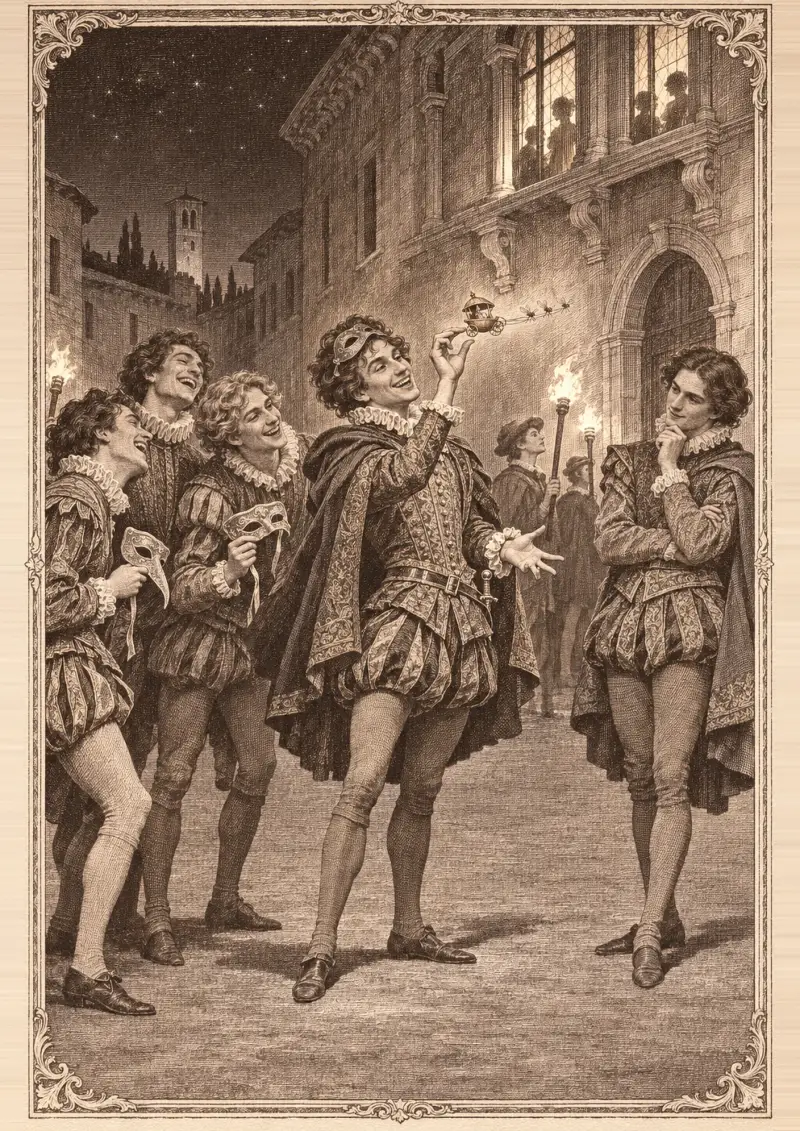
Mercutio is Romeo’s friend and the Prince’s kinsman. He belongs to neither feuding house, and his name is on Capulet’s guest list for the feast his Montague friends attend uninvited. Standing outside the quarrel, he is the play’s free voice: he can laugh at lovers, dreamers and swordsmen alike, and for two acts he does. Then he is killed in the feud he stood outside, and the play has no free voice left.
Mercutio is the play’s anti-romantic, and Shakespeare removes him at the midpoint because the tragedy cannot proceed while he is alive to laugh at it. The central question about him is how far he is the feud’s innocent victim. He curses both houses as he dies, and he is right that their quarrel has killed him. He is also the man who drew his sword first.
Mercutio across the play
Act 1, Scene 4: the mocker of dreams
On the way to the feast Mercutio tries to joke Romeo out of his lovesickness. His cure is blunt: be rough with love
. When Romeo mentions a dream, Mercutio launches into the Queen Mab speech, a brilliant fantasy that grows darker until Romeo stops him. At the feast itself he does not speak.
Act 2, Scene 1: outside the wall
Romeo has jumped the orchard wall. Mercutio, in the lane, pretends to summon him like a spirit, listing Rosaline’s body from her bright eyes
downward. He does not know that Rosaline is already forgotten, and Romeo, listening from the other side, answers him in one line before turning to Juliet.
Act 2, Scene 4: wit at full stretch
Next morning he mocks Tybalt as a fashionable duellist, More than prince of cats
, and then fights a duel of puns with Romeo, which Romeo wins. Mercutio is delighted: Now art thou sociable, now art thou Romeo
. It is his happiest scene, and he has misread its cause.
Act 3, Scene 1: the fight and the curse
In the afternoon heat he is restless and looking for trouble. Tybalt wants Romeo, not him, but when Romeo refuses to fight, Mercutio draws. He is stabbed under Romeo’s arm as Romeo tries to part them. He jokes, curses both houses and is helped away. Benvolio returns to report that he is dead.
After his death
Mercutio is gone before the play is half over. Nobody afterwards mocks love or fate. The Prince counts him among his losses: My blood for your rude brawls doth lie a-bleeding
. His curse keeps working too. It is a sickness in the city that seals up Friar John and stops the letter.
Reading the character
His wit keeps feeling at a distance
Mercutio turns everything into performance. Love becomes a dirty joke and even his own death becomes a pun. Romeo sees what the jokes are for: He jests at scars that never felt a wound
. He can laugh at love because it has never hurt him. The Queen Mab speech hints at something less comfortable. It begins as play and ends with soldiers cutting foreign throats
and a hag
pressing on sleeping girls, until Romeo has to calm him: Peace, peace, Mercutio, peace
. His wit looks like a defence, and the play never tells us against what.
He despises Tybalt’s style and shares his code
Mercutio’s contempt for Tybalt is contempt for a manner: the Italian fencing terms, the fighting by the book of arithmetic
. He never questions the principle that an insult must be answered with steel. When Tybalt asks for a word, Mercutio offers a word and a blow
. When Romeo declines the challenge, Mercutio feels the shame as his own. He is not a Montague, so nothing compels him. Shakespeare uses him to show that the honour code is wider than the two families. It is how young men in Verona prove themselves, as we argue in our quotes about conflict.
He dies without knowing why
Mercutio never learns that Juliet exists. On the morning of the wedding he still thinks Rosaline Torments
his friend. So he cannot understand why Romeo speaks gently to a Capulet, and his last question is real bewilderment: Why the devil came you between us?
This is dramatic irony (the audience knowing more than the character) at its harshest. A secret marriage, meant to end the feud, makes Romeo’s peacemaking look like cowardice and gets his friend killed. Mercutio’s curse blames both your houses
, and it leaves out his own part. The audience can hold both facts: the feud killed him, and he chose to fight.
Key quotations
These six quotations are in play order. The first four show the mocker, and the last two show what the mockery could not protect him from.
If love be rough with you, be rough with love.
Mercutio · Act 1, Scene 4 1.4.27-28
Prick love for pricking, and you beat love down.
Plain English: If love treats you roughly, treat it roughly back. Stab it for stabbing you, and you will defeat it.
Context: Romeo, refusing to dance, has complained that love is rough and pricks like thorn
. Mercutio answers on the way into the feast.
Methods: The first line is a chiasmus (a pattern in which terms repeat in reverse order): love, rough, rough, love. Prick
is a bawdy pun, so the advice is to cure love with sex. The verbs are a fighter’s verbs, prick
and beat
, and love is cast as an opponent. That joins desire to violence in the way the servants’ jokes did in the opening scene.
In an essay: The clearest statement of Mercutio’s view that love is appetite. Use it as the foil (the contrast) to the reverent language of the lovers’ sonnet a scene later.
O, then I see Queen Mab hath been with you.
Mercutio · Act 1, Scene 4 1.4.58-61
She is the fairies’ midwife, and she comes
In shape no bigger than an agate stone
On the forefinger of an alderman
Plain English: Then the fairy Queen Mab has visited you. She delivers dreams, and she is as tiny as the stone in a councillor’s ring.
Context: Romeo has said that he had a dream and that it is unwise to go to the feast. Mercutio cuts him off with a speech of over forty lines.
Methods: Mab is a midwife
because she brings dreams to birth, and the simile of the ring on an alderman’s finger shrinks her to the scale of a city ornament. The speech then builds her coach from insect parts in a long list. Its argument is satire. Each sleeper dreams of what he already wants, lovers of love and lawyers of fees
, so dreams reveal appetite, not the future. The structure matters most. The fancy speeds up and turns violent, and Mercutio cannot stop until Romeo interrupts.
In an essay: Use it to show Mercutio’s imagination and its dark edge. It is also the play’s case against omens, made just before an omen that comes true.
True, I talk of dreams,
Mercutio · Act 1, Scene 4 1.4.103-106
Which are the children of an idle brain,
Begot of nothing but vain fantasy,
Which is as thin of substance as the air
Plain English: Yes, I am talking about dreams, which are produced by a lazy mind out of nothing but empty imagination, as thin as air.
Context: Romeo has stopped the Queen Mab speech with Thou talk’st of nothing
. Mercutio agrees, and makes the agreement his point.
Methods: The metaphor is of parenthood. Dreams are children
, Begot
by fantasy on an idle brain
, and what is born is nothing. Vain
means empty, and the simile thin of substance as the air
removes the last solidity. Shakespeare then undercuts the scepticism. Within a few lines Romeo voices his fear of Some consequence yet hanging in the stars
, and the Prologue has told us that he is right.
In an essay: Mercutio speaks for reason in a play where forebodings prove true. Quote it when weighing fate against chance, alongside our quotes about fate.
Why, is not this better now than groaning for love? Now art thou sociable, now art thou Romeo, now art thou what thou art, by art as well as by nature.
Mercutio · Act 2, Scene 4 2.4.90-93
Plain English: Is this not better than moaning about love? Now you are good company, now you are yourself, both by nature and by skill.
Context: It is the morning after the feast. Romeo, secretly engaged to Juliet, has just beaten Mercutio in a fast exchange of puns.
Methods: The speech is prose, the medium of the friends’ banter. Anaphora (repetition at the start of successive clauses) drives it: now art thou
three times. Mercutio defines the real Romeo as the sociable
one, the wit among male friends, and treats the lover as an illness now cured. The pun on art
, meaning both “are” and “skill”, shows off the very quality he is praising. The irony is that returned love is what has given Romeo back his wit.
In an essay: Use it on identity and names: Mercutio and Juliet each claim to know who Romeo really is. Compare her reasoning in “What’s in a name?”.
O calm, dishonorable, vile submission!
Mercutio · Act 3, Scene 1 3.1.74-75
Alla stoccato carries it away.
Plain English: What a calm, shameful, disgusting surrender. The fencer’s thrust wins the day.
Context: Tybalt has called Romeo a villain. Romeo, married to Tybalt’s cousin an hour ago, has answered that he loves him. Mercutio draws his sword as he speaks.
Methods: Three adjectives rise in disgust, and the first is the most revealing. In the feud’s vocabulary calm
is an insult. The scene began in his loose prose. By now the quarrel has tightened into verse, which gives the judgement a formal ring. Alla stoccato
is an Italian fencing term for a thrust, the kind of jargon he mocked Tybalt for using, and here it stands as a scornful name for Tybalt himself. The honour at stake is Romeo’s, and Mercutio takes the shame on himself.
In an essay: The line that proves Mercutio shares the honour code. It is also the hinge of the plot: this is the moment an avoidable fight becomes unavoidable.
No, ’tis not so deep as a well, nor so wide as a church door, but ’tis enough. ’Twill serve. Ask for me tomorrow, and you shall find me a grave man. I am peppered, I warrant, for this world. A plague o’ both your houses!
Mercutio · Act 3, Scene 1 3.1.100-104
Plain English: The wound is not as deep as a well or as wide as a church door, but it will do. Ask for me tomorrow and you will find me serious, and in my grave. I am finished. A curse on both your families.
Context: Mercutio has been stabbed. Romeo, who cannot see how bad the wound is, has told him that it cannot be much.
Methods: He answers in prose and in understatement, measuring the wound against homely things, a well and a church door. The pun on grave
, serious and buried, is the play’s most famous joke, and it is the point at which joking stops being possible. Then the tone breaks into the curse, which he speaks three times in all. Comedy turns into tragedy inside one paragraph.
In an essay: Use the pun to show how Shakespeare changes the play’s genre in a single speech, and the curse as a judgement on the feud from a man who belongs to neither side.
Relationships
Mercutio and Romeo
Mercutio’s energy is spent on Romeo: teasing him, searching for him, welcoming him back. He wants the friend he had before love. Romeo keeps him at a distance, describing him to the Nurse as one who loves to hear himself talk
and telling him nothing about Juliet. The friendship ends in the most painful exchange in the play. Mercutio asks why Romeo came between them, and Romeo can only say I thought all for the best
.
Mercutio and Tybalt
They are opposites in manner and alike in pride. Tybalt is all formal anger. Mercutio mocks him as Good king of cats
and a ratcatcher
, and the mockery is the provocation. Tybalt came looking for Romeo and greets Mercutio politely enough. It is Mercutio who turns the meeting into a fight, and Tybalt who lands the fatal thrust and runs.
Mercutio and Benvolio
Benvolio is the peacemaker, and his opening words in Act 3 are a plea to go indoors. Mercutio replies by accusing him, absurdly, of being a man who would quarrel with someone for cracking nuts
. The portrait fits Mercutio far better, and describes the mood that kills him.
How the character has been read
Mercutio has often been thought the most vivid character in the play, and it has long been said that Shakespeare had to kill him before he took the play over. The guide calls it the hinge of the whole play, the point at which comedy stops. A reading that stresses structure sees him less as a person than as a function: the voice of laughter that tragedy must silence.
Readings that stress character divide over what lies under the wit. Some take him as a healthy realist whose bawdy common sense corrects Romeo’s posing. Others hear in the Queen Mab speech a mind that finds nothing solid anywhere, in love, in dreams or in honour, and that fights because it is bored. Critics who read the feud as a display of masculinity place him at its centre, as the man who polices his friend’s courage.
Performance adds a further question about his feeling for Romeo. Some productions play it as possessive, even as love, and point to his hostility to Romeo’s romances. The text supports the intensity of the attachment and says nothing explicit beyond it.
Essay angles and a model paragraph
- Mercutio is a victim of the feud and an agent of it, and the play needs him to be both.
- Mercutio’s mockery of love tests the lovers’ language, which proves its worth by surviving the comparison.
- Mercutio speaks for reason against dreams and omens in a play that proves the omens right.
Question: How does Shakespeare use Mercutio to explore attitudes to love?
Why it works: It treats Mercutio as part of an argument about love and not as a personality sketch. It names a method, shows what it does, follows the idea into a second scene, and ends by saying what the contrast is for.
Practice questions
- Read Mercutio’s speeches from his wounding to his exit in Act 3, Scene 1. How does Shakespeare present his reaction to his own death?
- How does Shakespeare present Mercutio as a contrast to Romeo?
- Compare Mercutio and Tybalt as representatives of the code of honour in Verona.
- “Queen Mab is the play in miniature: a delightful fancy that turns into a nightmare.” Discuss.
For the wider picture, see quotes about love, the study questions and answers on Act 3, and the full Romeo and Juliet study guide.