
- Role
- Macbeth’s wife, later Queen of Scotland; his partner in the murder of Duncan
- First appears
- Act 1, Scene 5
- Last appears
- Act 5, Scene 1
- Key scenes
- 1.5, 1.7, 2.2, 3.2, 3.4, 5.1
- Speaks in
- Blank verse; prose for the letter she reads and in the sleepwalking scene
Macbeth: key quotes and analysis (PDF)
PDF, 11 pages, 813 KB. Free, no sign-up, made to be printed.
The ten core quotations for Macbeth, each with plain English, analysis and a fill-the-gap test. Or read the full study guide.
Who is Lady Macbeth?
Lady Macbeth is the wife of the play’s hero and the person who turns his wish for the crown into a plan. She persuades him to kill King Duncan, manages the night of the murder, and holds the court together when his nerve fails at the banquet. Then she almost vanishes from the play, returning once, asleep, to reveal a mind in ruins. Nobody in the dialogue ever calls her by a name of her own. She is defined by her marriage, and her ambition works through her husband.
The central question is whether she is the fiend-like queen
of Malcolm’s last speech or something more human. Lady Macbeth’s cruelty is an act of will against her own nature, and the play shows that will failing. Everything she says in Act 1 about remorse, pity and tenderness assumes that she has them and must get rid of them. Act 5 shows that she never did.
Lady Macbeth across the play
Act 1: the planner
She enters reading her husband’s letter and has decided on the outcome before she finishes speaking: he shalt be / What thou art promised
. Her fear is not of the deed but of his scruples. She calls on spirits to harden her and takes charge: Leave all the rest to me
. When he backs out in Scene 7 she attacks his love, his courage and his manhood until he gives way.
Act 2: the accomplice
She has drugged the grooms and steadied herself with drink, yet she starts at an owl’s cry and could not strike the sleeping King herself. When Macbeth returns helpless, her practicality saves them. She takes the daggers back, smears the grooms and scorns his fear of blood: A little water clears us of this deed
. At the discovery of the body she faints and is helped out, which may be acting or the first sign of strain.
Act 3: the queen who is shut out
She has the crown and no joy in it: Naught’s had, all’s spent
. She must send a servant to ask for her husband’s company, and he hides the plot against Banquo from her. At the banquet she is still formidable, covering for him and dismissing the lords, but once the guests have gone her lines are few, short and tired.
Acts 4 and 5: the sleepwalker
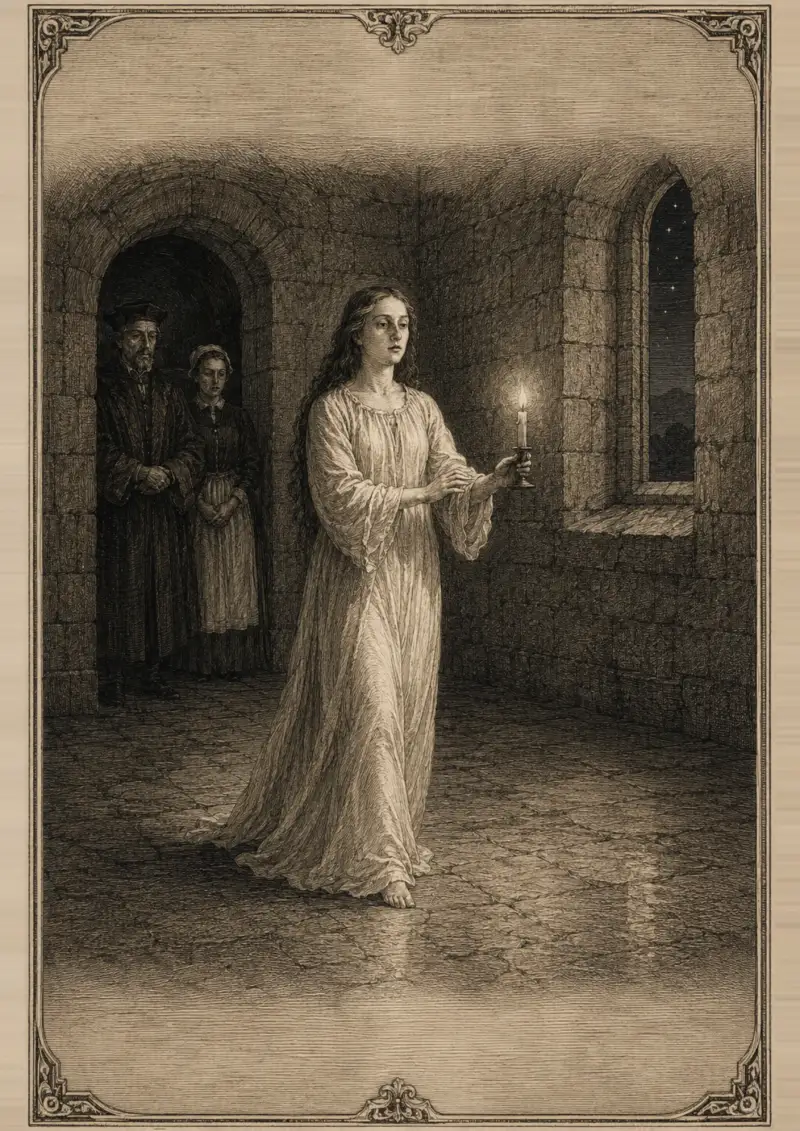
She is absent for the whole of Act 4, while Macbeth has Macduff’s family killed. In her last scene she walks in her sleep with a candle, rubbing at her hands and replaying the crimes in broken prose. Her death is reported in one line in Act 5, Scene 5, and Malcolm later says it is thought she took her own life.
Reading the character
Her cruelty is willed, not natural
A person who is cruel does not need to pray for cruelty. Lady Macbeth asks to be filled top-full / Of direst cruelty
and for night to come so that my keen knife see not the wound it makes
. Even in fantasy she does not want to look. The proof comes in Act 2: with the daggers ready and the King asleep, she cannot do it, because he resembles her father. She can plan a murder and tidy up afterwards, but the act itself is beyond her.
Her power is the power of speech
She holds no office and commands no soldiers. What she has is language and an exact knowledge of one man. She plans to chastise with the valor of my tongue
whatever holds him back, and Scene 7 shows the method: no moral argument at all, only questions about his courage and love. It works on Macbeth alone, and only while he listens. Once he stops confiding in her in Act 3, she has no other way to act.
She thinks a deed can be finished
Her confidence rests on one mistaken belief, that an action ends when it is over. Blood is something to wash off. The past is closed: What’s done is done
. The sleepwalking scene reverses each of her certainties. The hands will not come clean, and her phrase comes back changed: What’s done cannot be undone
. The page of Macbeth quotes about guilt sets the two versions side by side.
Key quotations
Yet do I fear thy nature;
Lady Macbeth · Act 1, Scene 5 1.5.16-18
It is too full o’ th’ milk of human kindness
To catch the nearest way.
Plain English: But I worry about your character. You are too full of ordinary human gentleness to take the quickest route.
Context: Her first speech in her own words, just after reading Macbeth’s letter about the Witches. She is alone and speaks to her absent husband.
Methods: The metaphor of milk
makes kindness a mother’s food, natural and nourishing, and she names it as a defect. That reversal of values echoes the Witches’ Fair is foul
. the nearest way
is a euphemism (a mild phrase for a harsh thing): she means murder and does not say it.
In an essay: Use it to show that she is the first to treat conscience as an obstacle, and that even she, at this stage, will not name the deed.
Make thick my blood.
Lady Macbeth · Act 1, Scene 5 1.5.50-53
Stop up th’ access and passage to remorse,
That no compunctious visitings of nature
Shake my fell purpose
Plain English: Thicken my blood. Block every route by which pity could reach me, so that no natural pangs of conscience weaken my deadly intention.
Context: From the soliloquy that follows the news that Duncan will sleep under her roof that night. She is calling on spirits to unsex me here
.
Methods: A string of imperatives (commands), Make
, Stop up
, gives the speech the form of a spell and aligns her with the Witches. The image is of a body being sealed against remorse. The key word is nature
. She expects compunctious visitings
, the pricks of conscience, to come naturally, and wants them prevented. The request admits what it tries to deny.
In an essay: The strongest evidence that she is not cruel by temperament. Link it to Act 5, where the remorse she blocked returns in sleep, the one state she cannot control.
I have given suck, and know
Lady Macbeth · Act 1, Scene 7 1.7.62-66
How tender ’tis to love the babe that milks me.
I would, while it was smiling in my face,
Have plucked my nipple from his boneless gums
And dashed the brains out
Plain English: I have nursed a baby and know how tenderly a mother loves it. Yet while it smiled up at me I would have torn it from my breast and smashed its skull.
Context: Macbeth has refused to go on. She tells him what she would have done sooner than break a promise like his.
Methods: The speech works by contrast. Two lines of real tenderness, with the soft words tender
, love
and smiling
, are followed by the violent verbs plucked
and dashed
. The detail of boneless gums
makes the child helpless and the image hard to bear. Its purpose is to shame him: if a mother could do this, a soldier can kill a king. Note the conditional I would
. It is a boast about a hypothetical, not a deed.
In an essay: Use it for her method of persuasion and for the play’s pattern of threatened children.
Had he not resembled
Lady Macbeth · Act 2, Scene 2 2.2.16-17
My father as he slept, I had done ’t.
Plain English: If he had not looked like my father as he lay asleep, I would have killed him myself.
Context: She waits alone while Macbeth is in Duncan’s chamber, and we learn that she has been in the room to lay out the daggers.
Methods: A single plain sentence, with no imagery, in the middle of a tense and broken speech. Its simplicity is the point: for a moment she is not performing. Structurally it comes only two scenes after the baby speech, and quietly contradicts it. The woman who claimed she could kill her own child could not kill a man who reminded her of a parent.
In an essay: The essential quotation for complicating the “evil” reading. It shows the visitings of nature
getting through after all.
Naught’s had, all’s spent,
Lady Macbeth · Act 3, Scene 2 3.2.6-9
Where our desire is got without content.
’Tis safer to be that which we destroy
Than by destruction dwell in doubtful joy.
Plain English: We have gained nothing and lost everything if we get what we wanted and are not happy. It would be better to be the dead man than to live, having killed him, in anxious pleasure.
Context: She is queen. Alone for a moment while a servant fetches Macbeth, she says what she will not say to him.
Methods: Two rhyming couplets, neat and proverb-like, as if she were summing up an account: had
against spent
, Naught
against all
. The antithesis (two opposed ideas set in balance) records a bad bargain. Then Macbeth enters, and she switches at once to brisk reassurance. The gap between the private couplets and the public voice shows the cost of her self-control.
In an essay: Use it as the turning point of her arc: disillusion arrives long before the sleepwalking. Compare Macbeth’s envy of Duncan in the same scene, After life’s fitful fever he sleeps well
. They feel the same thing and no longer share it.
To bed, to bed. There’s knocking at the gate. Come, come, come, come. Give me your hand. What’s done cannot be undone.
Lady Macbeth · Act 5, Scene 1 5.1.69-71
Plain English: Come to bed. Someone is knocking at the gate. Come along, give me your hand. What has been done can never be reversed.
Context: Her final words in the play, spoken in her sleep while a Doctor and a Gentlewoman watch. She is back on the night of Duncan’s murder.
Methods: She speaks prose, in short sentences with nothing to join them, where once she spoke commanding verse. The loss of metre enacts the loss of control. Repetition replaces argument, and Give me your hand
asks for a touch from a man who is not there. The last sentence rewrites her own What’s done is done
: the added cannot be undone
turns dismissal into despair.
In an essay: Use it for the end of her arc and for the play’s view that guilt suppressed is not guilt removed. The essay on “Out, damned spot” analyses the earlier part of the scene.
Relationships
Macbeth
The marriage begins as a real partnership. He calls her his dearest partner of greatness
, and she knows his mind better than he does. She uses that closeness as a lever, making the murder a test of his love: From this time / Such I account thy love
. The crime they commit together divides them: he stops telling her his plans, and after the banquet they never share the stage again. See the analysis of Macbeth.
The Witches
She never meets them, but Shakespeare ties her to them. Her invocation of spirits uses their kind of language, and she completes the work their prophecy began, supplying the human persuasion they leave out. See the analysis of the Witches.
Lady Macduff
The play’s other wife is her foil (a character whose likeness highlights a difference). Lady Macduff appears in one scene, at home with her child. Her murder is the crime that surfaces in the sleepwalking: The Thane of Fife had a wife
.
How the character has been read
The oldest reading takes Malcolm’s phrase at face value: she is a fiend, the temptress who corrupts a brave man. The text gives this some support. She invites evil spirits and plans the murder of a guest without hesitation. But Malcolm speaks as a victor who never heard her soliloquies, and the audience knows more than he does.
Feminist critics have asked what the play does with her gender. She believes that to act she must stop being a woman, and she attacks her husband with a narrow idea of what a man is. One view is that the play punishes a woman for reaching beyond her allotted role. Another is that it exposes a society in which power is available only through violence coded as male, so that an ambitious wife can act only through her husband.
Performance can tilt the part at several points. Her faint in Act 2 can be a calculated distraction or a genuine collapse. Her reply We fail?
can be scornful or grimly accepting. Each choice produces a colder or a more vulnerable woman, and the text permits both.
Essay angles and a model paragraph
- Lady Macbeth is not unnatural: she is a person trying, and failing, to make herself so.
- Lady Macbeth’s influence is decisive for one murder only, and the play measures her decline by her growing silence.
- Through Lady Macbeth the play tests the idea that strength means feeling nothing, and rejects it.
Question: How does Shakespeare present Lady Macbeth as a powerful character?
Practice questions
- Read Lady Macbeth’s soliloquy in Act 1, Scene 5, from the Messenger’s exit to Macbeth’s entrance. How does Shakespeare present her at this point in the play?
- How does Shakespeare present the change in Lady Macbeth between Act 1 and Act 5?
- “Lady Macbeth is more to blame than Macbeth for the murder of Duncan.” How far do you agree?
- Consider the view that the play is less interested in Lady Macbeth as a person than in what her language reveals about its ideas of gender.
For more evidence, see Macbeth quotes about ambition, test yourself with the Macbeth questions and answers, and return to the study guide for context and critics.