
Macbeth: key quotes and analysis (PDF)
PDF, 11 pages, 813 KB. Free, no sign-up, made to be printed.
The ten core quotations for Macbeth, each with plain English, analysis and a fill-the-gap test. Or read the full study guide.
Guilt in Macbeth
In Macbeth, guilt is the punishment: it begins before the crime, it cannot be washed, slept or argued away, and it never turns into repentance. For most of the play no court or army threatens the Macbeths. What they suffer is done to them by their own minds, and Macbeth has a phrase for it: the torture of the mind
. Shakespeare gives that torture a body. Guilt is a prayer that sticks in the throat, a voice in the house, a ghost in a chair, a smell on a hand.
The play also separates two ways of carrying guilt and then makes them change places. Macbeth feels it at once and aloud; his wife treats it as a stain, sure that A little water clears us of this deed
. By Act 5 he has taught himself to feel almost nothing, and she is saying in her sleep that What’s done cannot be undone
.
The harder point, and the one that lifts an essay, is that guilt in this play does not make anyone better. Neither Macbeth confesses, makes amends or asks forgiveness. Guilt drives Macbeth to further murder in search of peace, and drives his wife to her death. It is conscience working as a punishment and failing as a guide.
Key quotations about guilt
The quotations are in play order, so they show guilt passing from Macbeth’s imagination to his body and then to his wife; learn the short phrases picked out in the analysis and note which of the two is speaking.
This even-handed justice
Macbeth · Act 1, Scene 7 1.7.10-12
Commends th’ ingredience of our poisoned chalice
To our own lips.
Plain English: Impartial justice offers the poison we mixed for someone else back to our own mouths.
Context: Macbeth is alone, before the murder, weighing what it will bring. He has just said that violent acts are lessons which return / To plague th’ inventor
.
Methods: Guilt is described before there is anything to be guilty of. Justice is personified as a cup-bearer who is even-handed
, serving murderer and victim alike, and the metaphor of the poisoned chalice
makes the crime something the criminal must swallow. A chalice is also the cup of the church service, so the image hints at sacrilege. The pronouns matter: our own lips
. He speaks of murderers in general and includes himself among them.
In an essay: Use it to show that Macbeth’s conscience works in advance and is ignored. Be precise, though: at this point he fears consequences here
, in this life. Fear of being punished and sorrow for the act are never fully separate in him.
But wherefore could not I pronounce “Amen”?
Macbeth · Act 2, Scene 2 2.2.42-44
I had most need of blessing, and “Amen”
Stuck in my throat.
Plain English: Why could I not say “Amen”? I needed a blessing more than anyone, and the word stuck in my throat.
Context: Macbeth has just come from Duncan’s chamber with the daggers. On his way he heard two sleepers wake and pray, one saying God bless us
, and found he could not answer.
Methods: The first effect of the murder is on speech. The verb Stuck
makes it physical: his body refuses a word his mind wants. The question wherefore
shows a man examining his guilt as a puzzle, honestly unable to see why a murderer cannot pray. Repeated through the exchange, Amen
becomes a word he can quote and cannot mean. Lady Macbeth’s answer is an unconscious prophecy about herself: such thoughts, she says, will make us mad
.
In an essay: Evidence that guilt is at once spiritual and bodily. Macbeth knows he is cut off from blessing
within minutes of the act; nothing later in the play tells him anything he does not know here.
Methought I heard a voice cry “Sleep no more!
Macbeth · Act 2, Scene 2 2.2.47-49
Macbeth does murder sleep” - the innocent sleep,
Sleep that knits up the raveled sleave of care
Plain English: I thought I heard a voice cry, “Sleep no more. Macbeth is murdering sleep”, innocent sleep, which smooths out the tangled threads of worry.
Context: The same conversation, seconds later. Lady Macbeth asks what he means and who cried out; he cannot say.
Methods: Methought
leaves it open whether the voice was in the house or in his head, so conscience is heard as if it came from outside. The metaphor murder sleep
is exact: he has killed a sleeping man and, with him, his own power to rest. The homely image of sleep knitting up a raveled sleave
, a tangle of loose thread, shows what he has lost by naming what sleep mends. The voice then condemns each of his titles in turn: Glamis hath murdered sleep
.
In an essay: Trace the sentence being carried out. Macbeth speaks in Act 3 of terrible dreams
, and in Act 5 his wife walks in her sleep. Sleeplessness is the play’s clearest image of guilt as a punishment that fits the crime.
A little water clears us of this deed.
Lady Macbeth · Act 2, Scene 2 2.2.86-87
How easy is it, then!
Plain English: A little water will wash this act off us. See how easy it is.
Context: Lady Macbeth has returned from smearing the grooms with blood. Someone is knocking at the gate, and she is hurrying her husband to bed.
Methods: She treats guilt as a substance on the skin. clears
means both cleans and acquits, as if washing were a verdict. The adjective little
answers her husband, who has just asked whether a whole ocean could clean his hand, and the exclamation How easy
makes his horror sound like fuss. She has told him I shame / To wear a heart so white
: in her vocabulary the shameful thing is fear, not murder. The line is dramatic irony (the audience knowing more than the speaker) held back for three acts.
In an essay: Always pair it with the sleepwalking scene, where the same woman cannot clean one hand. The contrast proves that guilt denied is not guilt escaped. See the analysis of Lady Macbeth.
To know my deed ’twere best not know myself.
Macbeth · Act 2, Scene 2 2.2.93-95
Wake Duncan with thy knocking. I would thou couldst.
Plain English: If I must know what I have done, I had better not know who I am. Wake Duncan with your knocking. I wish you could.
Context: The last lines of the murder scene. The knocking at the gate continues, and Macbeth speaks to whoever is outside.
Methods: The first line is a paradox (a statement that seems to contradict itself and yet holds a truth). To live with the deed he must become a stranger to himself, and the rest of the play shows him doing so. He still cannot name the act, only my deed
. The second line is the nearest he ever comes to remorse: four plain monosyllables, I would thou couldst
, with no imagery to hide behind. It is a wish, and a hopeless one.
In an essay: This complicates the view of Macbeth as a hardened villain, and equally the view that he repents. He regrets at once and wholly; a scene later he is lying fluently to the thanes. Regret changes nothing he does.
Better be with the dead,
Macbeth · Act 3, Scene 2 3.2.22-25
Whom we, to gain our peace, have sent to peace,
Than on the torture of the mind to lie
In restless ecstasy.
Plain English: It would be better to be dead, like the man we killed for our own peace, than to lie on this rack of the mind in sleepless frenzy.
Context: Macbeth is king and speaks to his wife in private. He has already arranged Banquo’s murder for that night and has not told her.
Methods: The repeated peace
carries two meanings: the contentment they wanted and the grave they gave Duncan. Only the second was delivered. The metaphor makes his bed a rack, the instrument on which prisoners were stretched: the verb lie
belongs to sleep and the noun torture
to the prison. ecstasy
here means frenzy, not joy. A murderer envying his victim is the play’s sharpest statement of what guilt costs: After life’s fitful fever he sleeps well
.
In an essay: The guilt that drives Act 3. Macbeth’s answer to this torture is another killing, in the hope that safety will bring rest. Guilt in this play produces crime as well as following it.
Thou canst not say I did it. Never shake
Macbeth · Act 3, Scene 4 3.4.61-62
Thy gory locks at me.
Plain English: You cannot say that I did it. Do not shake your bloody hair at me.
Context: The state banquet. Banquo’s ghost sits in Macbeth’s place, visible to him alone, moments after a murderer reported at the door that Banquo lay dead with twenty trenched gashes on his head
.
Methods: Macbeth’s first words to the Ghost are a legal defence. I did it
is technically deniable because hired men struck the blows, and the quibble shows how thin his protection is. The gory locks
match the murderer’s report, so the vision is built from what he has just been told, whether or not it is also a real spirit. Above all this is guilt made public: the short imperative Never shake
is spoken to an empty chair in front of the whole court.
In an essay: Use it to show guilt escaping private thought and becoming evidence. From this scene the thanes begin to suspect. For the question of whether the Ghost is real, see the quotations about the supernatural.
Here’s the smell of the blood still. All the perfumes of Arabia will not sweeten this little hand. O, O, O!
Lady Macbeth · Act 5, Scene 1 5.1.53-55
Plain English: The smell of blood is still here. All the perfumes of Arabia could not make this small hand sweet.
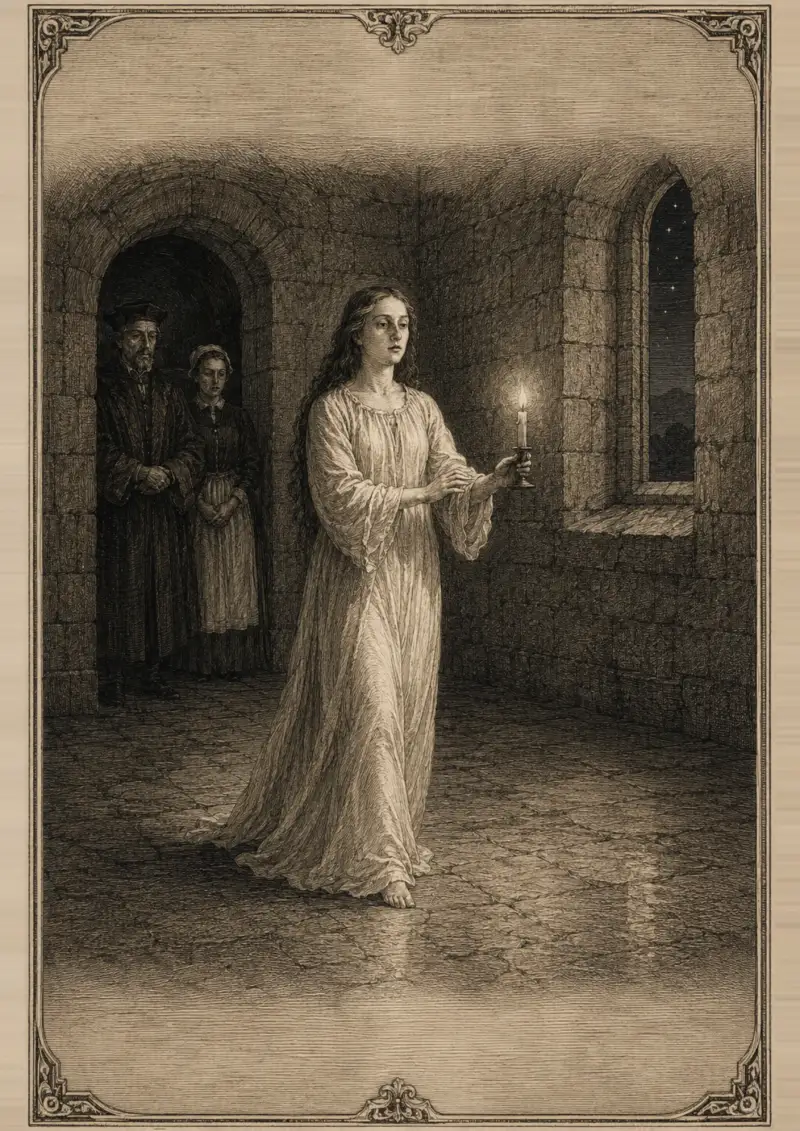
Context: Lady Macbeth walks and talks in her sleep, rubbing her hands, watched by a Doctor and a Gentlewoman. She has been absent from the stage since the banquet.
Methods: She speaks prose, the controlled verse of her earlier scenes gone. Guilt has moved from sight to smell
, a sense that cannot be shut out by looking away. The hyperbole (deliberate exaggeration) of All the perfumes of Arabia
echoes her husband’s ocean in Act 2: she has arrived, alone, at the knowledge she mocked in him. little
returns from A little water
, now attached to the hand that cannot be cleaned. Then words fail and guilt is only a sound, O, O, O
.
In an essay: The proof that suppressed guilt returns. Note that she confesses only in sleep, to people she cannot see. The essay on “Out, damned spot” reads the whole scene.
Canst thou not minister to a mind diseased,
Macbeth · Act 5, Scene 3 5.3.50-52
Pluck from the memory a rooted sorrow,
Raze out the written troubles of the brain
Plain English: Can you not treat a sick mind, pull a deep-rooted sorrow out of the memory, and rub out the troubles written on the brain?
Context: As Malcolm’s army approaches, the Doctor reports that the Queen is troubled by thick-coming fancies
. Macbeth orders him to cure her.
Methods: Macbeth asks for guilt to be removed like a growth. The verbs are all of force: Pluck
, Raze out
. Each metaphor admits why it cannot be done: the sorrow is rooted
, the troubles are written
. What he asks for is a sweet oblivious antidote
, a drug to make her forget, and not forgiveness. He asks about his wife and describes himself, and the Doctor’s reply slips into the masculine: Therein the patient / Must minister to himself
.
In an essay: Use it to argue that the Macbeths want relief from guilt without repentance. The Doctor has already said what is needed: More needs she the divine than the physician
.
Of all men else I have avoided thee.
Macbeth · Act 5, Scene 8 5.8.5-7
But get thee back. My soul is too much charged
With blood of thine already.
Plain English: You are the one man I have kept away from. Go back. My soul is already too heavily loaded with the blood of your family.
Context: The last battle. Macduff, whose wife and children Macbeth had killed, finds him at last. Macbeth still believes that no man born of woman can harm him.
Methods: Macbeth has claimed to have almost forgot the taste of fears
, yet here he admits to avoiding one man. charged
means loaded or burdened, and it echoes the Doctor’s verdict on Lady Macbeth, whose heart was sorely charged
: husband and wife end under the same weight. He says soul
, the word of a man who still believes he has one to lose. The syntax is short and unadorned, without the defiance he shows every other enemy.
In an essay: A late quotation against the claim that Macbeth ends as an unfeeling butcher
. The murder with no political purpose is the one he cannot face. He feels it, and fights on anyway.
How the theme develops
| Where | What happens to the theme | Quotation to know |
|---|---|---|
| Act 1 | Guilt is foreseen. Macbeth imagines the consequences of the murder and his own damnation before he has agreed to it. | our poisoned chalice |
| Act 2 | Guilt is immediate and bodily for Macbeth: a stuck prayer, a voice, blood. Lady Macbeth denies it. | Macbeth does murder sleep |
| Act 3 | Guilt becomes sleeplessness, envy of the dead and a ghost seen in public. Macbeth answers it with more killing. | Never shake / Thy gory locks at me |
| Act 4 | Macbeth resolves to stop reflecting and act at once. The only man who accuses himself is an innocent one: Macduff, blaming himself for his family’s deaths. | Sinful Macduff, / They were all struck for thee |
| Act 5 | The guilt Lady Macbeth suppressed returns in sleep and destroys her. Macbeth is numbed but not emptied. | What’s done cannot be undone |
The overall shape is a crossing. Macbeth begins with the most vivid conscience in the play and spends four acts deadening it; his wife begins by denying that conscience exists and is destroyed by it. The turn comes in Act 3, when he stops confiding in her and she is left alone with what she knows. The play ends without a confession from either, which is why the cure for guilt is last sought from a doctor and not in a prayer.
Model paragraph
Question: How does Shakespeare present guilt in Macbeth?
Why it works: It argues one idea, that denial fails, and proves it by setting two moments side by side. It follows a single word, little
, across three acts, which shows development and close reading at once. Form (verse to prose) and context (the Doctor’s religious verdict) are used as evidence for the argument, not added on.
Practice questions
- Read Act 2, Scene 2, from Macbeth’s entrance with the daggers to the end of the scene. How does Shakespeare present the different reactions of Macbeth and Lady Macbeth to the murder?
- How does Shakespeare use the imagery of sleep to present guilt across the play?
- “Lady Macbeth suffers more from guilt than her husband does.” How far do you agree?
- Guilt in Macbeth is felt intensely and repented never. Discuss the relationship between conscience and repentance in the play, considering why Shakespeare withholds any scene of confession.
Scene-by-scene answers are in the Macbeth questions and answers, and the Macbeth study guide sets guilt beside the play’s other themes. Guilt is the price of what is traced in the quotations about ambition.