
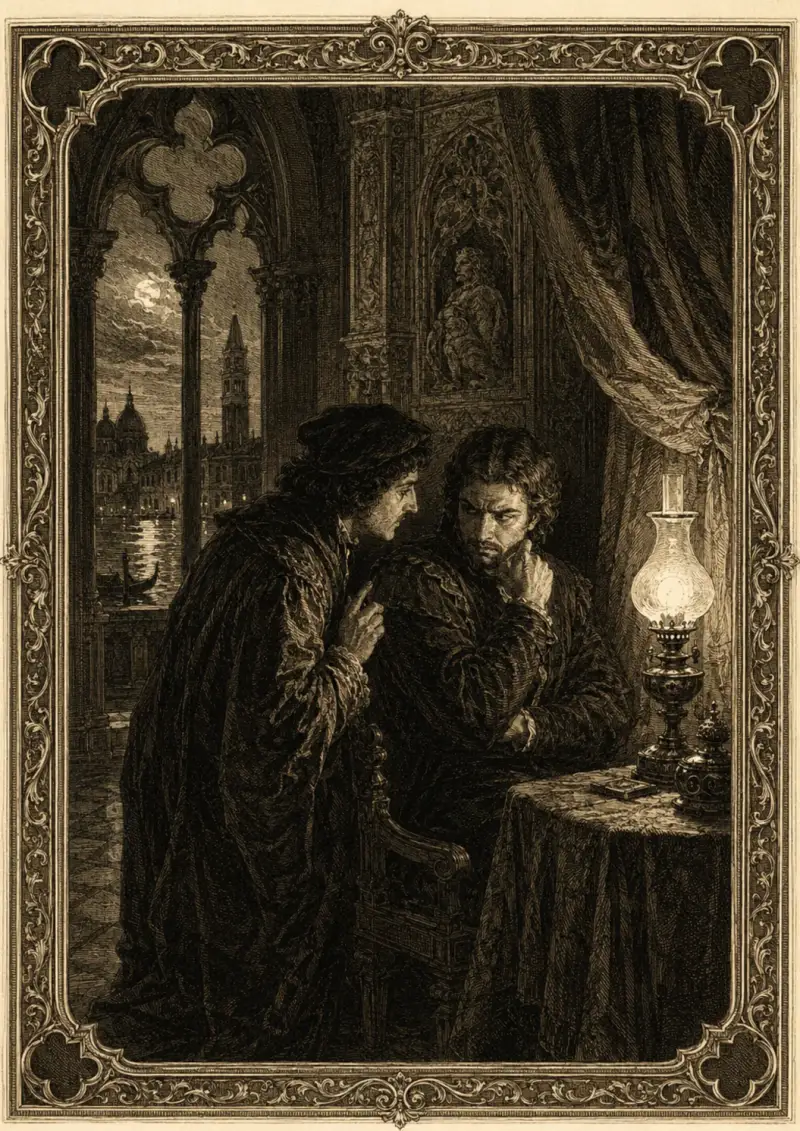
- Role
- Daughter of the Venetian senator Brabantio; wife of Othello
- First appears
- Act 1, Scene 3
- Last appears
- Act 5, Scene 2
- Key scenes
- 1.3, 2.1, 3.3, 3.4, 4.2, 4.3, 5.2
- Speaks in
- Blank verse; prose in her banter with Iago (2.1) and with the Clown (3.4)
Othello: key quotes and analysis (PDF)
PDF, 11 pages, 822 KB. Free, no sign-up, made to be printed.
The ten core quotations for Othello, each with plain English, analysis and a fill-the-gap test. Or read the full study guide.
Who is Desdemona?
Desdemona is a senator’s daughter who has refused the eligible men of Venice and secretly married a Black general much older than herself. She stands at the centre of the plot of Othello and is the one person in it who never knows there is a plot. Everyone talks about her before she appears, and each man describes a different woman: her father a timid girl, Iago a creature of appetite, Cassio a goddess, Othello a prize beyond price. Part of the play’s work is to let us compare these portraits with the person.
Desdemona is not a passive victim: she is a strong-willed woman whose strengths, frankness, loyalty and persistence, are exactly what Iago turns into evidence against her. The central question is how to read her final acts. When she forgives Othello and tries to take the blame for her own death, is that the collapse of the bold woman of Act 1, or the same will, still choosing him?
Desdemona across the play
Act 1: the woman who chooses
Brabantio calls her A maiden never bold
. She then walks into a council of war and disproves him, dividing her duty between father and husband with a lawyer’s care and asking the Duke for a hearing. Her request is plain: Let me go with him.
She has already done the boldest thing in the play, offstage, by leaving her father’s house at night.
Act 2: at ease in Cyprus
Waiting on the quay for Othello’s ship, she hides her fear in wordplay with Iago and tells us so: I am not merry, but I do beguile / The thing I am by seeming otherwise.
It is a harmless version of what Iago does. Cassio calls her our great captain’s captain
, and Othello greets her as his fair warrior
. This is the marriage at its best.
Act 3: the advocate
She takes up Cassio’s cause with energy and a touch of playfulness, sure of her influence. When Othello turns strange she does not understand why, and when he demands the handkerchief she is frightened into her one falsehood: It is not lost
. Afterwards she blames herself for resenting him, reasoning that men are not gods
.
Act 4: bewilderment
Struck in public, she answers with dignity: I have not deserved this.
Called a whore in private, she is stunned, Faith, half asleep
, and turns for help to Iago, kneeling before the man who has ruined her. In the willow scene she is quiet, sad and still loyal, but her mind runs on death and on a maid whose lover proved mad
.
Act 5: the murder
Woken by Othello, she learns the charge at last, denies it flatly and asks for the obvious test: Send for the man / And ask him.
She pleads for her life in shrinking units of time, Kill me tomorrow, let me live tonight
, and resists. Her final words clear herself and then shield her husband.
Reading the character
Her boldness is real, and it is used against her
Each of Desdemona’s strengths reappears as a piece of Iago’s case. She chose her husband against her father’s will, so Brabantio can warn, She has deceived her father, and may thee
, and Iago can repeat it at the decisive moment in Act 3. She speaks freely to men in public, so her kindness to Cassio can be watched and reinterpreted. She keeps her promises To the last article
, so she goes on pleading for Cassio when a more calculating woman would have stopped. The play does not suggest she should have been more cautious. It shows a world in which a woman’s candour can always be redescribed as looseness. See quotes about deception.
She cannot defend herself because she is never charged
In Venice Othello is accused in the open and allowed to answer. Desdemona gets no such hearing. Othello questions her about a handkerchief without saying what it means, then abuses her without naming a man. Her questions are the right ones, To whom, my lord? With whom? How am I false?
, and they go unanswered until she is on her deathbed. Her innocence adds to the difficulty. She tells Emilia, I do not think there is any such woman
as an unfaithful wife, and she cannot bring herself to repeat the word Othello has used. She lacks the vocabulary of the offence she is supposed to have committed.
Her constancy is an act of will
It is easy to read the Desdemona of Acts 4 and 5 as broken. The text supports a harder reading. When Emilia says she wishes Desdemona had never seen Othello, the answer is immediate: So would not I.
She declares that his unkindness may kill her but will not alter her love, which is a decision, stated as one. Even her mistake in the willow song is revealing. She sings Let nobody blame him, his scorn I approve
, then stops: Nay, that’s not next.
The line has come out of order, as though her own resolve had pushed it forward. Whether this loyalty is admirable or is the last cruelty her marriage inflicts is for each reader to argue.
Key quotations
My heart’s subdued
Desdemona · Act 1, Scene 3 1.3.285-289
Even to the very quality of my lord.
I saw Othello’s visage in his mind,
And to his honors and his valiant parts
Did I my soul and fortunes consecrate.
Plain English: My heart has given itself over to what my husband truly is. I saw Othello’s real face in his mind, and I dedicated my soul and my future to his honour and his courage.
Context: Before the Duke and Senate, Desdemona asks permission to go with Othello to Cyprus.
Methods: Her verbs come from war and worship. subdued
is the language of conquest, applied willingly to herself, and consecrate
makes the marriage a religious dedication. The central line answers her father’s racism by moving Othello’s visage
from skin to mind
, yet it also concedes that his face is something to be seen past. What she loves is honors
and valiant parts
: like Othello, she fell in love with a reputation and a story.
In an essay: Use it to show both her independence and the foundation of the marriage. Link to quotes about race and otherness for the double edge of visage in his mind
.
My lord shall never rest:
Desdemona · Act 3, Scene 3 3.3.24-26
I’ll watch him tame and talk him out of patience;
His bed shall seem a school, his board a shrift;
Plain English: My husband will get no peace. I will keep him awake until he gives in and talk until his patience runs out; his bed will be like a classroom and his dinner table like a confessional.
Context: Desdemona promises Cassio that she will win back his post. Othello and Iago are about to enter.
Methods: The tone is teasing and confident. watch him tame
comes from falconry, where a hawk is kept awake until it submits; later in the scene Othello will use the same sport to imagine casting her off. The balanced metaphors of school
and shrift
turn the marriage bed and table into places of instruction, with her as teacher and priest. The dramatic irony (the audience knows more than she does) is severe: we know Iago needs her to do exactly this.
In an essay: Shows a wife who expects to be heard. A few lines on she says she would rather die
than abandon Cassio’s cause, which the plot takes literally.
Who, he? I think the sun where he was born
Desdemona · Act 3, Scene 4 3.4.31-32
Drew all such humors from him.
Plain English: Him, jealous? I think the sun of his native country burned all such moods out of him.
Context: Desdemona has missed the handkerchief. Emilia, who knows where it went, asks whether Othello is jealous.
Methods: The incredulous opening, two monosyllables and a question mark, shows complete trust. humors
refers to the bodily fluids thought to govern temperament, so she pictures jealousy as moisture dried away by a hot climate. The compliment turns a stereotype upside down, since hot climates were often supposed to breed hot tempers, but it still explains Othello by where he comes from. Coming one scene after he has sworn to kill her, the line is among the most painful ironies in the play.
In an essay: Use it to show how little she knows her husband, and how even her love speaks of him as a foreigner.
Upon my knees, what doth your speech import?
Desdemona · Act 4, Scene 2 4.2.37-39
I understand a fury in your words,
But not the words.
Plain English: On my knees I ask you, what do you mean? I can hear the rage in what you say, but I cannot understand the words themselves.
Context: Othello has sent Emilia out as if she were the keeper of a brothel and is about to call his wife a whore.
Methods: She separates tone from meaning: fury
reaches her, sense does not. The repetition of words
at the end of two clauses marks the gap. The short final line leaves a silence in the verse, a space for the explanation he never gives. Kneeling makes her a suppliant, and she will kneel again to Iago later in the scene, so that the posture links the two men who are destroying her.
In an essay: The clearest statement of her position in the second half of the play. She is condemned in a language she is not permitted to learn.
Unkindness may do much,
Desdemona · Act 4, Scene 2 4.2.187-190
And his unkindness may defeat my life,
But never taint my love.
Plain English: Cruelty can do a great deal, and his cruelty may destroy my life, but it will never corrupt my love.
Context: Desdemona has knelt to Iago and sworn that she has never wronged Othello in thought or deed.
Methods: The sentence builds through three steps to an antithesis (two opposed ideas set in balance) between life
and love
: one can be taken from her, the other cannot. defeat
keeps the military vocabulary she has used since Act 1, and taint
answers the charge of contamination that Othello has thrown at her. Unkindness
meant unnatural conduct as well as cruelty. She foresees her death and states her terms.
In an essay: Central to the debate about her ending. Argue that her constancy is chosen and declared, not a failure to resist.
Nobody. I myself. Farewell.
Desdemona · Act 5, Scene 2 5.2.152-153
Commend me to my kind lord. O, farewell.
Plain English: No one did it. I did it myself. Goodbye. Give my love to my kind husband. Goodbye.
Context: Smothered and thought dead, Desdemona revives for a moment when Emilia asks who has killed her.
Methods: Three tiny sentences, each a full stop, are all the breath she has. Seconds earlier she said, A guiltless death I die
, so she insists on her innocence and then lies to protect the guilty. kind
is the hardest word. It may be forgiveness, or the habit of a loving wife, or a refusal to let Othello be other than the man she chose. Othello’s response is to call her a liar gone to burning hell
and then to confess.
In an essay: Set it beside her first speech. In Act 1 she used her voice to claim her husband; in Act 5 she uses it to save him. Decide whether that is continuity or loss.
Relationships
Desdemona and Othello
She fell in love with his history and married the man she saw in it. Her love is the steadier of the two: she expects it to grow with time, while Othello treats it as a perfection that can only be lost. She never stops believing in the husband of Act 1, which is why she keeps looking for outside causes, state business or a headache, to explain the stranger he has become.
Desdemona and Emilia
Mistress and attendant become, by Act 4, the play’s only real friendship. They differ in everything: rank, experience, view of men. Emilia is worldly where Desdemona is idealistic, and their talk in the willow scene sets two ways of being a wife side by side. Emilia fails her over the handkerchief and then dies defending her name.
Desdemona and Brabantio
Her father loves her as a possession, a jewel
stolen from his house, and cannot believe she acted freely. She treats him with respect and does not yield. His parting line plants the first doubt in Othello’s mind, and we learn in the final scene that the marriage killed him: pure grief / Shore his old thread in twain.
She dies without knowing it.
How the character has been read
An older tradition made Desdemona a saint: pure, gentle, and so innocent as to be almost without character. That reading takes its cue from Cassio’s divine Desdemona
and from her forgiving death. It has to ignore a good deal, including the elopement, the wit of Act 2 and the persistence of Act 3.
Feminist criticism has pulled in two directions. Some critics recover the assertive Desdemona and stress how much she does and says. Others argue that the play shows that assertiveness being worn down by marriage, until the woman who addressed the Senate accepts being ordered to bed. On this view her obedience is not a virtue the play admires but a code it shows to be lethal. There is also a harsher line of comment, which blames her for deceiving her father, fibbing about the handkerchief and meddling in army business. It is worth noticing that this is the case made within the play by Brabantio and Iago.
Performance can tilt the part either way. A girlish Desdemona heightens the pathos; a mature, self-possessed one makes the murder an injustice done to an equal. Small moments carry weight, such as her remark in the willow scene that This Lodovico is a proper man
, which can be idle talk or a passing thought of the life she gave up.
Essay angles and a model paragraph
- Desdemona’s strengths, not her weaknesses, make Iago’s plot possible.
- Desdemona is denied the fair hearing that Othello receives in Act 1, and the contrast is the play’s sharpest comment on how women are judged.
- Her forgiveness of Othello is a deliberate act of will that the play invites us both to admire and to question.
Question: How does Shakespeare present Desdemona as a strong character?
Practice questions
- Read Desdemona’s speech to the Senate in Act 1, Scene 3, beginning
My noble father
. How does Shakespeare present her attitude to duty? - How does Shakespeare present the relationship between Desdemona and Emilia in Act 4, Scene 3?
- “Desdemona is too good to be believable.” How far do you agree?
- “The play punishes Desdemona for the independence it admires in Act 1.” Discuss with reference to the play’s treatment of marriage and obedience.
Check the order of events with the Othello questions and answers, and see quotes about jealousy for the passion she is certain her husband does not have.