
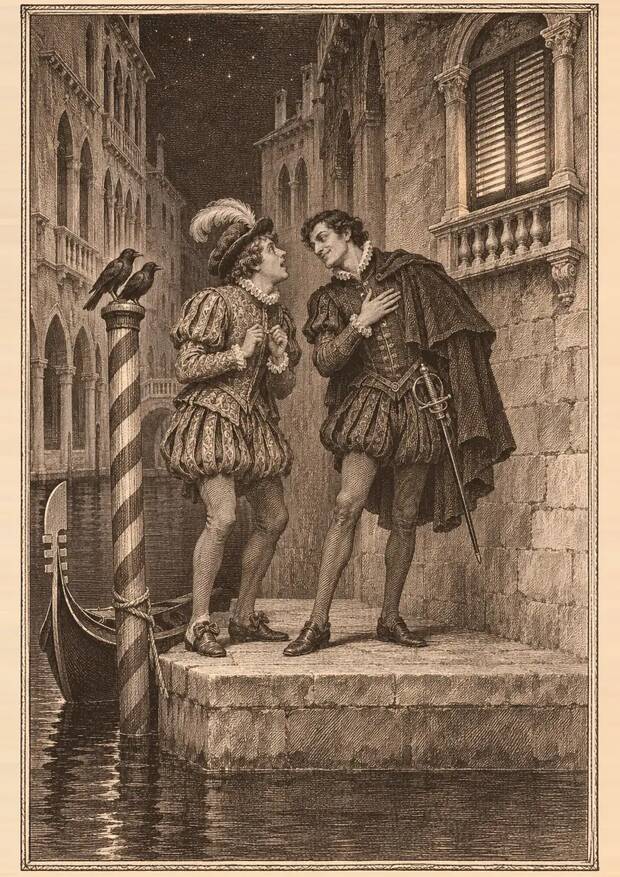
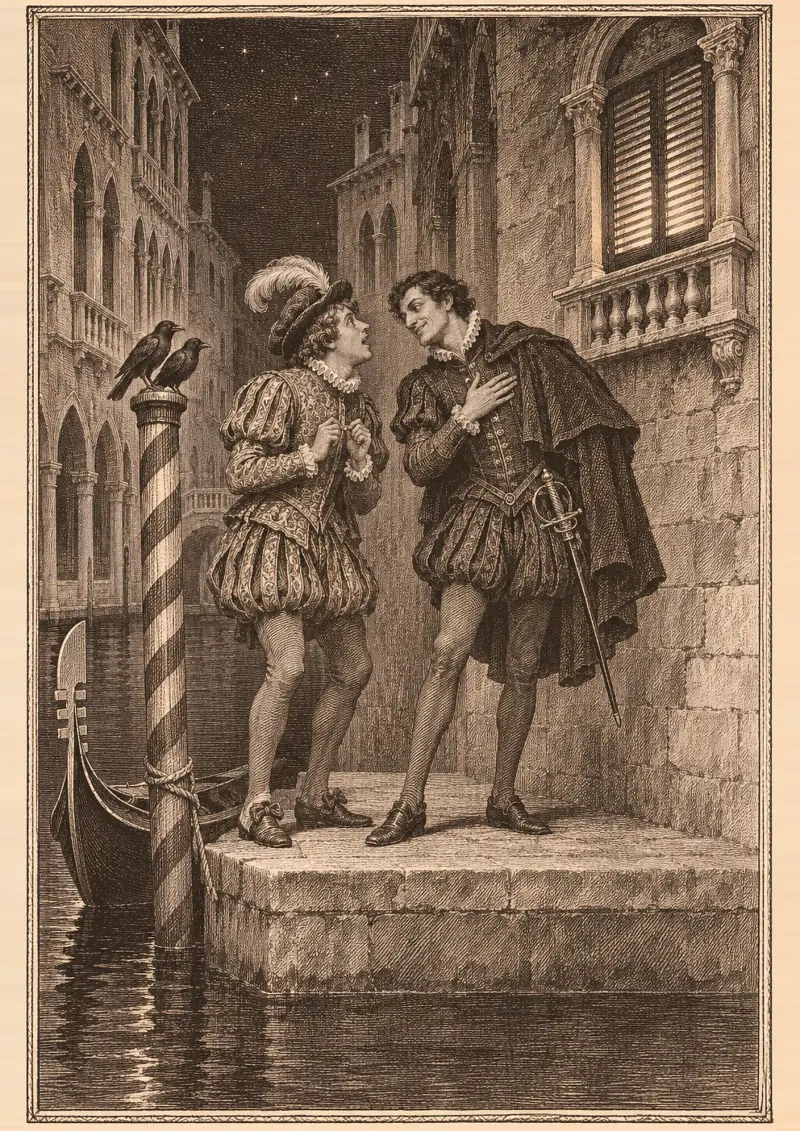
Othello: study cards (PDF)
PDF, 14 pages, 1.0 MB. Free, no sign-up, made to be printed.
Also for Othello: the study guide and the quotation sheet (PDF).
How to use the cards
Each card has one quotation from Othello on the front. Say who speaks it, where it comes in the play, and what it means, then turn the card to check. Mark the ones you know and the deck will skip them next time on this device; keep turning the rest until they stick.
Every card comes from the study guide and the quotes-by-theme pages, so each one links back to the full analysis. On paper, print the PDF, cut along the dashed lines and fold each strip down the middle.
The cards
-
Card 1 of 45
But I will wear my heart upon my sleeve
For daws to peck at. I am not what I am.Who says it, when, and what does it mean?
Card 1 of 45
Iago · Act 1, Scene 1
If my behaviour ever showed my real feelings I would be easy prey. I am not the man I appear to be.
In an essay: Use it to show that deception in the play does not depend on concealment alone. Iago can describe his method aloud because each listener assumes he is the exception.
Quotes about deception
-
Card 2 of 45
Even now, now, very now, an old black ram
Is tupping your white ewe.Who says it, when, and what does it mean?
Card 2 of 45
Iago · Act 1, Scene 1
At this very moment an old black ram is mating with your white ewe.
In an essay: Do not stop at “Iago is racist”. Ask what the speech assumes about Brabantio, a senator, and what it proves about Venice when he responds exactly as intended.
Quotes about race and otherness
-
Card 3 of 45
What a full fortune does the thick-lips owe
If he can carry ’t thus!Who says it, when, and what does it mean?
Card 3 of 45
Roderigo · Act 1, Scene 1
What a great piece of luck the thick-lipped man possesses, if he can get away with this.
In an essay: Use it to show that racial abuse in the play is a vehicle for other resentments, sexual and professional. Note the withheld name: Othello is not called “Othello” by anyone until the Duke greets him in Scene 3.
Quotes about race and otherness
-
Card 4 of 45
Run from her guardage to the sooty bosom
Of such a thing as thou - to fear, not to delight!Who says it, when, and what does it mean?
Card 4 of 45
Brabantio · Act 1, Scene 2
Would she have run from her father’s protection to the black breast of a thing like you - something to be afraid of, not to take pleasure in?
In an essay: The key evidence that racism in Venice is respectable as well as vulgar. Othello was welcome as a guest and a storyteller. The welcome ended at marriage.
Quotes about race and otherness
-
Card 5 of 45
I fetch my life and being
From men of royal siege, and my demerits
May speak unbonneted to as proud a fortune
As this that I have reached.Who says it, when, and what does it mean?
Card 5 of 45
Othello · Act 1, Scene 2
I am descended from men of royal rank, and my merits can speak on equal terms to a fortune as high as the one I have won in this marriage.
In an essay: Use it to establish the self that the play then dismantles, and to show that Othello’s security is conditional. He also calls his former life an
unhoused free condition
: he has never had a fixed home, in Venice or anywhere else.Quotes about race and otherness
-
Card 6 of 45
Let him do his spite.
My services which I have done the signiory
Shall out-tongue his complaints.Who says it, when, and what does it mean?
Card 6 of 45
Othello · Act 1, Scene 2
Let him do his worst. The service I have given the Venetian state will speak louder than his complaints.
In an essay: Use it as the starting point: reputation as earned, public and protective. Pair it with
I have done the state some service
in Act 5, where the same claim can no longer save him.Quotes about reputation
-
Card 7 of 45
She loved me for the dangers I had passed,
And I loved her that she did pity them.Who says it, when, and what does it mean?
Card 7 of 45
Othello · Act 1, Scene 3
She fell in love with me because of what I had lived through, and I loved her for feeling for me.
-
Card 8 of 45
The Moor is of a free and open nature
That thinks men honest that but seem to be soWho says it, when, and what does it mean?
Card 8 of 45
Iago · Act 1, Scene 3
Othello is frank and trusting; he assumes that anyone who looks honest is honest.
-
Card 9 of 45
I saw Othello’s visage in his mind,
And to his honors and his valiant parts
Did I my soul and fortunes consecrate.Who says it, when, and what does it mean?
Card 9 of 45
Desdemona · Act 1, Scene 3
I saw Othello’s true face in his mind, and I have dedicated my soul and my future to his honour and his courage.
In an essay: A quotation that complicates. Use it for Desdemona’s courage and independence, then show that her defence of Othello leaves the Venetian equation of blackness with ugliness in place.
Quotes about race and otherness
-
Card 10 of 45
If virtue no delighted beauty lack,
Your son-in-law is far more fair than black.Who says it, when, and what does it mean?
Card 10 of 45
The Duke · Act 1, Scene 3
If goodness is a kind of beauty, then your son-in-law is far more fair than he is black.
In an essay: Use it to argue that Venice’s tolerance is practical and partial. The court is fair to Othello on the night it needs him to fight the Turks.
Quotes about race and otherness
-
Card 11 of 45
BRABANTIO Look to her, Moor, if thou hast eyes to see.
She has deceived her father, and may thee.
OTHELLO My life upon her faith!Who says it, when, and what does it mean?
Card 11 of 45
Brabantio and Othello · Act 1, Scene 3
Brabantio: Watch her, Moor, if you have eyes in your head. She has deceived her father and may deceive you. Othello: I would stake my life on her faithfulness.
In an essay: Trace the afterlife of this line. In Act 3 Iago repeats it almost word for word,
She did deceive her father, marrying you
, and Othello answers,And so she did
. A true fact has become the foundation of a false case.Quotes about deception
-
Card 12 of 45
For that I do suspect the lusty Moor
Hath leaped into my seat - the thought whereof
Doth, like a poisonous mineral, gnaw my inwardsWho says it, when, and what does it mean?
Card 12 of 45
Iago · Act 2, Scene 1
Because I suspect that Othello has slept with my wife, and the thought eats away at my insides like a corrosive poison.
In an essay: Use it to argue that Iago does not invent jealousy but hands on his own. He plans to put Othello
into a jealousy so strong / That judgment cannot cure
, and later says with satisfaction,The Moor already changes with my poison
.Quotes about jealousy
-
Card 13 of 45
Reputation, reputation, reputation! O, I have lost my reputation! I have lost the immortal part of myself, and what remains is bestial.
Who says it, when, and what does it mean?
Card 13 of 45
Cassio · Act 2, Scene 3
My reputation, my reputation. I have lost my reputation. I have lost the part of me that cannot die, and all that is left is animal.
In an essay: The clearest statement of reputation as identity. Use it to show what the men of this world fear most, and so what Iago can threaten them with.
Quotes about reputation
-
Card 14 of 45
Reputation is an idle and most false imposition, oft got without merit and lost without deserving.
Who says it, when, and what does it mean?
Card 14 of 45
Iago · Act 2, Scene 3
Reputation is an empty and thoroughly false thing laid on us by others, often gained without earning it and lost without deserving to lose it.
In an essay: Set it against
Good name in man and woman
to show that Iago has no fixed view, only a listener. Then argue that the action of the play supports this version.Quotes about reputation
-
Card 15 of 45
Divinity of hell!
When devils will the blackest sins put on,
They do suggest at first with heavenly shows,
As I do now.Who says it, when, and what does it mean?
Card 15 of 45
Iago · Act 2, Scene 3
This is the theology of hell. When devils want to bring about the blackest sins, they begin by tempting with a show of heavenly goodness, as I am doing now.
In an essay: The best evidence that Iago deceives through honest counsel. Each victim is caught by a virtue: Cassio’s wish to make amends, Desdemona’s kindness, Othello’s trust.
Quotes about deception
-
Card 16 of 45
O, beware, my lord, of jealousy!
It is the green-eyed monster which doth mock
The meat it feeds on.Who says it, when, and what does it mean?
Card 16 of 45
Iago · Act 3, Scene 3
Be careful of jealousy, my lord. It is a monster that torments the very person it consumes.
In an essay: This is the source of the page’s argument: the misery is located in doubt. Our essay on “O, beware, my lord, of jealousy” reads the whole speech line by line.
Quotes about jealousy
-
Card 17 of 45
Haply, for I am black
And have not those soft parts of conversation
That chamberers haveWho says it, when, and what does it mean?
Card 17 of 45
Othello · Act 3, Scene 3
Perhaps it is because I am black, and lack the smooth manners of courtiers.
In an essay: The central quotation for how Othello comes to see himself through Venetian eyes. Set the confident line about her eyes against this one to measure how far he has moved within a single scene.
Quotes about race and otherness
-
Card 18 of 45
Excellent wretch! Perdition catch my soul
But I do love thee! And when I love thee not,
Chaos is come again.Who says it, when, and what does it mean?
Card 18 of 45
Othello · Act 3, Scene 3
Wonderful creature. May my soul be damned if I do not love you; and when I stop loving you, the world will fall back into chaos.
In an essay: Use it to show that Othello’s jealousy grows out of the way he loves. A love that is everything or nothing leaves no room for an ordinary doubt.
Quotes about jealousy
-
Card 19 of 45
I’ll see before I doubt; when I doubt, prove;
And on the proof, there is no more but this:
Away at once with love or jealousy.Who says it, when, and what does it mean?
Card 19 of 45
Othello · Act 3, Scene 3
I will see something before I suspect; if I suspect, I will test it; and once it is tested there is only one thing left to do, which is to be rid at once of either my love or my jealousy.
In an essay: Use it against the idea that Othello is simply gullible. He sets a rational test and then abandons it, asking for
the ocular proof
and settling for a reported dream.Quotes about jealousy
-
Card 20 of 45
Trifles light as air
Are to the jealous confirmations strong
As proofs of holy writ.Who says it, when, and what does it mean?
Card 20 of 45
Iago · Act 3, Scene 3
To a jealous person, things as weightless as air are confirmation as solid as proof from scripture.
In an essay: The best single quotation for the claim that jealousy makes its own evidence. When Othello vows revenge he has not seen the handkerchief; he has only been told that Cassio wiped his beard with it.
Quotes about jealousy
-
Card 21 of 45
Like to the Pontic Sea,
Whose icy current and compulsive course
Ne’er feels retiring ebb ...
Even so my bloody thoughts, with violent pace
Shall ne’er look back, ne’er ebb to humble loveWho says it, when, and what does it mean?
Card 21 of 45
Othello · Act 3, Scene 3
Like the Black Sea, whose cold current drives on and never flows back, my murderous thoughts will rush forward and never turn back to gentle love.
In an essay: Use it as the turning point at which jealousy stops being doubt. From here the question for Othello is how to kill, not whether she is guilty.
Quotes about jealousy
-
Card 22 of 45
Not to affect many proposed matches
Of her own clime, complexion, and degree,
Whereto we see in all things nature tendsWho says it, when, and what does it mean?
Card 22 of 45
Iago · Act 3, Scene 3
She turned down many offers of marriage from men of her own country, colour and rank, which is where we see nature always inclines.
In an essay: This is where race becomes a mechanism of the plot. Iago does not need Othello to believe he is inferior, only to believe that Venice, and so perhaps his wife, sees him that way. See the character study of Iago.
Quotes about race and otherness
-
Card 23 of 45
Good name in man and woman, dear my lord,
Is the immediate jewel of their souls ...
But he that filches from me my good name
Robs me of that which not enriches him
And makes me poor indeed.Who says it, when, and what does it mean?
Card 23 of 45
Iago · Act 3, Scene 3
A good name, my lord, is the most precious possession of any man’s or woman’s soul. Whoever steals my good name takes something that does not make him richer and leaves me truly poor.
In an essay: Use it to show reputation working as a weapon. By praising a good name at this moment Iago makes Othello imagine one about to be lost, and Othello’s reply shows it:
By heaven, I’ll know thy thoughts
.Quotes about reputation
-
Card 24 of 45
O, now, forever
Farewell the tranquil mind! Farewell content!
Farewell the plumed troops and the big wars
That makes ambition virtue!Who says it, when, and what does it mean?
Card 24 of 45
Othello · Act 3, Scene 3
Now and for ever, goodbye to peace of mind, goodbye to happiness, goodbye to the plumed troops and the great wars that turn ambition into a virtue.
In an essay: Evidence that Othello’s sense of who he is depends on his public role. It supports the reading that he grieves for his standing as much as for his marriage.
Quotes about reputation
-
Card 25 of 45
IAGO Men should be what they seem;
Or those that be not, would they might seem none!
OTHELLO Certain, men should be what they seem.Who says it, when, and what does it mean?
Card 25 of 45
Iago and Othello · Act 3, Scene 3
Iago: Men ought to be what they appear to be; and those who are not, I wish they did not look like men at all. Othello: Certainly, men ought to be what they appear.
In an essay: Use it to define insinuation: Iago makes Othello supply the accusation himself. Antony works a crowd in a similar way in “Friends, Romans, countrymen”, praising honourable men until the word turns.
Quotes about deception
-
Card 26 of 45
In Venice they do let God see the pranks
They dare not show their husbands. Their best conscience
Is not to leave ’t undone, but keep ’t unknown.Who says it, when, and what does it mean?
Card 26 of 45
Iago · Act 3, Scene 3
In Venice wives let God see the tricks they dare not show their husbands. Their idea of conscience is not to refrain from the act but to keep it hidden.
In an essay: Use it to show how deception changes the way its victim reads. After this speech Desdemona’s openness can only count against her. For the way Iago uses Othello’s foreignness here, see quotes about race and otherness.
Quotes about deception
-
Card 27 of 45
Villain, be sure thou prove my love a whore!
Be sure of it. Give me the ocular proofWho says it, when, and what does it mean?
Card 27 of 45
Othello · Act 3, Scene 3
Villain, make sure you prove that my love is a whore. Make sure of it. Give me proof I can see with my own eyes.
In an essay: Use it to show the standard of proof being lowered step by step, from seeing to inferring to hearing a story. The lies arrive when Othello is already asking to be convinced.
Quotes about deception
-
Card 28 of 45
They are not ever jealous for the cause,
But jealous for they’re jealous. It is a monster
Begot upon itself, born on itself.Who says it, when, and what does it mean?
Card 28 of 45
Emilia · Act 3, Scene 4
Jealous people are not jealous for a reason. They are jealous because they are jealous; it breeds itself.
In an essay: Quote it as the play’s thesis, then note the irony: the woman who understands jealousy best has just supplied its only prop, and does not connect the two.
Quotes about jealousy
-
Card 29 of 45
EMILIA Is he not jealous?
DESDEMONA Who, he? I think the sun where he was born
Drew all such humors from him.Who says it, when, and what does it mean?
Card 29 of 45
Emilia and Desdemona · Act 3, Scene 4
Emilia: Is he not jealous? Desdemona: Him? I think the sun of the country where he was born drew all such moods out of him.
In an essay: A quotation that complicates. It supports Othello’s own claim that jealousy was not in his nature, since the person who knows him best says so. It can equally show how little the lovers know each other. For the racial assumption she is answering, see quotes about race and otherness.
Quotes about jealousy
-
Card 30 of 45
Is this the noble Moor, whom our full senate
Call all in all sufficient? Is this the nature
Whom passion could not shake?Who says it, when, and what does it mean?
Card 30 of 45
Lodovico · Act 4, Scene 1
Is this the noble Moor whom our whole Senate calls capable in every way? Is this the character that no passion could shake?
In an essay: Use it for the public collapse of Othello’s name, and for Iago’s control over what Venice will hear. Lodovico’s earlier line,
this would not be believed in Venice
, shows reputation resisting the evidence of the eyes.Quotes about reputation
-
Card 31 of 45
As he shall smile, Othello shall go mad,
And his unbookish jealousy must construe
Poor Cassio’s smiles, gestures, and light behaviors
Quite in the wrong.Who says it, when, and what does it mean?
Card 31 of 45
Iago · Act 4, Scene 1
When Cassio smiles, Othello will go mad, and his ignorant jealousy is bound to interpret poor Cassio’s smiles, gestures and light-hearted manner completely wrongly.
In an essay: Use it to argue that deception here is a matter of interpretation, not fabrication, and that Othello is a collaborator in it. See quotes about jealousy for the state of mind that does the misreading.
Quotes about deception
-
Card 32 of 45
But there where I have garnered up my heart,
Where either I must live or bear no life,
The fountain from the which my current runs
Or else dries up - to be discarded thenceWho says it, when, and what does it mean?
Card 32 of 45
Othello · Act 4, Scene 2
But the place where I have stored up my heart, where I must either live or have no life at all, the spring my whole being flows from or else runs dry - to be thrown out of there.
In an essay: The most sympathetic account Othello gives of his jealousy, and a necessary counterweight to readings that see only possessiveness. Note, though, that the language of storing and keeping is still the language of ownership.
Quotes about jealousy
-
Card 33 of 45
But alas, to make me
A fixed figure for the time of scorn
To point his slow unmoving finger atWho says it, when, and what does it mean?
Card 33 of 45
Othello · Act 4, Scene 2
But, alas, to make me a fixed target for a scornful age to point its slow, unmoving finger at.
In an essay: A quotation that complicates the theme. Here Othello ranks love above reputation, against the reading that he kills for honour alone. You can accept the claim, or note that the doubled
well, very well
protests a little too much.Quotes about reputation
-
Card 34 of 45
DESDEMONA Am I that name, Iago?
IAGO What name, fair lady?
DESDEMONA Such as she said my lord did say I was.Who says it, when, and what does it mean?
Card 34 of 45
Desdemona and Iago · Act 4, Scene 2
Desdemona: Am I what that name says, Iago? Iago: What name, dear lady? Desdemona: The one she said my husband said I was.
In an essay: Use it for the difference between male and female reputation. A man’s name rests on many deeds; a woman’s on one word, which all three women in the play are called. Bianca answers the same charge with
I am no strumpet
. See the character study of Desdemona.Quotes about reputation
-
Card 35 of 45
I will be hanged if some eternal villain,
Some busy and insinuating rogue,
Some cogging, cozening slave, to get some office,
Have not devised this slander.Who says it, when, and what does it mean?
Card 35 of 45
Emilia · Act 4, Scene 2
I will be hanged if some out-and-out villain, some meddling, worming rogue, some cheating, lying wretch, has not invented this slander to get himself a post.
In an essay: A quotation that complicates. Deception in the play is not undetectable, since Emilia detects it by reasoning. What she cannot do is attach it to “honest” Iago, and she is keeping her own silence about the handkerchief. See the character study of Emilia.
Quotes about deception
-
Card 36 of 45
Let husbands know
Their wives have sense like them.Who says it, when, and what does it mean?
Card 36 of 45
Emilia · Act 4, Scene 3
Husbands should understand that their wives have feelings and appetites just as they do.
-
Card 37 of 45
Put out the light, and then put out the light.
Who says it, when, and what does it mean?
Card 37 of 45
Othello · Act 5, Scene 2
First I will put out this candle, and then I will put out her life.
-
Card 38 of 45
Then must you speak
Of one that loved not wisely, but too well;
Of one not easily jealous, but being wrought,
Perplexed in the extremeWho says it, when, and what does it mean?
Card 38 of 45
Othello · Act 5, Scene 2
Describe me as a man who loved unwisely but too much; not jealous by nature, but, once worked upon, utterly confused.
-
Card 39 of 45
It is the cause, it is the cause, my soul.
Let me not name it to you, you chaste stars.
It is the cause.Who says it, when, and what does it mean?
Card 39 of 45
Othello · Act 5, Scene 2
This is the reason, this is the reason, my soul. I will not speak its name to you, pure stars. This is the reason.
In an essay: Use it to show jealousy’s last disguise, as impersonal justice. He says she must die
else she’ll betray more men
, and calls the killinga sacrifice
.Quotes about jealousy
-
Card 40 of 45
O, the more angel she, and you the blacker devil!
Who says it, when, and what does it mean?
Card 40 of 45
Emilia · Act 5, Scene 2
Then she is all the more an angel, and you are all the blacker a devil.
In an essay: Use it for the hardest question the theme raises, whether the ending confirms the stereotype. The stronger argument is that Iago’s plot manufactures the figure Venice had imagined, and that the real devil of the play is a white Venetian whom everyone called honest.
Quotes about race and otherness
-
Card 41 of 45
And say besides, that in Aleppo once,
Where a malignant and a turbanned Turk
Beat a Venetian and traduced the state,
I took by th’ throat the circumcised dog,
And smote him, thus.Who says it, when, and what does it mean?
Card 41 of 45
Othello · Act 5, Scene 2
And tell them also that once, in Aleppo, when a vicious Turk in a turban beat a Venetian and insulted Venice, I took the circumcised dog by the throat and struck him - like this.
In an essay: Use it to show that Othello dies still seeking the state’s approval, in the state’s terms. It pairs with the Act 1 speech on
royal siege
: the same storytelling gift, turned from self-assertion to self-destruction.Quotes about race and otherness
-
Card 42 of 45
Why, anything.
An honorable murderer, if you will,
For naught I did in hate, but all in honor.Who says it, when, and what does it mean?
Card 42 of 45
Othello · Act 5, Scene 2
Say anything you like. An honourable murderer, if you wish, for I did nothing out of hatred and everything out of honour.
In an essay: The key quotation for honour as self-justification. Ask whether the play lets the two words stand together, or whether
murderer
cancelshonorable
.Quotes about reputation
-
Card 43 of 45
I have done the state some service, and they know ’t.
No more of that. I pray you in your letters,
When you shall these unlucky deeds relate,
Speak of me as I am.Who says it, when, and what does it mean?
Card 43 of 45
Othello · Act 5, Scene 2
I have given the state some service, and they know it. Enough of that. I ask you, when you report these unfortunate events in your letters, to describe me as I am.
In an essay: Use it for the central debate about the ending, which the study guide sets out through Bradley, Leavis and Eliot: is this honest self-knowledge or a final piece of image-making? The theme of reputation gives you strong evidence for the second view.
Quotes about reputation
-
Card 44 of 45
EMILIA O, who hath done this deed?
DESDEMONA Nobody. I myself. Farewell.
Commend me to my kind lord. O, farewell.Who says it, when, and what does it mean?
Card 44 of 45
Emilia and Desdemona · Act 5, Scene 2
Emilia: Who has done this? Desdemona: No one. I did it myself. Goodbye. Remember me to my kind husband. Goodbye.
In an essay: Use it against a simple equation of deceit with evil. Iago does harm with truths, and Desdemona does good with a lie. The play judges by purpose, not by accuracy.
Quotes about deception
-
Card 45 of 45
Demand me nothing. What you know, you know.
From this time forth I never will speak word.Who says it, when, and what does it mean?
Card 45 of 45
Iago · Act 5, Scene 2
Ask me nothing. You know what you know. From this moment I will never speak another word.
In an essay: Use it to end an argument about Iago’s motives or about the limits of knowledge in the play. The deceiver is exposed but not explained. See the character study of Iago.
Quotes about deception
Next steps
When the deck is easy, write with it: take three cards and turn them into a paragraph with the essay planner, or test yourself on the quotation sheet and the questions and answers. For one passage a day without trying, Daily Bard puts a quotation and its plain-English reading on your phone each morning.

A page of Shakespeare, every day.
This resource comes from Daily Bard, an app for iPhone and iPad. Each morning it shows one engraved plate and one passage, exactly as Shakespeare wrote it, with a plain-English reading on the back of the leaf.
Free to download. The Full Edition is a one-time US$11.99: no subscription, no account, no ads, no tracking.
Get it on the App Store: apps.apple.com/app/id6792967225
More free study guides, lesson plans and close readings: dailybard.app