
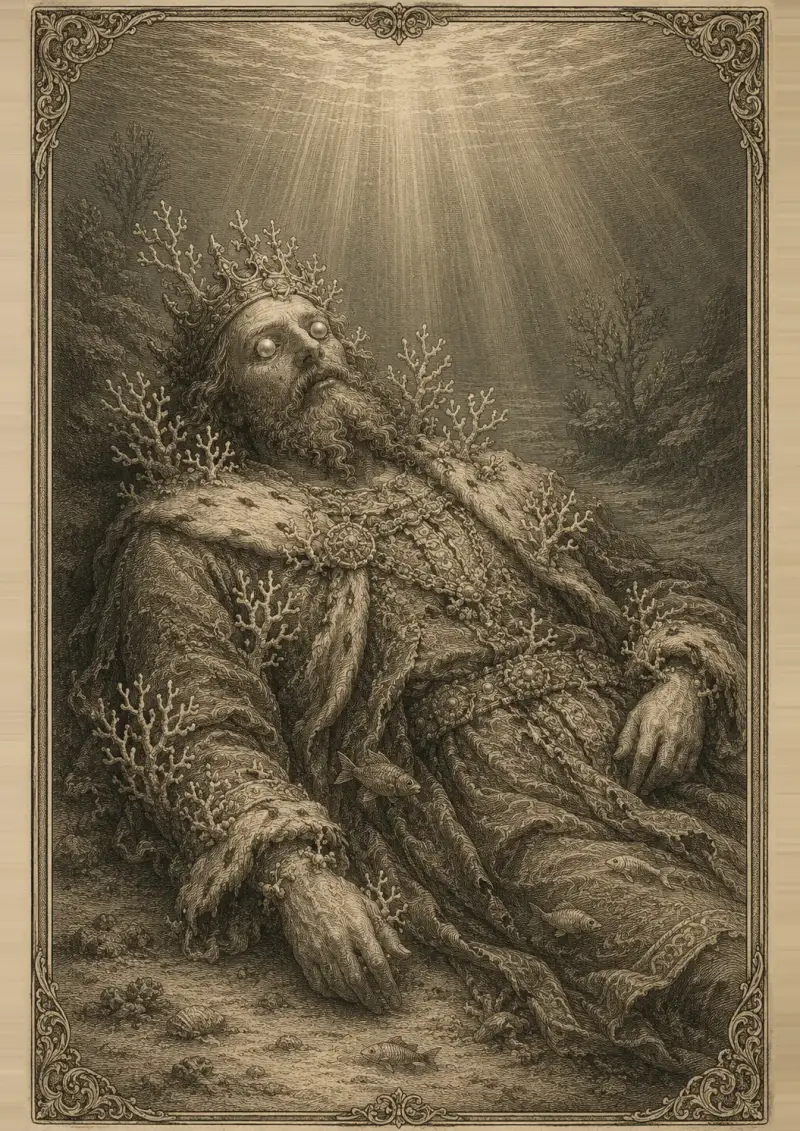
- Role
- Son of the witch Sycorax, born on the island; Prospero’s slave, who fetches wood and plots his master’s death
- First appears
- Act 1, Scene 2
- Last appears
- Act 5, Scene 1
- Key scenes
- 1.2, 2.2, 3.2, 4.1, 5.1
- Speaks in
- Mostly blank verse, even beside prose speakers; some prose when frightened or drinking
The Tempest: key quotes and analysis (PDF)
PDF, 11 pages, 826 KB. Free, no sign-up, made to be printed.
The ten core quotations for The Tempest, each with plain English, analysis and a fill-the-gap test. Or read the full study guide.
Who is Caliban?
Caliban was born on the island to Sycorax, a witch banished from Algiers, who died before Prospero arrived. He grew up alone, was taken into Prospero’s cell and taught to speak, and was enslaved after he tried to rape Miranda. When The Tempest begins he carries wood, lives penned in a rock, and curses. In the design of the play he is three things at once. He is the island’s first claimant, whose title is older than Prospero’s. He is the comic plot’s would-be rebel, who takes a drunken butler for a god. And he is a test case for the play’s argument about nature and education.
The central question is how we are meant to judge him. The other characters have no doubt, and their words for him are mostly insults. Caliban is neither the born devil his master describes nor a blameless victim: the play makes him guilty of one thing and wronged in another, and asks the audience to hold both. He is also the conspirator who learns the most, which is the last thing Prospero expects of him.
Caliban across the play
Act 1: the dispossessed heir
His first words come from offstage and are a refusal: There’s wood enough within.
He enters cursing, and then states his case in steady verse. The island was his, Prospero was kind and he was kind in return, and now he is shut out of his own land. Charged with the attack on Miranda, he does not deny it: Would ’t had been done!
The scene ends with his submission, spoken aside: I must obey.
Act 2: a new master
Alone, he lists the torments Prospero’s spirits inflict for every trifle
. He takes Trinculo for one of them and hides. Stephano’s wine does the rest. Caliban decides that the butler is a brave god
, kneels, and offers him the island’s secrets exactly as he once offered them to Prospero. He leaves singing of liberty, with a new master to carry for.
Act 3: the plotter and the dreamer
The plan is his. Stephano is to kill Prospero during his afternoon sleep, and Caliban is precise about the order of work: Remember / First to possess his books
. He offers Miranda as the prize. In the same scene, when invisible music frightens the two Europeans, it is Caliban who calms them with a speech about the island’s sounds and his own dreams.
Act 4: the only serious conspirator
Led through thorns and a stinking pool, the three reach the cell, where Prospero has hung out bright clothing as bait. Stephano and Trinculo fall on it. Caliban alone sees the trap: Let it alone, thou fool. It is but trash.
Nobody listens. Spirits in the shape of hounds hunt all three away.
Act 5: the pupil who learns
Driven in with the others, he expects the worst: I shall be pinched to death.
Instead Prospero calls him mine
and sends him to tidy the cell with a hint of pardon. Caliban’s last speech is a resolution to be wiser and a judgment on his own folly. He goes out, and the play does not say what becomes of him.
Reading the character
His claim is never answered, and neither is the charge against him
Caliban’s case is simple: This island’s mine by Sycorax, my mother
. Prospero does not dispute the facts. He replies with an insult, Thou most lying slave
, and with a different subject, the attempt on Miranda. That charge is true, and Caliban’s answer is a boast: he would have peopled else / This isle with Calibans
. Shakespeare therefore builds the scene so that each side is right about something. Prospero has taken what was not his. Caliban has done something that makes his confinement understandable. A reading that drops either half is simpler than the play. It is also worth noticing that Sycorax was herself a newcomer, so even Caliban’s title begins with an arrival.
He speaks the island’s poetry
Caliban is often surrounded by prose, and he mostly speaks verse. His language is full of things the Europeans have no names for: brine pits
, pignuts
, clustering filberts
, the nimble marmoset
. He knows the place by walking it, where Prospero knows it from above. His great speech about the island’s music gives him an inner life of longing that nobody else in the comic plot comes near. The effect is deliberate. Shakespeare lets us hear what the insults leave out, and he does it with the language that Miranda and her father taught. The pupil they call unteachable uses their speech better than their countrymen do.
He mistakes a new master for freedom, and learns from it
Caliban’s rebellion is a second surrender. His song of liberty contains its own contradiction: Has a new master
. He begs Stephano, I prithee, be my god
, and offers to lick his shoe. Shakespeare shows a man so used to service that he can imagine freedom only as a better lord. But he is not a fool for long. He is the one who sees that Stephano is easily distracted, and at the end he says so plainly. Set him beside Antonio, who has every advantage of birth and schooling and ends the play unrepentant and silent. On the evidence of the last act, nurture has stuck to Caliban better than to Antonio. See quotes about power and colonialism.
Key quotations
This island’s mine by Sycorax, my mother,
Caliban · Act 1, Scene 2 1.2.396-398
Which thou tak’st from me. When thou cam’st first,
Thou strok’st me and made much of me
Plain English: This island is mine, inherited from my mother Sycorax, and you are taking it from me. When you first came, you stroked me and made a fuss of me.
Context: Caliban’s first long speech. Prospero has summoned him with insults and threatened him with cramps.
Methods: The claim is made in the vocabulary of inheritance, mine by
a parent, the same ground on which Prospero holds Milan. The verb tak’st
is in the present tense: the theft is still going on. Then the tone changes. strok’st
is what one does to an animal or a child, and the memory is tender on both sides, for he goes on to say And then I loved thee
. The speech ends in a bitter summary: I am all the subjects that you have, / Which first was mine own king
.
In an essay: The central text for any reading of the play as a story of colonisation. Note that it is a story of betrayed affection as well as of stolen land.
You taught me language, and my profit on ’t
Caliban · Act 1, Scene 2 1.2.437-439
Is I know how to curse. The red plague rid you
For learning me your language!
Plain English: You taught me to speak, and all I have gained by it is knowing how to curse. May the red plague destroy you for teaching me your language.
Context: Miranda has just reminded him that she pitied him and taught him words when he could only gabble
.
Methods: profit
is a word from trade, and Caliban uses it to show that the bargain was a bad one. The reply is tightly made: language
begins and ends it, and the curse he promises arrives in the next sentence as proof. The possessive matters. It is your language
, not his, and yet he argues in it with more force than his teachers. learning me
, for teaching me, is an old usage, not a mistake.
In an essay: Use it to question the idea that education is a pure gift. The language lets Caliban state his wrongs, which is more than his masters intended.
I’ll show thee the best springs. I’ll pluck thee berries.
Caliban · Act 2, Scene 2 2.2.166-168
I’ll fish for thee and get thee wood enough.
A plague upon the tyrant that I serve.
Plain English: I will show you the best springs, pick you berries, fish for you and bring you plenty of wood. A curse on the tyrant I serve now.
Context: Caliban has tasted Stephano’s wine and sworn to be his subject. Stephano and Trinculo are speaking prose.
Methods: Four promises begin I’ll
, and each offers a service. The list repeats, almost item for item, what he says he did for Prospero in Act 1, when he showed him The fresh springs
. The irony is structural: he curses one tyrant
in the middle of binding himself to another, and wood enough
recalls the very chore he refused in his first line. He moves into verse here while the two Europeans stay in prose, which gives his servility an odd dignity.
In an essay: Shows that Caliban repeats his history. The first arrival of Europeans is replayed as farce, with a bottle in place of a book.
The clouds methought would open, and show riches
Caliban · Act 3, Scene 2 3.2.154-156
Ready to drop upon me, that when I waked
I cried to dream again.
Plain English: I thought, as I dreamed, that the clouds would open and show me treasures about to fall on me, so that when I woke I wept to dream again.
Context: Ariel’s invisible music has terrified Stephano and Trinculo. Caliban reassures them: Be not afeard. The isle is full of noises
.
Methods: The syntax drifts between sleeping and waking until the two are hard to tell apart, which is the experience it describes. riches
are always Ready to drop
and never do: the image is of a promise held just out of reach, the condition of his life. The last line is five plain words and a child’s reaction, and cried
is not what a monster does. The speech is a gift to two men who have done nothing to earn it.
In an essay: The best evidence for Caliban’s humanity. Compare his dream with Prospero’s speech on dreams in Act 4: master and slave share the play’s deepest image.
A devil, a born devil, on whose nature
Prospero · Act 4, Scene 1 4.1.211-213
Nurture can never stick; on whom my pains,
Humanely taken, all, all lost, quite lost;
Plain English: He is a devil, a devil by birth, on whose nature no upbringing will ever hold. All the trouble I kindly took over him is lost, completely lost.
Context: Prospero speaks of Caliban after hearing where Ariel has left the conspirators. Caliban is not present.
Methods: The near-rhyme of nature
and Nurture
sets the two terms of the debate side by side. born devil
places the fault in his birth, which conveniently clears his teacher. But the rhythm gives Prospero away: the repetitions all, all lost, quite lost
are the sound of a man grieving over a failure. Humanely
claims kindness, and the next thing he says is a promise to plague them all
.
In an essay: Quote it as Prospero’s view, not the play’s. Then test it against Act 5, where Caliban resolves to seek for grace
.
Ay, that I will, and I’ll be wise hereafter
Caliban · Act 5, Scene 1 5.1.351-354
And seek for grace. What a thrice-double ass
Was I to take this drunkard for a god,
And worship this dull fool!
Plain English: Yes, I will, and from now on I will be wiser and try to earn favour. What an utter ass I was to take this drunkard for a god and worship this stupid fool.
Context: Caliban’s last speech. Prospero has ordered him to the cell and told him that pardon depends on his doing the work well.
Methods: grace
can mean his master’s favour or something nearer to mercy in the religious sense, and the line does not choose. The self-mockery of thrice-double ass
is the first joke he makes at his own expense. The contrast of drunkard
with god
shows he has measured his mistake exactly. He is speaking verse, and the exclamation is a judgment, not a plea. Nothing in the speech says that Prospero was right to rule him.
In an essay: Use it to weigh growth against submission. He has learned to tell a false master from a true one, but the play leaves open whether that is wisdom or defeat.
Relationships
Caliban and Prospero
Each remembers the early days in the same way: care on one side, love and guidance on the other. Each blames the other for the end of it. Since then Prospero has ruled by pain and Caliban has answered with curses, and both know that the household cannot do without the slave’s work. The relationship closes on a sentence that can be heard as ownership or as responsibility: This thing of darkness I / Acknowledge mine.
Caliban and Miranda
She was his teacher, and he repaid her with an attack she has not forgiven. The fierce speech beginning Abhorred slave
is hers in the Folger text, though some editors once gave it to her father because they thought it too harsh for her. He still thinks of Miranda as a prize, and promises her to Stephano. She is the one subject on which the play gives him no defence.
Caliban, Stephano and Trinculo
The butler and the jester see Caliban as merchandise before they see him as anything else. Trinculo thinks of showing him at a fair, and Stephano of taking him home as a present for any emperor
. They call him monster
again and again. Yet he is the abler man, with a plan, a knowledge of the ground and a sense of urgency, while they are distracted by a show of fine clothes. The comedy lies in the wrong man kneeling. His opposite in service is Ariel, who bargains where Caliban rebels.
How the character has been read
The oldest stage tradition played Caliban as a comic monster, a creature of appetite to be laughed at and beaten. On this view he is nature without nurture, and his plot is a parody of the courtiers’ treason that confirms the need for a master. His name is often taken as a play on “cannibal”, which fits that reading. Romantic critics insisted on his poetry, and found in him something noble and sad.
From the middle of the twentieth century, postcolonial readings put him at the centre of the play. They begin from his first long speech and see a native inhabitant robbed of his land, taught the coloniser’s language, and described as a savage to excuse his enslavement. Writers from colonised countries have retold the story from his side. The reading is powerful, and it has to make room for the attack on Miranda, which Shakespeare places in the same scene as the claim.
On stage the first choice is what he looks like. The text gives no single answer. He is called a man or a fish
, a mooncalf
, a puppy-headed monster
and a misshapen knave
, always by people who want to sell him or rule him. Productions have shown everything from a scaled sea creature to an ordinary man in chains. The more human he looks, the harder the audience finds it to accept what is done to him.
Essay angles and a model paragraph
- Caliban is both wronged and guilty, and the play’s refusal to settle the account is its point.
- Caliban’s verse contradicts everything that is said about him, so that the audience hears a person where the characters see a monster.
- Caliban is the play’s real test of nature against nurture, and by Act 5 he has learned more than the civilised villains.
Question: How does Shakespeare present Caliban as more than a monster?
Practice questions
- Read Caliban’s speech in Act 1, Scene 2, beginning
I must eat my dinner
. How does Shakespeare present Caliban’s sense of injustice? - How does Shakespeare use Caliban’s language to shape the audience’s response to him?
- “Caliban’s rebellion only proves that he needs a master.” How far do you agree?
- “The play is more sympathetic to Caliban than Prospero is.” Discuss, with reference to the ending.
Check the order of his scenes with the Tempest questions and answers, and see quotes about power and colonialism for the argument over who owns the island.